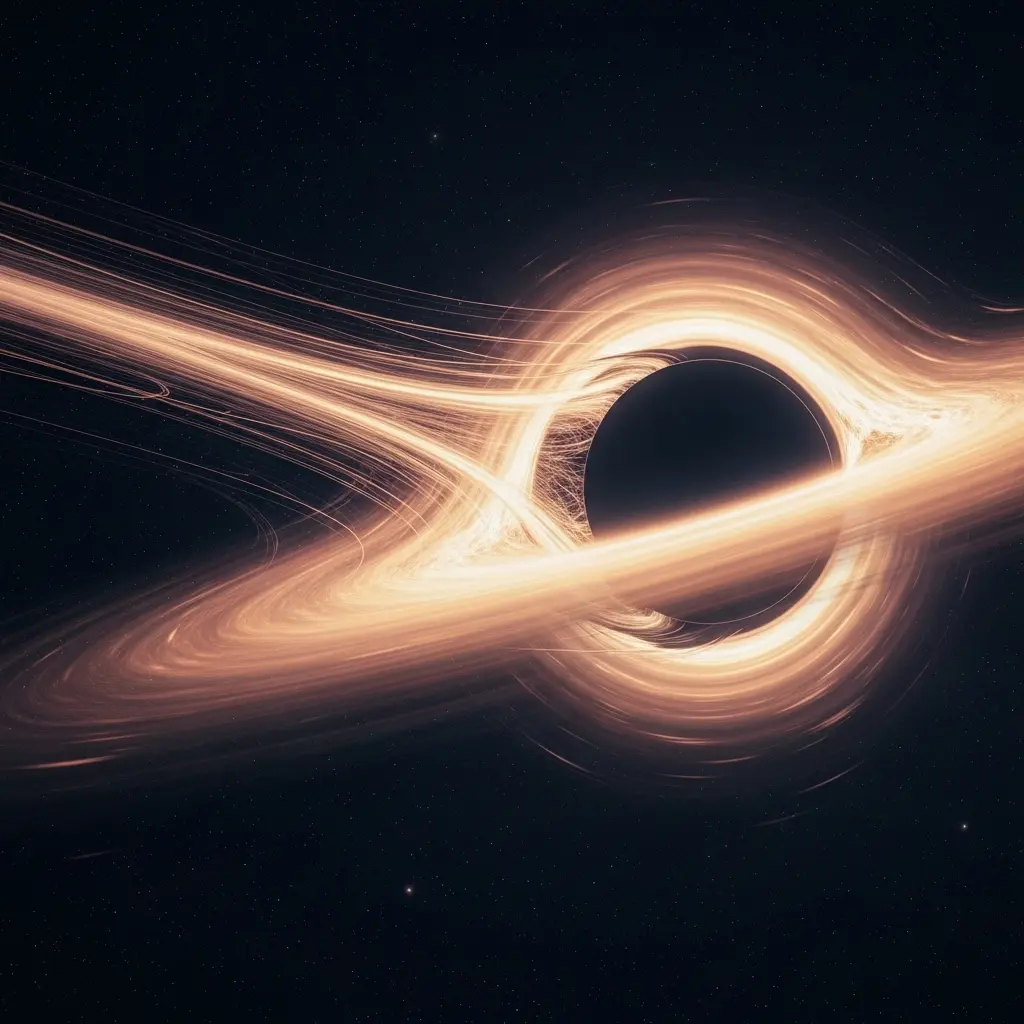
Scientists are increasingly puzzled by the growing number of repeating partial tidal disruption events (rpTDEs), occurrences where stars are stretched but not completely destroyed by a supermassive black hole. Zhen Pan and Dong Lai, both from the Tsung-Dao Lee Institute and Shanghai Jiao-Tong University, alongside colleagues, demonstrate that the observed rate of these rpTDEs challenges existing theoretical models based on the ‘loss cone’ mechanism. Their research highlights a critical inequality that many candidate rpTDEs appear to break, suggesting a different formation pathway is at play. The team propose that rpTDEs may originate from stars captured through the disruption of close binary systems, a process which predicts a corresponding population of hypervelocity stars ejected from galactic centres, but currently lacking observational evidence? A comprehensive search for these high-speed stars within the Milky Way, they argue, could therefore validate or refute this compelling new explanation.
Observed rpTDE rates conflict with loss cone predictions regarding stellar orbits, suggesting alternative dynamical mechanisms
Challenges to Understanding Tidal Disruption Events
Scientists have recently identified a potential crisis in our understanding of repeating partial tidal disruption events (rpTDEs), occurrences where a star is partially torn apart by a supermassive black hole and then repeats the process. A new study reveals that the observed frequency of rpTDEs challenges existing theoretical models based on the “loss cone” mechanism, which predicts how stars fall close enough to a black hole to be disrupted.
The team investigated the formation of rpTDEs by examining the dynamics of stars near supermassive black holes. They calculated the expected rate of rpTDEs based on the loss cone theory, which considers the relaxation process where stars are nudged onto orbits that lead to disruption. This calculation involved determining the time it takes for stars to diffuse into orbits close enough to the black hole, considering factors like the black hole’s mass, the stellar density, and the velocity dispersion of stars in the galactic nucleus.
The study establishes that the predicted rpTDE rate and the distribution of events in terms of orbital period and black hole mass do not align with recent observations, indicating the need for alternative formation channels. Experiments show that the commonly proposed Hills mechanism, involving the tidal disruption of near-contact binary stars, offers a potential solution.
Novel Mechanisms for Repeating Stellar Disruption
This mechanism allows for rpTDEs to occur even when the conditions predicted by the loss cone theory are not met. If this process dominates rpTDE formation in the Galactic Center, the research predicts the existence of a population of hypervelocity stars ejected at velocities up to 3.6 × 10³(M•/106M⊙)1/6km s−1.
However, these high-velocity stars have not yet been detected. The work opens the possibility of testing this prediction through a comprehensive search for hypervelocity stars within the Milky Way. A complete survey could confirm or refute the Hills mechanism as the primary driver of rpTDEs, providing crucial insights into the dynamics of stars around supermassive black holes and the frequency of these fascinating astronomical events. This research highlights the importance of observational verification to refine theoretical models and deepen our understanding of extreme astrophysical phenomena.
Modeling Stellar Dynamics in Galactic Centers
Relaxation timescale calculations and modelling of nuclear star cluster dynamics are crucial for understanding their evolution
Scientists are investigating a growing number of repeating partial tidal disruption events (rpTDEs) and their implications for understanding stellar dynamics around supermassive black holes. The research addresses a potential tension between observed rpTDE rates and predictions based on the loss cone model, which describes how stars are kicked onto orbits leading to tidal disruption.
Analyzing Predicted Orbital Rate Distributions
Researchers calculated the expected rpTDE rate and distribution in the space of orbital period (Tobt) versus black hole mass (M•), revealing discrepancies with reported observations. To explore this, the study employed a detailed analysis of stellar dynamics within nuclear star clusters surrounding supermassive black holes.
The team considered a supermassive black hole with mass M• embedded in a nuclear stellar cluster comprised of stars with mass m⋆, calculating the relaxation timescale (trlx) using the equation t rlx = 0.339 ln Λ σ 3 (r) m 2 ⋆ n ⋆ (r). This timescale, crucial for understanding how stars diffuse in orbital energy and angular momentum space, was determined assuming a Bahcall-Wolf profile for the stellar number density, n ⋆ (r) ∝ r −7/4 .
The radius of influence of the SMBH, rh, was estimated as rh ≈ 2.1 × 10 7 M• 0.5 ,6 pc, linking black hole mass to the region where tidal disruptions are most likely. Experiments focused on quantifying the ratio of angular momentum relaxation timescale (t J ) to the orbital period (T obt ) using the formula t J T obt ≈ 0.1 (r p /r h ) (a/r h ) −9/4 (M•/m⋆).
This allowed scientists to assess how efficiently stars change orbits due to gravitational interactions. The study pioneered a method for calculating the expected rpTDE rate, accounting for the possibility of multiple partial disruptions from the same star, and comparing it to observations from sources like ZTF. This innovative approach enables a more accurate assessment of the observed rpTDE rate, potentially revealing the need for alternative formation channels beyond the standard loss cone model.
Hills mechanism explains repeating partial tidal disruptions and predicts hypervelocity stars ejected from galactic nuclei
Scientists have identified a potential discrepancy between predicted and observed rates of repeating partial tidal disruption events (rpTDEs). Recent observations suggest a high fraction of rpTDEs relative to all tidal disruption events, challenging predictions based on the loss cone channel. Researchers discovered an inequality relating the central supermassive black hole (SMBH) mass and the orbital period of the star, which the majority of reported rpTDE candidates appear to violate, suggesting an alternative formation mechanism.
The team proposes the Hills mechanism, involving the tidal disruption of near-contact binaries, as a dominant source of rpTDEs, as it can circumvent this inequality. If this process occurs in the Galactic Center, it predicts the existence of hypervelocity stars (HVSs) ejected at velocities up to 1,000 kilometers per second, though these have not yet been detected.
A comprehensive search for HVSs in the Milky Way is therefore crucial for validating this prediction. Experiments reveal that the fate of a captured star depends on the ratio of Jacobi and gravitational wave timescales (tJ/tGW). When tJ/tGW is greater than 1, gravitational radiation drives the star towards becoming a stellar extreme-mass ratio inspiral (EMRI).
Conversely, when tJ/tGW is less than 1, scatterings dominate, leading to an rpTDE with a period dictated by a specific equation. Observations show some rpTDEs exhibit short periods, such as 0.114 days for ASASSN-14ko. Data shows that for SMBH masses of 106 solar masses, binary disruption leads to captured stars entering the 2-body scattering regime.
Those with orbital periods less than 10 years are identified as observable rpTDEs, while longer periods classify as non-repeating TDEs. For SMBH masses of 107 solar masses, captured stars immediately become observable rpTDEs. Calculations demonstrate that a critical SMBH mass exists, at which the transition between rpTDE and stellar EMRI formation occurs.
Measurements confirm that the fractional rate of rpTDEs contributed by the Hills mechanism depends on the fraction of stars in hard binaries, estimated at 20 percent. The research establishes that for lighter SMBHs, all captured stars with specific orbital parameters become observable rpTDEs, while heavier SMBHs produce rpTDEs from near-contact binaries with separations around 2.5times the stellar radius. The study provides a quantitative framework for predicting rpTDE rates based on SMBH mass and binary characteristics.
Loss cone limitations and the hypervelocity star puzzle remain significant challenges in astrophysics
Scientists have investigated the formation channels of repeating partial tidal disruption events (rpTDEs), occurrences where a star is partially torn apart by a supermassive black hole and repeats the process. Their analysis suggests the standard “loss cone” channel, predicting rpTDE rates based on single stars, likely cannot account for the observed frequency of these events.
The research demonstrates that the majority of reported rpTDE candidates violate a key inequality predicted by the loss cone model, implying an alternative mechanism is at play. Researchers propose the Hills mechanism, involving the disruption of near-contact binary star systems, as a more plausible explanation for rpTDEs.
This model predicts a population of hypervelocity stars (HVSs) ejected at extremely high speeds alongside the rpTDEs. However, current observations of HVSs in the Milky Way reveal lower ejection velocities than predicted by the Hills mechanism, creating a discrepancy. The authors acknowledge limitations in current HVS surveys, potentially missing the fastest examples, and suggest further investigation into binary star separations within nuclear star clusters is needed.
This work establishes that if the observed rpTDE candidates are genuine events, the loss cone channel is unlikely to be the dominant formation pathway. The Hills mechanism offers a viable alternative, contingent on a substantial fraction of stars in nuclear star clusters existing in binary systems. Resolving the discrepancy between predicted and observed HVS velocities, through more comprehensive surveys and refined modelling of binary star dynamics, will be crucial for confirming the prevalence of the Hills mechanism in generating rpTDEs and furthering our understanding of galactic nuclei.
🗞 A Formation Crisis of Repeating Partial Tidal Disruption Events
🧠 ArXiv: https://arxiv.org/abs/2601.22465