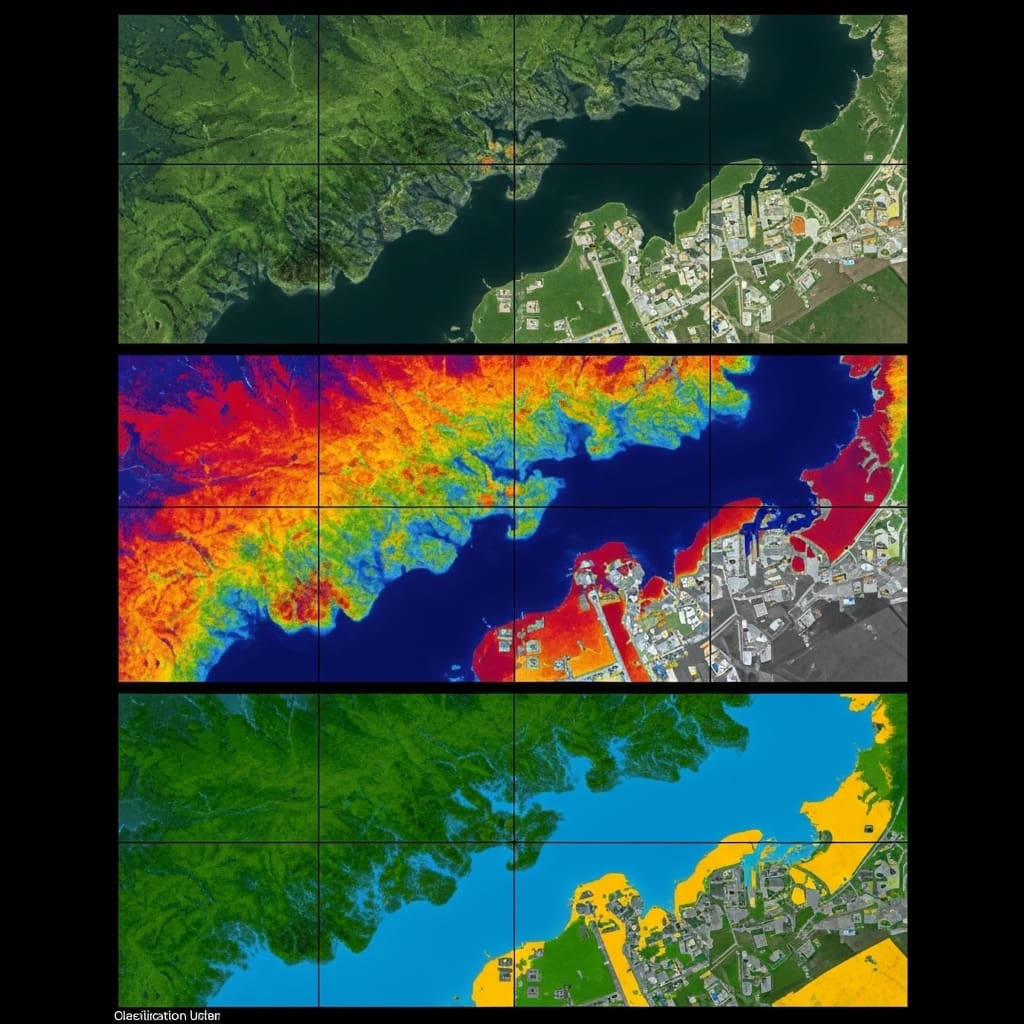
Researchers are tackling the challenge of classifying hyperspectral images when only limited labelled data is available, a common problem in remote sensing applications. Naeem Paeedeh, Mahardhika Pratama, and Ary Shiddiqi, from Adelaide University and Institut Teknologi Sepuluh Nopember, alongside Zehong Cao et al., present a new approach that leverages the power of foundation models to improve cross-domain few-shot learning. This work is significant because it moves away from simplistic data augmentation techniques and instead utilises a pre-trained model, enabling rapid adaptation to new tasks and reducing the risk of overfitting. By introducing the MIFOMO framework, built on a remote sensing foundation model and incorporating techniques like coalescent projection and mixup domain adaptation, the team demonstrate substantial performance gains, exceeding previous methods by up to 14%, and have made their code openly available to facilitate further research.
Foundation model adaptation via mixup for few-shot hyperspectral image classification improves performance
Scientists have recently unveiled a new approach to cross-domain few-shot learning for hyperspectral image classification, addressing limitations in existing methods that rely on unrealistic data augmentation and are prone to overfitting. Researchers propose the MIxup FOundation MOdel, or MIFOMO, which leverages the power of foundation models pre-trained on large-scale remote sensing problems to improve generalisation and adaptability.
This work directly tackles the challenge of classifying hyperspectral images when only limited labelled data is available, and when the characteristics of the training and testing data differ significantly. The team achieved this breakthrough by introducing a novel coalescent projection technique, allowing rapid adaptation of the foundation model to new tasks while preserving its core knowledge.
MIFOMO incorporates mixup domain adaptation to mitigate extreme discrepancies between data domains, effectively bridging the gap between source and target datasets. Furthermore, label smoothing is implemented to improve robustness against noisy pseudo-labels, enhancing the reliability of the classification process.
This combination of techniques allows the model to learn more effectively from limited data and generalise to unseen scenarios. Experiments demonstrate that MIFOMO outperforms existing state-of-the-art methods by a margin of up to 14%, showcasing its superior performance in cross-domain few-shot learning for hyperspectral image classification.
The research establishes a new benchmark for performance in this challenging field, offering a significant advancement over previous approaches. To promote reproducibility and further research, the source code for MIFOMO has been made openly available, enabling other scientists to build upon this innovative work and explore its potential applications.
This innovation has implications for a range of applications, including precision agriculture, environmental monitoring, and geological surveys, where accurate and efficient hyperspectral image analysis is crucial despite limited labelled data. The work opens avenues for developing more robust and adaptable remote sensing systems capable of operating effectively in diverse and challenging environments.
Coalescent Projection and Mixup Domain Adaptation for Hyper-spectral Image Classification achieve state-of-the-art results
Scientists developed the MIxup FOundation MOdel (MIFOMO) to address challenges in cross-domain few-shot learning (CDFSL) for hyper-spectral image (HSI) classification. The study pioneered a novel approach leveraging a pre-trained remote sensing (RS) foundation model, trained on a large scale of RS problems, to provide generalizable features for downstream tasks.
Researchers addressed the issue of data scarcity, avoiding reliance on unrealistic data augmentation techniques commonly used in prior work. The team engineered a coalescent projection (CP) technique to quickly adapt the foundation model to new tasks while strategically freezing the backbone network. This method enables efficient transfer learning, preserving the generalizable features learned during pre-training.
Furthermore, scientists proposed mixup domain adaptation (MDM) to mitigate extreme domain discrepancies between source and target datasets. Experiments employed label smoothing to improve performance when dealing with potentially noisy pseudo-labels generated during the adaptation process. This work harnessed 3D data cubes inherent to HSI, containing abundant spatial and spectral information, to achieve superior classification accuracy.
The system delivers a significant improvement over existing methods, demonstrating performance gains of up to 14%. Researchers implemented a rigorous experimental setup, and the source code for MIFOMO is openly available for reproducibility and further investigation at https://github.com/Naeem- Paeedeh/MIFOMO.
The approach overcomes limitations of traditional methods dependent on manual feature extraction and struggles with high-dimensional data. The study’s methodological innovations enable effective knowledge transfer even when the label spaces between source and target domains differ completely, a key advancement in CDFSL for HSI classification. This technique achieves robust performance despite external factors influencing data collection, such as weather or sensor variations, which commonly cause domain shifts.
MIFOMO achieves state-of-the-art hyperspectral image classification across multiple benchmark datasets consistently
Scientists have developed the MIxup FOundation MOdel (MIFOMO) for cross-domain few-shot learning (CDFSL) of hyperspectral image (HSI) classifications, achieving significant improvements over existing methods. Experiments demonstrate that MIFOMO surpasses prior art by up to 14% in performance margin. Results from the Salinas dataset recorded OA of 93.05, AA of 92.59, and KC of 96.11, and the Houston dataset achieved OA of 97.84, AA of 91.84, and KC of 98.63.
These measurements confirm the model’s consistent high performance across diverse datasets. The research introduces coalescent projection (CP) for efficient parameter fine-tuning and mixup domain adaptation (MDM) to address domain discrepancies. Ablation studies on the Indian Pines dataset reveal that label smoothing contributes to a 17% performance gain, while the intermediate domain training phase improves performance by approximately 3%.
The coalescent projection strategy delivers a 1% performance increase, and the mixup technique, combined with the intermediate domain, results in a 2% improvement. Data shows that MIFOMO outperforms CFSL-KT on the Houston dataset with a 13% margin and MGDPO on the PU dataset with a 6% margin. Furthermore, MIFOMO exceeds MGPDO in the IP dataset by 15% in overall accuracy.
T-SNE analysis confirms that MIFOMO generates distinct embeddings, enabling clear separation of different classes in the feature space, indicating minimal classification error. The breakthrough delivers a hyper-spectral foundation model with a novel parameter fine-tuning approach, enabling seamless knowledge transfer between domains.
Coalescent projection and mixup adaptation enhance hyperspectral image classification performance significantly
Scientists have developed a new approach, MIxup FOundation MOdel (MIFOMO), to address cross-domain few-shot learning (CDFSL) for hyperspectral image (HSI) classification. This research introduces a foundation model pre-trained on a large scale of remote sensing problems, leveraging its generalizable features to improve classification accuracy.
T-SNE analysis confirms the model generates decent and discriminative embeddings, effectively separating different classes in the feature space. Label smoothing was also integrated to mitigate issues with noisy pseudo-labels. The authors acknowledge that, like other approaches in this field, MIFOMO currently operates as a transductive method, requiring access to unlabeled target domain samples.
Future research will focus on developing an inductive method, removing this requirement and presenting a more challenging scenario. This work was supported by funding from the Indonesian Endowment Fund for Education.
🗞 Cross-Domain Few-Shot Learning for Hyperspectral Image Classification Based on Mixup Foundation Model
🧠 ArXiv: https://arxiv.org/abs/2601.22581