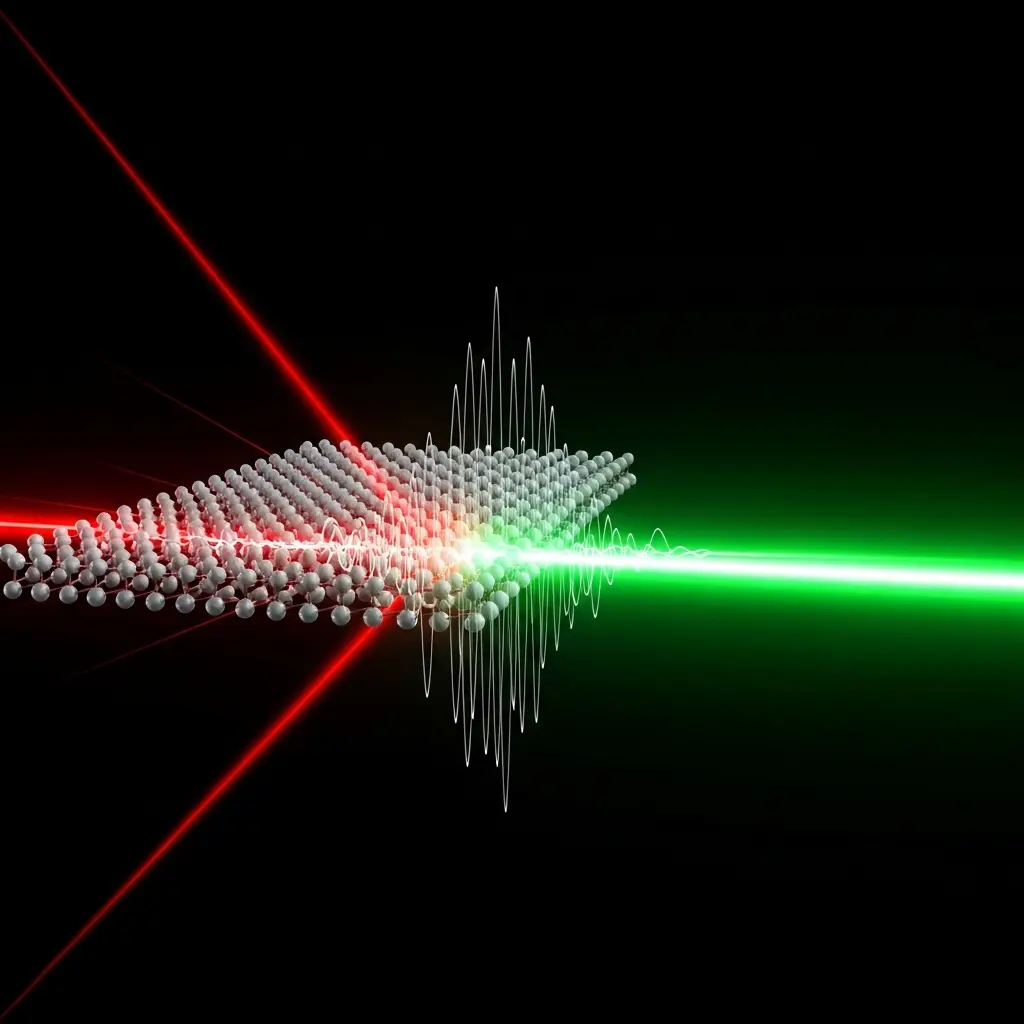
Researchers are exploring how manipulating the band topology of materials can dramatically enhance their nonlinear optical properties, potentially revolutionising fields like quantum photonics and advanced laser technology. Wen-Zheng Chen, Hongjun Xiang, and Yusheng Hou, from Fudan University and Sun Yat-Sen University respectively, demonstrate a giant enhancement of second-harmonic generation in a single layer of bismuth, achieved through a carefully controlled topological transition. Their first-principles calculations reveal a susceptibility exceeding that of molybdenum disulphide by two orders of magnitude, further boosted by an additional order of magnitude when the material is tuned to a critical point where Dirac electrons emerge. This significant finding not only identifies a new pathway for exceptional nonlinear optical responses but also offers a means of experimentally verifying the presence of Dirac electrons within topological materials.
This significant finding not only identifies a new pathway for exceptional nonlinear optical responses but also offers a means of experimentally verifying the presence of Dirac electrons within Topological materials.
Bismuth monolayer buckling boosts nonlinear optical response significantly
The research team unveiled that manipulating the buckling of this material induces a topological transition, dramatically enhancing its nonlinear optical properties. This work establishes a general principle for achieving exceptional second-harmonic generation through the engineering of topological criticality, potentially serving as a direct observation of Dirac electrons within topological materials. The findings are particularly significant for developing quantum light sources and sub-wavelength topological lasers. Nonlinear optics is fundamental to modern photonics, underpinning technologies like light frequency conversion and on-chip modulation.
Integrated nonlinear photonics prioritises materials and device engineering to improve conversion efficiency and enable dense integration. Second-harmonic generation, a key nonlinear process, offers a high signal-to-noise ratio and is crucial for applications ranging from symmetry probing to direct device implementation. Two-dimensional materials present unique advantages for large second-harmonic generation, as their nonlinear susceptibilities can exceed those of conventional bulk materials. Their atomic thickness also facilitates interfacial and heterostructure engineering, enabling programmable second-harmonic generation in systems like TMDs and graphene.
Finding materials with large second-harmonic generation remains a significant challenge. A well-known empirical rule connects the second-order susceptibility to the product of the linear susceptibility. Ferroelectric materials, possessing large linear susceptibilities, are therefore promising candidates for achieving giant second-harmonic generation, with recent reports demonstrating this in 2D ferroelectrics. Simultaneously, topological materials, with their unique band structures and topological features, offer platforms for exploring nonlinear optical phenomena and higher-order responses. Theoretical proposals suggest that second-harmonic generation contributions can arise from quantum geometric and Berry curvature dipole effects, with giant susceptibilities pursued in Dirac and Weyl semimetals via induction mechanisms.
Buckling-tuned topological transition enhances harmonic generation in 2D
To clarify the gap contribution to second-harmonic generation, scientists employed a scissors-operator method, rigidly shifting the conduction-band manifold and adjusting the band gap from ��= 0.266 eV to �� ���= 2.0 eV, comparable to MoS2. Spectral integrals confirmed this amplitude reduction, demonstrating that the giant second-harmonic generation is fundamentally gap-driven. Further analysis involved Kramers-Kronig transformation to understand the physical origin of the large static second-harmonic generation. The static susceptibility, χ(2)(0), is expressed as an integral of the imaginary part of χ(2), where low-energy spectral weight carries a larger contribution.
The remarkably dense distribution of resonances below 1.5 eV, resulting from the narrow band gap, creates a dominant spectral concentration region governing this integral. This low-energy placement aligns with the gap-controlled trend observed using the scissors-operator analysis. Scientists found that the static susceptibility decayed significantly faster than the spectral integrals, due to its sensitivity to both peak-position shifts and amplitude reduction. Researchers then mapped the k-resolved static susceptibility, χxxx (2) (0), and the imaginary component at 0.55 eV, revealing symmetric patterns about the ��-axis. These k-resolved patterns indicated that the second-harmonic generation signal arises from a competition between the two sides of the ��-axis, consistent with the ferroelectric polarization and C2v symmetry of the bismuth monolayer. Polarization-resolved studies demonstrated co-polarized emission along 0° and 180°, and cross-polarized emission at 90° and 270°, with two orthogonally distributed channels.
Bismuth monolayer exhibits giant second-harmonic generation due to
Measurements confirm a susceptibility on the order of 10⁻⁶ m/V, a value significantly higher than previously observed in similar materials. Data shows that the static susceptibility, χ(2)(0), decays significantly faster than the spectral integrals, a behaviour attributed to its dual sensitivity to both peak-position shifts and amplitude reduction. Brillouin-zone-resolved contributions were presented, displaying the k-resolved distribution of static susceptibility χxxx(2)(0), and k-resolved Im χxxx(2) at a photon energy of 0.55 eV. These patterns are symmetric about the kx-axis, aligning with the spontaneous ferroelectric polarization and C2v symmetry of the bismuth monolayer.
Both the low-frequency χ(2)(2ω) and static χ(2)(0) increased by more than a factor of two, coinciding precisely with the emergence of Dirac cones in the band structure. When Δh was tuned to approximately 0.125 Å, the formation of Dirac cones triggered an extraordinary order-of-magnitude enhancement in SHG. Channel-resolved decomposition confirmed that the low-frequency surge was dominated by the “intra” term, resulting from the modification of the interband linear susceptibility by intraband motion, and k-resolved analysis pinpointed the collapse of low-frequency SHG into the two Dirac cones.
Buckling-tuned bismuth monolayer enhances harmonic generation significantly
The observed order-of-magnitude difference between co- and cross-polarized second-harmonic generation provides a clear experimental signature for verifying these findings. Recent reports of anomalous conductivity in the material may also support the presence of Dirac-electron transport. This work establishes bismuth monolayer as a promising ferroelectric topological platform for exceptional nonlinear optical responses. The combination of a ferroelectric state and a narrow band gap yields a large second-order susceptibility. Tuning the buckling near the topological transition introduces a low-frequency resonance, further enhancing the effect. The authors acknowledge that the theoretical model relies on certain approximations and that further experimental validation is needed to fully confirm the predicted behaviour. Future research could focus on exploring substrate or strain engineering to control the buckling and optimise the material for low-power, on-chip near-infrared frequency conversion, potentially leading to new devices for quantum light sources and sub-wavelength lasers.
👉 More information
🗞 Topological-transition-driven Giant Enhancement of Second-harmonic Generation in Ferroelectric Bismuth Monolayer
🧠 ArXiv: https://arxiv.org/abs/2601.20454
See today’s quantum computing news on Quantum Zeitgeist for the latest breakthroughs in qubits, hardware, algorithms, and industry deals.