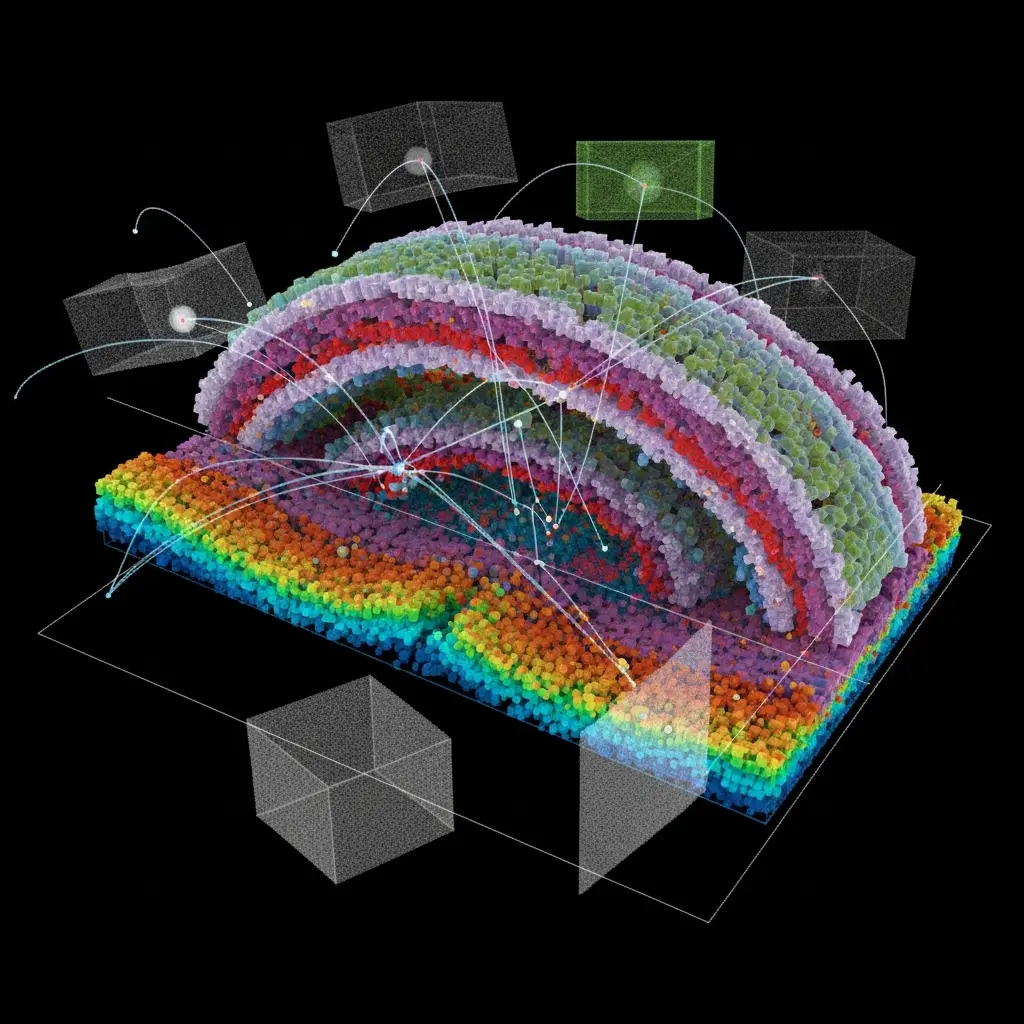
Researchers are tackling a significant challenge in photoacoustic computed tomography (PACT): accurately reconstructing high-resolution images despite limitations caused by ultrasound transducer characteristics. Kaiyi Yang, Seonyeong Park, and Gangwon Jeong, from the University of Illinois Urbana-Champaign, alongside Hsuan-Kai Huang, Alexander A. Oraevsky, and Umberto Villa et al., have developed a novel learning-based framework to compensate for spatial impulse responses (SIRs) of the transducer directly within the data domain. This approach offers a crucial advantage over existing methods, bypassing the computational burden of traditional optimisation techniques while preserving spatial resolution. By effectively ‘cleaning’ the raw data to mimic an idealised system, their learned compensation models , utilising both U-Net and a physics-inspired Deconv-Net architecture , enable the use of fast reconstruction algorithms without sacrificing image quality, and have demonstrated improved resolution and robustness in both virtual and in-vivo breast imaging studies.
Utilizing ultrasound transducers with larger surface areas enhances detection sensitivity in PACT, but conventional computationally efficient reconstruction methods that ignore the SIRs of the transducer compromise spatial resolution. While optimization-based reconstruction methods can account for these effects, they are computationally expensive, particularly in 3D applications. This research addresses the need for accurate and rapid 3D PACT image reconstruction by establishing a learned SIR compensation method operating directly on the acquired data.
Compensating Data for Superior PACT Spatial Resolution
Overcoming Limitations Through Data Compensation
The team achieved a significant breakthrough by mapping SIR-corrupted PACT measurement data to compensated data, effectively simulating recordings from idealized point-like transducers. This allows the use of computationally efficient reconstruction methods that previously required assumptions of point-like transducers, thereby accelerating the imaging process without sacrificing accuracy. Two distinct learned compensation models were investigated: a U-Net model, a widely used Deep learning architecture, and Deconv-Net, a novel physics-inspired model specifically designed for this application. A crucial component of the work is a fast and analytical procedure for generating training data, streamlining the model development process.
Rigorous validation through virtual imaging studies confirmed the framework’s ability to improve resolution and maintain robustness against variations in noise, object complexity, and sound speed heterogeneity. Experiments using clinically relevant numerical breast phantoms demonstrated the framework’s effectiveness in challenging imaging scenarios. Furthermore, when applied to in-vivo breast imaging data, the learned compensation models successfully revealed fine structures previously obscured by SIR-induced artifacts, highlighting the potential for improved clinical diagnostics. This study unveils the first demonstration of learned SIR compensation in 3D PACT imaging, representing a substantial advancement in the field.
The framework’s ability to accurately compensate for SIR effects while maintaining Computational efficiency opens new avenues for real-time, high-resolution 3D PACT imaging. The research establishes a pathway towards more sensitive and detailed medical imaging, potentially improving the detection and characterization of various diseases, particularly in breast cancer screening and monitoring. The innovative combination of data-driven learning and physics-inspired modeling promises to significantly impact the future of PACT technology and its clinical applications.
Learned Compensation for PACT Spatial Resolution improves image
Architectural Design of the Learned Compensation Model
Scientists developed a novel framework for accurate and rapid three-dimensional photoacoustic computed tomography (PACT) image reconstruction, addressing limitations inherent in current methodologies. The research team tackled the challenge of spatial resolution loss when using larger ultrasound transducers, which, while improving detection sensitivity, introduce spatial impulse responses (SIRs) that compromise image clarity. Instead of computationally expensive optimisation-based reconstruction methods, they pioneered a learned SIR compensation technique operating directly on the raw data. This innovative approach maps SIR-corrupted PACT measurements to compensated data, effectively simulating recordings from idealised point-like transducers.
Architectural Details of the AI Reconstruction Model
The study employed two distinct learned compensation models: a U-Net and a physics-inspired Deconv-Net, both designed to refine the initial PACT data. Crucially, the team engineered a fast, analytical procedure for generating training data, streamlining the model development process and reducing computational burden. This training data generation method allowed for the creation of large datasets necessary for robust model learning. Subsequently, the compensated data was processed using computationally efficient reconstruction methods that inherently assume idealised transducers, achieving a balance between accuracy and speed.
Validating Performance with Advanced Phantom Testing
Learned compensation improves PACT image resolution significantly
Scientists have developed a novel framework for learned spatial impulse response (SIR) compensation in three-dimensional photoacoustic tomography (PACT) imaging, achieving significant improvements in image resolution and robustness. The research addresses a key limitation of computationally efficient PACT reconstruction methods, which often compromise spatial resolution by neglecting the spatial impulse responses of the ultrasound transducer. Experiments revealed that the team successfully mapped SIR-corrupted PACT measurement data to compensated data, effectively mimicking the output of idealized point-like transducers. The core of this breakthrough lies in two learned compensation models: a U-Net model and a physics-inspired Deconv-Net.
Testing Performance with Virtual Imaging Phantoms
Both models were trained using a fast and analytical data generation procedure, ensuring a diverse and robust training dataset. Virtual imaging studies, utilising clinically relevant numerical breast phantoms, demonstrated substantial resolution improvements and resilience to variations in noise, object complexity, and sound speed heterogeneity. Measurements confirm that the learned compensation models effectively mitigated SIR-induced artifacts, revealing fine structures previously obscured in the reconstructed images. Data shows that the framework accurately compensates for the blurring effects caused by finite-sized transducers.
The team generated synthetic data based on the target PACT system configuration, creating a dataset sufficiently diverse to enable robust model performance on experimental data. Quantitative validation through virtual imaging studies involved complex numerical breast phantoms, rigorously assessing the framework’s ability to reconstruct detailed anatomical features. Tests prove that the proposed method significantly extends preliminary work by introducing the physics-inspired Deconv-Net model and conducting comprehensive assessments. Furthermore, application of the learned compensation models to in-vivo breast imaging data revealed previously unseen fine structures, demonstrating the potential for improved clinical diagnostics.
The C-C imaging model, foundational to PACT, describes the pressure detected by an ideal point-like transducer as a function of the initial pressure distribution and a point response function. However, the C-D imaging model accounts for the degradation of the pressure field due to the transducer’s finite aperture, introducing the spatial impulse response. The framework effectively addresses this by mapping the measured data to a compensated form, allowing the use of computationally efficient reconstruction methods that assume ideal transducers. To our knowledge, this is the first demonstration of learned SIR compensation in 3D PACT imaging, opening new avenues for rapid and accurate biomedical imaging.
Learned compensation improves PACT image resolution significantly
Scientists have developed a learned method for compensating for spatial impulse response (SIR) artifacts in three-dimensional photoacoustic tomography (PACT) imaging. This framework maps SIR-corrupted PACT data to compensated data, effectively mimicking measurements from idealised transducers. Consequently, computationally efficient reconstruction methods, which typically ignore SIR effects, can then be applied to produce higher-resolution images. Researchers investigated two compensation models: a U-Net and a physics-inspired Deconv-Net, both trained using a fast, analytic data generation procedure.
Rigorous virtual imaging studies confirmed the framework’s robustness against variations in noise, object complexity, and sound speed heterogeneity. Application to in-vivo breast imaging data revealed previously obscured fine structures, demonstrating the method’s potential for practical use. The authors acknowledge that this learned compensation does not entirely replace optimisation-based reconstruction methods that explicitly model the SIR for maximum accuracy. However, the proposed framework offers a significantly faster alternative, particularly valuable in time- or computationally-constrained clinical applications. Despite training on synthetic data of stochastic spheres, the models exhibited strong generalizability to both anatomically realistic datasets and in-vivo breast imaging data, aided by learning within the data domain to minimise the introduction of physically inaccurate structures. Future work could explore expanding the training data to include a wider range of anatomical structures to further enhance the models’ performance and applicability.
🗞 A Learning-based Framework for Spatial Impulse Response Compensation in 3D Photoacoustic Computed Tomography
🧠 ArXiv: https://arxiv.org/abs/2601.20291
See today’s quantum computing news on Quantum Zeitgeist for the latest breakthroughs in qubits, hardware, algorithms, and industry deals.