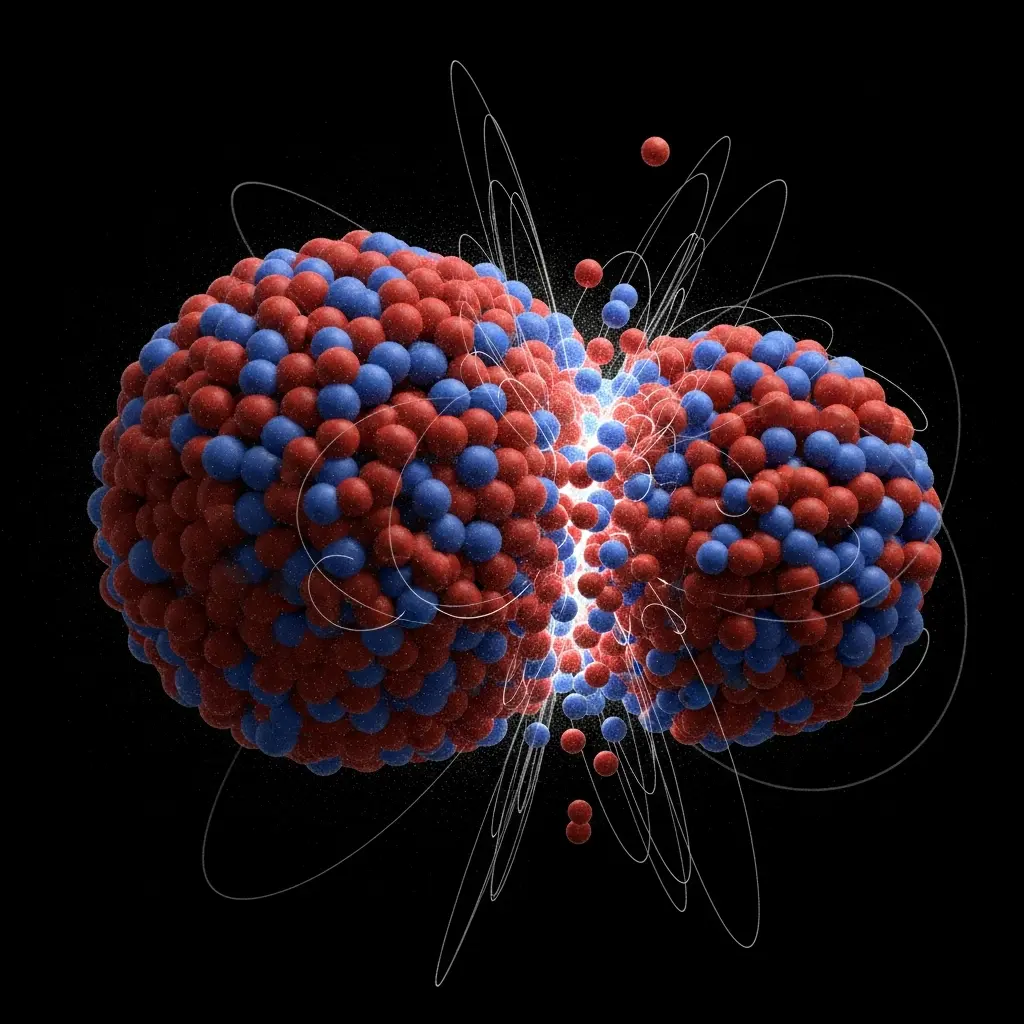
Scientists are increasingly focused on understanding the complex processes governing multi-nucleon transfer (MNT) reactions, and a new study quantifies the crucial impact of nuclear de-excitation on correlations within these events. Y. C. Yang, D. D. Zhang, and D. Vretenar, from institutions including the Institute of Modern Physics, Chinese Academy of Sciences, alongside B. Li, T. Nikšić, and P. W. Zhao et al., present a hybrid theoretical approach combining time-dependent covariant density functional theory (TDCDFT) with the GEMINI++ statistical de-excitation model. This research is significant because it bridges the gap between the initial dynamics of nuclear collisions and the final experimental observables, demonstrating that de-excitation is essential for accurately reproducing theoretical cross sections and revealing how fundamental correlations between fragments are lost during the reaction process.
Modeling How De-excitation Alters Nuclear Correlations
Modeling How De-excitation Alters Nuclear Correlations
Prior research focused on the primary fragments immediately following the collision, but this study specifically addresses how de-excitation alters these correlations. GEMINI++ provides a robust statistical model for simulating the de-excitation process, including particle evaporation and fission. By combining these two approaches, the researchers created a powerful tool for investigating the complex interplay between reaction dynamics and de-excitation. Experiments show that de-excitation processes significantly alter the yield distribution of heavy primary nuclei, shifting it towards lighter isotopes, and this study confirms that theoretical models must incorporate these mechanisms to provide reliable predictions. Furthermore, the researchers investigated the energy dependence of the cross-section distributions by simulating reactions at incident energies ranging from 235 to 270 MeV, revealing how reaction pathways change with energy. Calculations were performed on a Cartesian grid with a grid spacing of 0.1 fm, extending to 40 fm in each direction, and a time step of 0.016 fs. This innovative approach enables a detailed understanding of how de-excitation affects the correlation between primary fragments, addressing a critical gap in previous research which focused solely on primary fragment analysis. Researchers investigated the energy dependence of cross-section distributions by simulating reactions at incident energies ranging from 235 to 270 MeV. These simulations revealed a systematic shift in the peak cross section as a function of energy, with the maximum cross section occurring at 249 MeV. The team measured the total angular momentum and excitation energy of reaction products, crucial inputs for the statistical model calculation.
Specific Calculations of Angular Momentum and Fragment Probabilities
Specifically, the expectation value of the total angular momentum was calculated using equation 13, incorporating contributions from both neutrons and protons. Furthermore, the study determined the probability of forming fragments with specific neutron and proton numbers, calculated using equation 8, which relies on the particle number projection operator detailed in equation 4. The resulting probabilities, PN,Z, were then integrated over impact parameters, as described by equation 12, to obtain the cross section for each reaction channel. Notably, the preservation of mutual information was stronger for proton numbers than for neutrons, suggesting that neutron evaporation is the primary driver of correlation weakening. The authors acknowledge a limitation in the model’s treatment of complex decay pathways, potentially simplifying the de-excitation process. Future research could focus on refining the model to incorporate more detailed descriptions of these pathways and exploring the impact of different nuclear densities on the observed correlations. These findings offer a more realistic description of MNT reactions, demonstrating the importance of de-excitation in both reproducing experimental data and understanding the evolution of quantum correlations during nuclear collisions.
Interpreting Key Results: Significance of De-excitation Effects
Summary of Key De-excitation Findings and Significance
Conclusion and Future Outlook for Multi-Nucleon Studies
👉 More information🗞De-excitation effects in multi-nucleon transfer reactions🧠
🗞 De-excitation effects in multi-nucleon transfer reactions
🧠 ArXiv: https://arxiv.org/abs/2601.20535