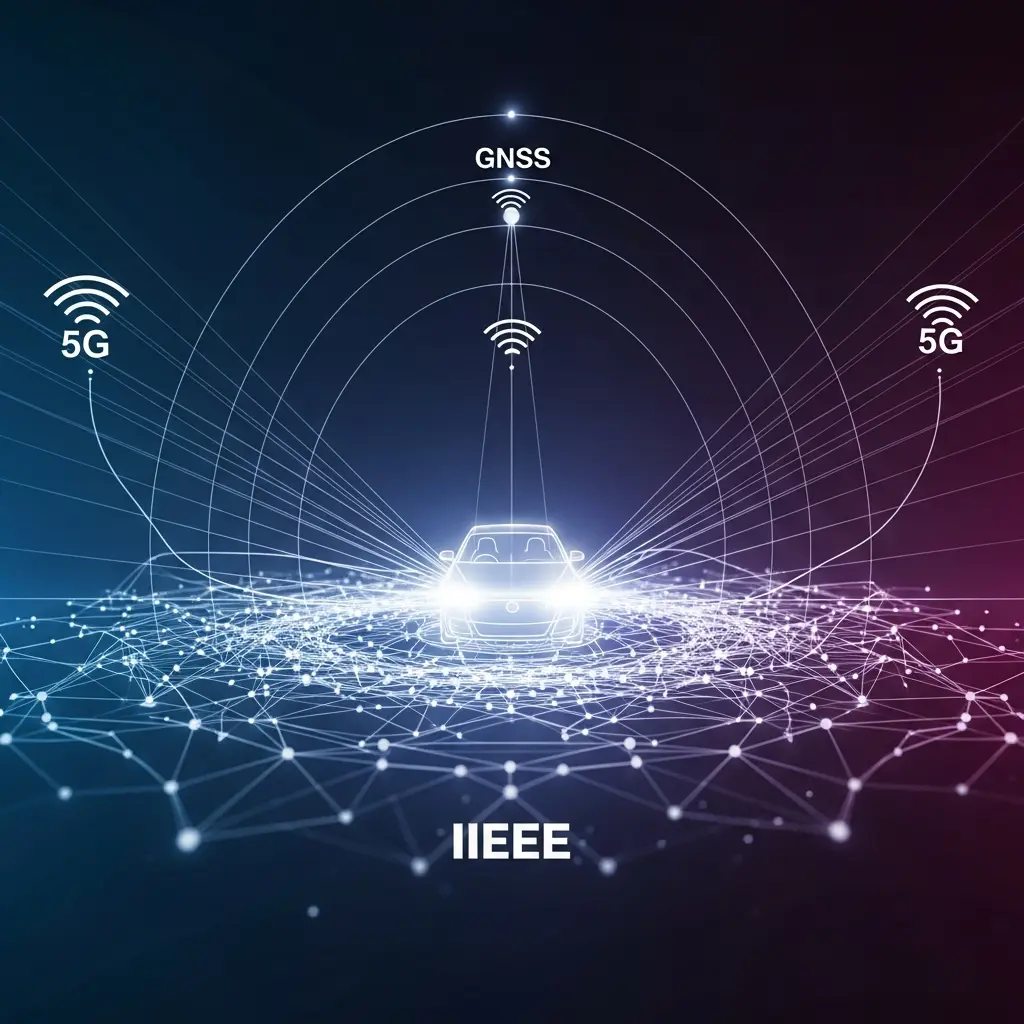
Researchers are increasingly focused on enabling accurate and dependable positioning for the next generation of connected and autonomous vehicles. Sharief Saleh from Chalmers University of Technology, Satyam Dwivedi and Peter Hammarberg from Ericsson Research, along with Russ Whiton et al., present a comprehensive survey examining the potential of wireless positioning technologies to meet the stringent demands of this rapidly evolving field. This work is significant because it consolidates knowledge of global navigation systems, cellular networks, and IEEE standards , including Wi-Fi and UWB , offering a holistic overview of current solutions, historical development, and crucially, the open challenges that remain in achieving robust vehicular positioning.
This work is significant because it consolidates knowledge of global navigation systems, Cellular Networks, and IEEE standards, including Wi-Fi and UWB, offering a holistic overview of current solutions, historical development, and crucially, the open challenges that remain in achieving robust vehicular positioning.
Vehicular positioning technologies for connected autonomy are rapidly
The team achieved a holistic overview of vehicular positioning use cases, meticulously outlining the specific performance requirements for each application. The study reveals the historical development, standardization processes, and ongoing evolution of each wireless positioning technology, providing a detailed categorization of existing solutions and algorithms. Researchers explored contemporary trends and identified persistent open challenges within the field, establishing a clear understanding of current limitations and future research directions. This work doesn’t simply document existing technologies; it critically assesses their capabilities and shortcomings in the context of demanding vehicular applications.
Experiments show that combining these technologies overcomes the limitations of individual systems, creating a more robust and dependable positioning solution. The survey meticulously examines how these technologies have evolved from early automotive navigation systems, such as the 1980s cassette tape-based systems and the 1990s GPS receivers like Mazda’s Eunos Cosmos, to the sophisticated systems required for full automation. This historical perspective underscores the significant advancements made and highlights the remaining hurdles to achieving fully autonomous driving. The work opens new avenues for improving transportation safety and efficiency, potentially delivering substantial societal, economic, and environmental benefits.
This breakthrough reveals a critical gap in the literature by offering a holistic perspective on the foundations, advancements, and future trajectories of wireless-based positioning for vehicular applications. Researchers categorize vehicular positioning technologies into relative and absolute positioning methods, detailing the strengths and weaknesses of each approach. Relative positioning relies on sensors like cameras, radars, lidars, wheel odometers, and IMUs, while absolute positioning leverages radio signals from GNSS, LEO satellites, 5G networks, and IEEE standards.
Scientists Method
The research began by defining specific performance requirements for diverse vehicular use cases, establishing a benchmark against which to evaluate each positioning system. Scientists assessed cellular positioning technologies up to 5G, noting that more recent work on 6G focuses on terahertz bands suited for short-range applications. This detailed analysis revealed a gap in existing literature regarding the integration of multiple wireless technologies for enhanced vehicular positioning. Experiments employed techniques to combine data from GNSS, LEO, 5G, Wi-Fi, UWB, Bluetooth, and V2V, alongside inputs from perception sensors and inertial measurement units. The work also reviewed cooperative GNSS techniques for vehicular networks and cooperative localisation within 5G networks, demonstrating the potential for improved performance through inter-vehicle communication. This innovative methodology enables a holistic perspective on wireless-based positioning, bridging the gap between individual technologies and integrated, robust vehicular positioning systems.
Sub-meter vehicle positioning now routinely achieved with modern
Recent commercial deployments utilising consumer-grade receivers and antennas have achieved horizontal error levels of less than 0.5m for 95% of measurements, demonstrating impressive performance in vehicular environments. Trimble’s RTX service, for example, consistently delivers sub-meter protection levels without any reported integrity errors. Swift Navigation’s Skylark service, paired with the Starling positioning engine, similarly achieved sub-meter accuracy during a cross-US drive, validating the potential for highly precise location tracking. Hexagon’s Terrastar service replicated these results, confirming sub-meter level accuracy and integrity across extensive testing.
Experiments revealed that verifying integrity performance requires substantial sample sizes, exceeding practical limits for individual researchers, therefore protection levels incorporate modelling assumptions. Limited data exists regarding the performance of low-Earth-orbit (LEO) systems, although Iridium satellite signals demonstrated 20-meter accuracy in an urban setting. Researchers explored cellular-based positioning, initially driven by regulatory mandates like the U. S. Federal Communication Commission’s E911 requirements in 1996 and subsequent European Council directives in 2000.
Cellular networks have evolved to support vehicular applications, with 5G New Radio (NR) utilising both millimeter-wave (mmWave) and sub-6GHz (FR1) positioning techniques currently under investigation. The study details the historical evolution of cellular standards, tracing positioning capabilities from 2G to the latest 3GPP Release 18, and ongoing releases 19 and 20. In 2G-GSM networks, rudimentary positioning services, utilising timing advance, enhanced cell identity (E-CID), enhanced observed time difference (EOTD), and assisted-GPS, supported emergency call localisation with requirements not demanding high precision. The introduction of network elements like the serving mobile location center (SMLC) and gateway mobile location center (GMLC) laid the groundwork for future developments0.3G standards incorporated these elements into the radio network controller (RNC) and added a positioning element (PE) to enhance observed time difference of arrival (OTDoA) measurements. Furthermore, 3GPP integrated uplink angle of arrival (AoA) estimation, leveraging adaptive antennas, although early implementations were limited by antenna array size and non-line-of-sight conditions0.4G standards refined existing methods, introducing assisted-GNSS and improving time resolution, though challenges remained in meeting the stringent demands of vehicular positioning. A graphic illustrates the evolution of cellular positioning capabilities, showing a progression from 1000m accuracy in 1G to potentially 0.1m accuracy with 6G technologies utilising mmWave, massive multiple-input multiple-output (M-MIMO), and reconfigurable intelligent surfaces (RISs).
Integrated Wireless Data for Vehicle Positioning offers real-time
The study details the historical development, standardization, and current algorithms associated with each technology, identifying key challenges and emerging trends within the field. Researchers highlight a critical need for integrated datasets combining wireless, inertial, and perception data captured under realistic conditions with precise synchronization and ground-truth alignment. While sensor fusion techniques have improved vehicular localization, further work is required to address uncertainty handling, resilience to interference, collaborative calibration, and real-time performance. The authors note a historical emphasis on positioning accuracy as the primary performance indicator, advocating for a broader focus encompassing safety, reliability, and scalability for fully autonomous systems. A key limitation acknowledged by the authors is the fragmentation of existing datasets, which often prioritize GNSS, vision, lidar, and inertial data while neglecting cellular and IEEE-based technologies. Future research should prioritize defining and validating robust integrity levels and alert limits for all positioning systems, particularly cellular and IEEE-based solutions.
👉 More information
🗞 Vehicular Wireless Positioning — A Survey
🧠 ArXiv: https://arxiv.org/abs/2601.20547



See today’s quantum computing news on Quantum Zeitgeist for the latest breakthroughs in qubits, hardware, algorithms, and industry deals.