

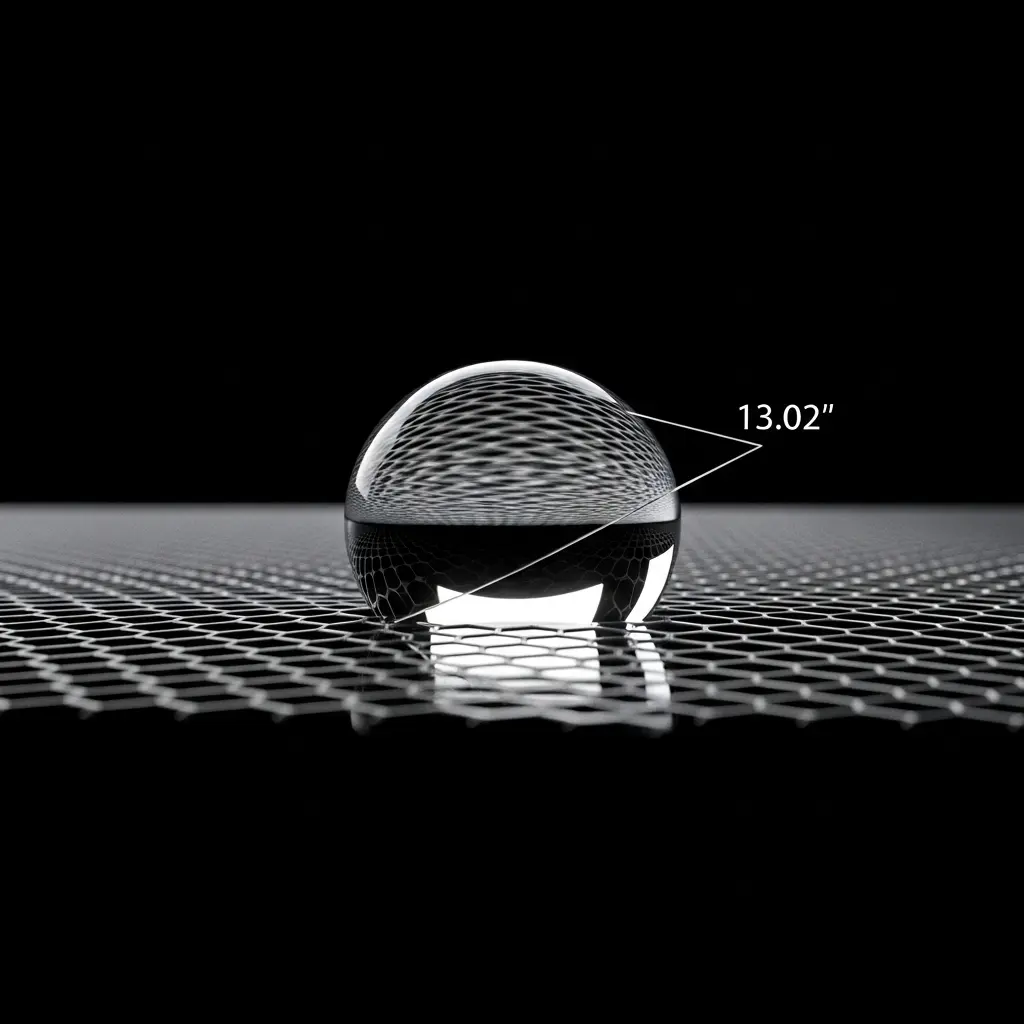
Researchers are striving to accurately predict and control how water interacts with graphene, a crucial factor in developing nanofluidic devices, sensors and energy technologies. Darren Wayne Lim and Xavier R Advincula, from the University of Cambridge, alongside William C Witt, Fabian L Thiemann, and Christoph Schran, have now presented a detailed atomistic understanding of water wetting on graphene using a highly accurate machine learning potential. Their work resolves a long-standing debate regarding the contact angle of water on free-standing graphene, finding a value of 89.1 degrees after accounting for finite-size effects. Significantly, the team demonstrate that graphene’s dynamic morphology and mechanical strain profoundly influence wetting behaviour, offering a compelling explanation for discrepancies in experimental results and opening up new avenues for controlling wettability in future technologies.
Water wetting on Graphene via molecular dynamics simulations
Scientists have long sought to understand how water wets surfaces, a critical factor in predicting and controlling its behaviour in applications ranging from nanofluidics to energy storage. A key metric for quantifying wetting is the contact angle formed by a liquid droplet on a surface, yet experimental measurements for free-standing graphene exhibit a wide range, hindering the development of a definitive understanding. The study reveals the contact angle of water on free-standing graphene, after finite-size correction, to be 72.1 ±1.5°.
The team achieved this breakthrough by developing a novel methodology to define the contact angle for a spherical nanodroplet on a non-flat surface, accurately accounting for the inherent rippling of free-standing graphene. Simulations employed a machine learning potential trained to replicate Density functional theory calculations at the revPBE-D3 level, enabling simulations at a scale and accuracy previously unattainable. This allowed for the modelling of droplets containing between 9,540 and 22,680 atoms, significantly larger than previous ab initio studies and crucial for mitigating finite-size effects that plague nanoscale contact angle measurements. By focusing on free-standing graphene, the researchers isolated its intrinsic wetting behaviour, eliminating the influence of supporting substrates or surface contaminants.
Experiments show that the three-phase contact line of a nanoscale water droplet strongly couples to the intrinsic thermal ripples of free-standing graphene, demonstrating that wetting properties are highly sensitive to mechanical strain. Applying tensile strain significantly increases the hydrophobicity of graphene, while compressive strain induces coherent ripples that the droplet effectively “surfs” upon, resulting in pronounced anisotropic wetting and contact angle hysteresis. This research establishes that graphene’s wetting properties are governed not only by its chemical composition but also by its dynamic morphology, offering a compelling explanation for the variability observed in experimental measurements. Furthermore, the study unveils that mechanical strain presents a practical route to controlling wetting in graphene-based technologies, with promising implications for nanofluidic devices and nano-filtration applications. The work demonstrates a two-way coupling between the dynamics of surface rippling and the three-phase contact line, highlighting the outsized effect of strain on graphene’s wettability. These findings suggest that manipulating mechanical strain could provide a powerful means of tailoring graphene surfaces for specific applications requiring precise control over water behaviour at the nanoscale.
Machine Learning for Analyzing Wetting Phenomena
Machine Learning for Analyzing Wetting Phenomena
Graphene Wetting via Machine-Learned Molecular Dynamics reveals critical
Scientists employed molecular dynamics simulations to investigate the wetting behaviour of water on free-standing graphene, addressing a long-standing discrepancy in experimental measurements. The study pioneered a novel methodology for defining contact angles on non-flat surfaces, crucial for accurately accounting for thermal ripples inherent in free-standing graphene. Researchers developed a machine learning potential, trained against density functional theory calculations at the revPBE-D3 level, enabling simulations at both first-principles accuracy and a feasible computational cost. This approach facilitated the modelling of significantly larger droplets, containing between 9,540 and 22,680 atoms, than previously possible with ab initio methods, allowing for robust finite-size corrections.
Experiments involved simulating spherical water droplets of varying sizes placed on a large, dynamically-evolving graphene sheet for 1. The contact angles were measured using a geometrically-based method, analysing the intersection between the droplet’s time-averaged interface and a time-averaged graphene heightmap. To correct for finite-size effects, the team plotted microscopic contact angles against the radius of the three-phase contact line, extrapolating to obtain a macroscopic contact angle of 72.1 ±1.5°. This extrapolation relied on the assumption of a linear relationship between the cosine of the contact angle and the inverse of the contact line radius, incorporating a line tension effect.
Mechanical Strain Effects on Graphene Wetting
The Influence of Mechanical Strain on Wetting
Furthermore, the research explored the interplay between graphene surface ripples and nanoscale droplet wetting by applying mechanical strain to the graphene sheet. Scientists discovered a strong coupling between the dynamics of surface rippling and the three-phase contact line, revealing that tensile strain increases hydrophobicity, while compressive strain induces coherent ripples that facilitate droplet movement. This finding demonstrates that wetting properties are not solely determined by graphene’s chemistry but also by its dynamic morphology, offering a potential explanation for variations in experimental results and suggesting mechanical strain as a viable control mechanism for nanofluidic and nano-filtration technologies.
Final Benchmark Results for Contact Angle Measurement
Graphene wettability benchmarked with molecular dynamics simulations reveals
Benchmark Results for Contact Angle Measurement
Scientists achieved a first-principles benchmark for the water droplet contact angle on free-standing graphene using molecular dynamics simulations. The team measured the contact angle to be 72.1 ±1.5° after finite-size correction, resolving a long-standing discrepancy in experimental measurements. These simulations employed a machine learning potential trained to replicate density functional theory calculations, enabling simulations with significantly larger droplets than previously possible and mitigating finite-size effects. Researchers constructed a novel methodology to define the contact angle for a spherical nanodroplet on a non-flat surface, accurately accounting for surface rippling in free-standing graphene.
Experiments revealed a strong coupling between the three-phase contact line of a nanoscale water droplet and the intrinsic thermal ripples of free-standing graphene. Data shows that graphene’s wetting properties are highly sensitive to mechanical strain, demonstrating that tensile strain significantly increases graphene’s hydrophobicity. Conversely, compressive strain induces coherent ripples, allowing the droplet to “surf” along the surface, resulting in pronounced anisotropic wetting and contact angle hysteresis. Measurements confirm that the dynamic morphology of graphene, not just its chemistry, governs wetting properties, offering a new explanation for the variability observed in experimental results.
Results demonstrate that the interplay between surface ripples and the wetting of nanoscale water droplets is substantial. The team discovered a two-way coupling between the dynamics of surface rippling and the three-phase contact line, indicating that mechanical strain exerts a considerable influence on graphene’s wettability. Specifically, the application of tensile strain induced a more hydrophobic surface, while compressive strain created ripples that facilitated droplet movement. These findings suggest that mechanical strain could serve as a practical method for controlling wetting in graphene-based technologies, with potential benefits for nanofluidic and nano-filtration applications.
Tests prove that the simulations accurately capture the intrinsic wettability of graphene, isolating its behaviour from substrate influences and contamination. The work utilized droplets orders of magnitude larger than previous ab initio studies, allowing for a more accurate resolution of finite-size effects. Furthermore, the study highlights the importance of capturing the membrane-like flexibility of free-standing graphene, which thermally ripples to lower its vibrational free energy and impacts water diffusion and transport.
🗞 Revealing Strain Effects on the Graphene-Water Contact Angle Using a Machine Learning Potential
🧠 ArXiv: https://arxiv.org/abs/2601.20134



See today’s quantum computing news on Quantum Zeitgeist for the latest breakthroughs in qubits, hardware, algorithms, and industry deals.



