Researchers have demonstrated a novel pathway for generating high-harmonic spin currents without relying on spin-orbit coupling, a significant advancement in the field of spin transport. Ousmane Ly, alongside colleagues, unveils this purely magnetic route to high-harmonic spin pumping, challenging conventional understandings of how these currents are produced. Their work, conducted without specifying institutional affiliations in a recent publication, promises to reshape our understanding of spin current generation.
Magnetic Nonlinearities Drive Spin Current Harmonics in ferromagnetic
This breakthrough establishes a purely magnetic route to efficient spin current generation, potentially broadening the range of materials suitable for advanced spintronic devices. The study centres on understanding how a time-dependent magnetization can inject a spin current into an adjacent conductor, a phenomenon known as spin pumping, and how to enhance this process beyond simple linear responses. Their analysis revealed that conventional spin pumping, driven by ferromagnetic or antiferromagnetic resonance, produces only spin currents oscillating at the driving frequency, limited by symmetry considerations. Experiments show that this configuration qualitatively reshapes the electronic energy bands, directly propagating into the dynamical transport response and enabling the generation of spin pumping accompanied by a cascade of higher harmonics. Specifically, the resulting energy dispersion exhibits an explicit and nonlinear dependence on time, imprinting higher harmonics onto the carrier motion. The findings open exciting avenues for designing novel spintronic devices capable of generating and manipulating spin currents with unprecedented efficiency and control, potentially leading to advancements in terahertz radiation and frequency conversion technologies.
Non-SOC Harmonic Spin Pumping via Driven Magnetism offers
This Hamiltonian, coupled with a uniformly precessing magnetic order m(t) = (sin θ cos ωt, sin θ sin ωt, cos θ) with cone angle θ and angular frequency ω, yielded two energy bands defined as ε± = −2γ cos k ± J0. The study meticulously investigated the band structure’s temporal evolution, revealing that conventional spin pumping, driven by ferromagnetic resonance, produces only linear spin responses at the driving frequency. Researchers discovered that to achieve high-Harmonic generation, the energy bands themselves must exhibit a nonlinear time dependence, a condition not inherently present in the initial model. This innovative configuration enabled the generation of a cascade of higher harmonics in spin pumping, even in the complete absence of SOC, demonstrating a fundamentally new mechanism for ultrafast spin transport.
This approach enables the exploration of purely magnetic systems for high-frequency spin-current generation, broadening the scope beyond traditional spin-orbit-based methods. The system delivers a minimal model for understanding the connection between nonlinear band dynamics and nonlinear spin transport, providing a transparent platform for future investigations. The technique reveals a pathway to harness magnetic materials for advanced spin-based technologies.
Spin pumping via magnetic nonlinearity alone
This breakthrough establishes a fundamentally new approach to ultrafast spin pumping. The team measured the energy bands using a Hamiltonian describing a uniformly precessing magnetic order, defined as m(t) = (sin θ cos ωt, sin θ sin ωt, cos θ), with cone angle θ and angular frequency ω. This Hamiltonian yielded two energy bands, ε± = −2γ cos k ± J0, which remained strictly time independent, indicating the absence of nonlinear temporal dynamics and thus, no high-harmonic generation at the spectral level. Tests prove that the resulting energy dispersion, ε± = −2γ cos k ± q J2 0 + J2 1 + 2J0J1 sin θ cos ωt, exhibits an explicit and nonlinear dependence on time.
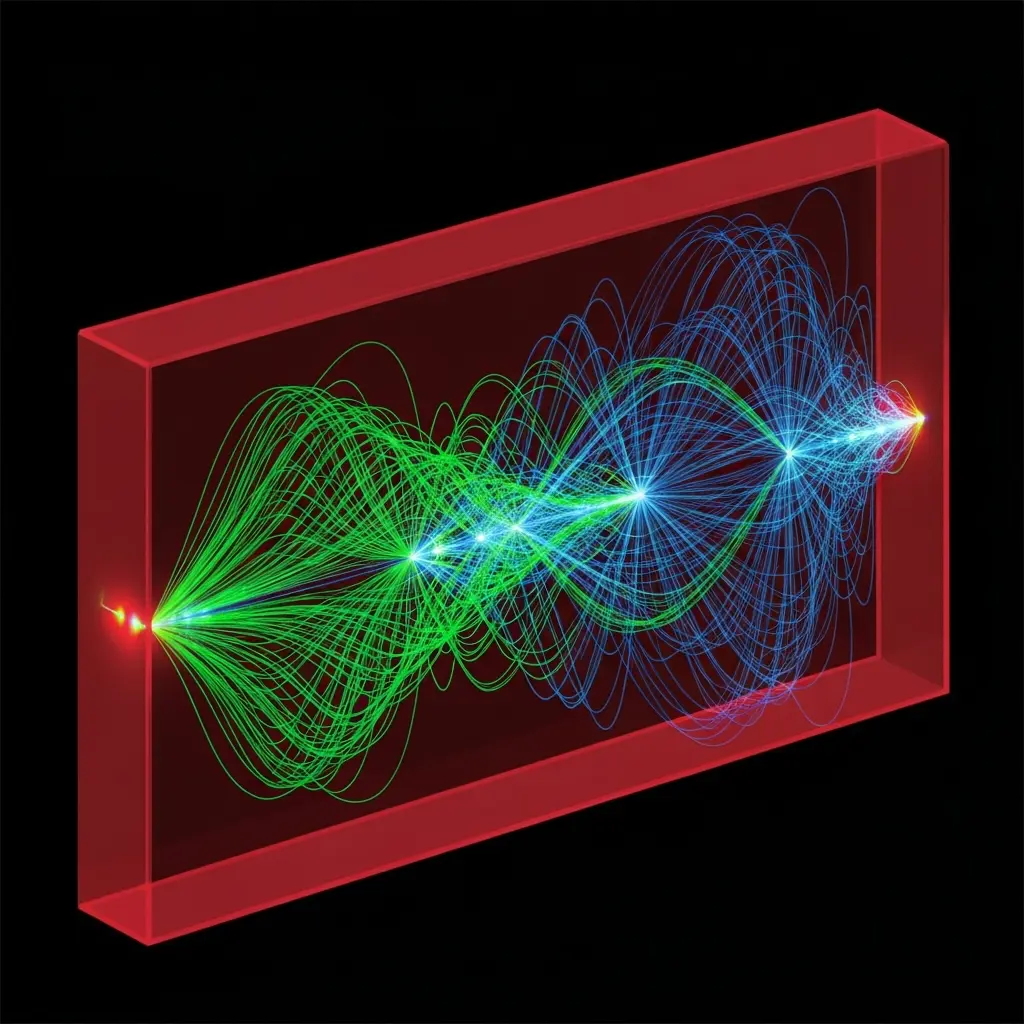
Numerical simulations of spin transport in a magnetic heterostructure validated this, demonstrating how this nonlinear band dynamics gives rise to high-harmonic spin pumping. Data shows that in the standard spin-pumping regime (J1 = 0), the charge current vanishes, while transverse spin components oscillate harmonically at the driving frequency, with only the spin current polarized along the z direction acquiring a finite time-averaged value. Conversely, with the inclusion of a static transverse magnetic field (J1 = 2), the Fourier spectra revealed the emergence of higher harmonics, extending up to the 30th order for a precession cone angle of θ = π/2. Measurements confirm a vanishing dc component for the spin current polarized along the static field direction, alongside finite dc contributions for the y and z polarized spin currents.
Nonlinear Magnetic Order Drives Harmonic Pumping in Antiferromagnets
Scientists have demonstrated a novel mechanism for high-harmonic spin pumping that doesn’t rely on spin-orbit coupling. The introduction of a static magnetic order perpendicular to a driven magnetization fundamentally alters spin pumping behaviour. Notably, the research identifies the interplay between two noncollinear magnetic orders as the key ingredient for this high-harmonic generation, alongside the emergence of dc spin components and a forbidden dc charge current. The. This work provides a promising foundation for developing ultrafast spintronic functionalities and high-frequency signal generation, potentially advancing the field of magnetic materials and devices.
👉 More information
🗞 A Purely Magnetic Route to High-Harmonic Spin Pumping
🧠 ArXiv: https://arxiv.org/abs/2601.20777