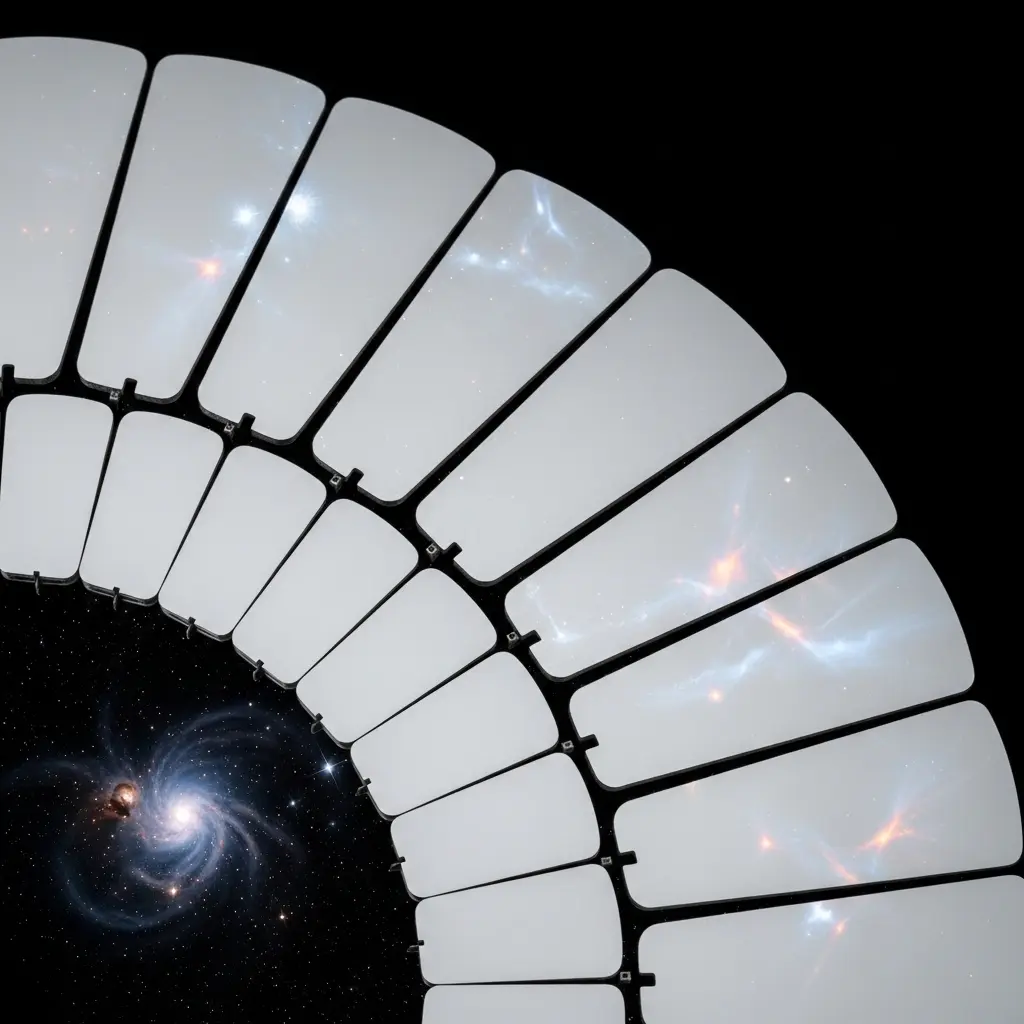
Researchers are pushing the boundaries of X-ray optics with a novel electroforming replication technique, promising advancements for both synchrotron technology and space astronomy. Ryuto Fujii, Koki Sakuta, and Kazuki Ampuku, all from the Graduate School of Science at Nagoya University, alongside et al., detail the development and testing of a 60-mm diameter electroformed nickel mirror and its assembly, achieving an exceptionally sharp core with a Full Width at Half Maximum of just 0.7 arcsec. This breakthrough, validated using a dedicated evaluation system at SPring-8, signifies a major step towards higher resolution X-ray imaging, and has already led to the successful integration of this technology into the FOXSI-4 sounding rocket experiment for studying solar flares , paving the way for more compact and powerful X-ray telescopes for future space missions.
Electroformed Nickel Mirrors Tested at SPring-8 reveal
Novel Electroforming Techniques for X-Ray Optics
Scientists have developed X-ray telescope mirrors utilising an original electroforming replication technique initially established through the fabrication of millimeter-aperture, ultra-short-focal-length nanofocusing mirrors for synchrotron X-ray microscopy. This work presents detailed results of X-ray illumination tests performed on a 60-mm-diameter, full-circumference, double-reflection monolithic electroformed nickel mirror and its Mirror Module Assembly (MMA). The experiments were conducted at the 1-km beamline BL29XUL at SPring-8, employing a dedicated evaluation system named the High-Brilliance X-ray Kilometer-long Large-Area Expanded-beam Evaluation System (HBX-KLAEES) to simulate a parallel X-ray beam from celestial sources0.7 arcsec and a Half Power Diameter (HPD) of 14 arcsec, even after integration into the MMA. This achievement represents a significant step forward in X-ray optics technology, showcasing the potential for high-resolution imaging in space-based astronomy. Furthermore, the research team discovered a positive correlation between angular resolution and axial figure error in both the primary and secondary mirror sections, indicating that axial figure errors contribute to image degradation, a crucial finding for optimising future designs. This correlation provides valuable insight into the factors limiting performance and guides efforts to further refine the fabrication process.
Based on these promising results, the MMA was selected as one of the hard X-ray optics for the FOXSI-4 sounding rocket experiment, designed to perform high-resolution soft and hard X-ray imaging spectroscopy of solar flares, and was successfully launched. This successful deployment in a space environment validates the robustness and reliability of the electroformed mirrors under real-world conditions. The team’s innovative approach to mirror fabrication and testing paves the way for further improvements in angular resolution and the development of high-resolution, ultra-short focal length X-ray optics for small satellites, including CubeSats. This breakthrough establishes a pathway towards more affordable and accessible high-resolution X-ray astronomy missions.
The research establishes a clear link between synchrotron-based nanofabrication techniques and the demands of space astronomy, demonstrating how advancements in ground-based technologies can directly benefit space-based instrumentation. Experiments show that the electroforming process, refined through synchrotron microscopy applications, yields mirrors with exceptional precision and imaging capabilities. The study unveils a novel approach to X-ray optic development, offering a cost-effective and scalable solution for future space missions. This work opens exciting possibilities for exploring the universe in greater detail, enabling scientists to study high-energy phenomena with unprecedented clarity and precision.
Electroformed Nickel Mirror Testing at SPring-8 revealed significant
Developing X-Ray Mirrors Through Electroforming Techniques
Scientists engineered a novel X-ray telescope mirror utilising an electroforming replication technique initially developed for millimeter-aperture, ultra-short-focal-length nanofocusing mirrors employed in synchrotron X-ray microscopy. This work details comprehensive X-ray illumination tests performed on a 60-mm-diameter, full-circumference, double-reflection monolithic electroformed nickel mirror and its Mirror Module Assembly (MMA). Experiments were conducted at the 1-km beamline BL29XUL at SPring-8, leveraging its unique capabilities for high-resolution optics characterisation. To accurately simulate parallel X-rays originating from distant celestial sources, the research team constructed the High-Brilliance X-ray Kilometer-long Large-Area Expanded-beam Evaluation System (HBX-KLAEES).
Advanced Testing Methodologies and Illumination Systems
This dedicated evaluation system harnessed a Fresnel Zone Plate (FZP), constructed from 1500nm thick gold with a 1mm diameter, positioned 95m upstream to generate a virtual point source. The 1km propagation distance within BL29XUL transformed the diverging beam from the FZP into a highly collimated beam at the mirror’s location, achieving both high collimation and sufficient coverage of the 60mm aperture. The, 1st diffraction order was selected, and a mask blocked the +1st order and direct beam, ensuring only the desired divergent component illuminated the sample. Two distinct measurement protocols were employed to characterise the mirrors: a spot-scan test and a full-illumination test.
The spot-scan method evaluated local imaging performance by scanning a 5 × 5 mm2 beam across the mirror surface, synchronously translating the mirror and detector stages to maintain alignment at 40 positions. Conversely, the full-illumination test, utilising HBX-KLAEES, assessed the overall imaging performance of the MMA with a large, expanded X-ray beam. The detector system comprised a scintillator-coupled CMOS camera, allowing pixel sizes of 6.5μm with a 2048 × 2048 resolution. The HBX-KLAEES system delivered an apparent source size of approximately 0.02 arcsec and a diverging angle of 7 arcsec, enabling precise measurements of on- and off-axis responses0.7 arcsec and a Half Power Diameter (HPD) of 14 arcsec, even after integration into the MMA. This exceptional performance, coupled with the identification of a correlation between angular resolution and axial figure error, led to the selection of the MMA for the FOXSI-4 sounding rocket experiment, successfully launched to image solar flares.
Evaluating Performance with Synchrotron X-Ray Illumination
Achieving Breakthrough Mirror Performance in Testing
Electroformed Nickel Mirror Performance at SPring-8 is exceptional
Scientists have achieved a breakthrough in X-ray telescope mirror technology using an innovative electroforming replication technique initially developed for synchrotron X-ray microscopy. This work details the results of X-ray illumination tests performed on a 60-mm-diameter, full-circumference, double-reflection monolithic electroformed nickel mirror and its Mirror Module Assembly (MMA). Experiments were conducted at the SPring-8 facility’s 1-km beamline BL29XUL, utilising a dedicated evaluation system named the High-Brilliance X-ray Kilometer-long Large-Area Expanded-beam Evaluation System (HBX-KLAEES)0.7 arcsec and a Half Power Diameter (HPD) of 14 arcsec, even after integration of the mirror into the MMA. This exceptional angular resolution was maintained despite the complexities of assembling the module. Furthermore, the team recorded a positive correlation between angular resolution and axial figure error in both the primary and secondary mirror sections, confirming that axial figure errors contribute to image degradation. Detailed analysis revealed that minimising these errors is critical for achieving optimal imaging performance.
Applying Ground Technology to Space Astronomical Missions
Based on these achievements, the MMA was selected as a hard X-ray optic for the FOXSI-4 sounding rocket experiment, which successfully launched to perform high-resolution soft and hard X-ray imaging spectroscopy of solar flares. Measurements confirm the potential for further improvements in angular resolution and the development of high-resolution, ultra-short focal length X-ray optics suitable for small satellites, including CubeSats. The study’s success paves the way for more compact and efficient X-ray telescopes capable of delivering unprecedented views of the universe. This innovative approach to mirror fabrication promises to significantly advance the field of high-energy astrophysics and solar physics.
🗞 Development of Electroformed X-ray Optics Bridging Synchrotron Technology and Space Astronomy
🧠 ArXiv: https://arxiv.org/abs/2601.19188


See today’s quantum computing news on Quantum Zeitgeist for the latest breakthroughs in qubits, hardware, algorithms, and industry deals.