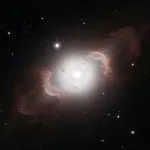
Scientists are challenging current understandings of planetary nebula formation with new observations of the Necklace nebula, a bipolar structure exhibiting a rare carbon dwarf companion star! David Jones (Instituto de Astrofísica de Canarias, Universidad de La Laguna) alongside Romano L. M. Corradi (Instituto de Astrofísica de Canarias, GRANTECAN) and Gustavo A. García Pérez (Instituto de Astronomía, Universidad Nacional Autónoma de México) et al, present compelling evidence from Hubble Space Telescope far-ultraviolet spectroscopy and detailed modelling that reveals a surprising discrepancy , the inner nebula appears carbon-poor despite being orbited by a carbon dwarf! This finding is significant because it questions the established link between carbon-rich stars and the nebulae they create, suggesting the progenitor star barely met the threshold for carbon production, or that carbon transfer within the binary system is more complex than previously thought , potentially requiring a re-evaluation of post-common-envelope binary evolution.
Necklace nebula’s carbon deficiency puzzles astronomers, challenging current
Scientists have unveiled a puzzling discovery concerning the Necklace nebula, a unique bipolar planetary nebula harboring a dwarf carbon star companion. This innovative approach allowed the team to constrain the parameters of the central star system and investigate the carbon abundance within the nebula itself. Surprisingly, the study reveals that the inner region of the Necklace nebula, observed with Hubble, appears to be carbon-poor, a finding that clashes with the expected carbon-rich nature of the dwarf companion star.
Progenitor Star’s Complex Evolutionary Pathways
Progenitor Star Mass and Complex Evolutionary Pathways
The initial mass of the nebula’s progenitor star was likely very close to the threshold required to become carbon-rich, potentially undergoing a late thermal pulse before its demise. This suggests a complex evolutionary pathway where the star nearly achieved the conditions necessary for carbon production. Furthermore, the dwarf carbon star companion is found to be significantly inflated compared to a typical main sequence star of the same mass, hinting at past interactions and accretion events. The properties of the central binary are consistent with a scenario where the progenitor star became carbon-rich and the companion accreted substantial amounts of this carbon-enriched material, shaping the nebula’s distinctive structure.
Experiments show that the favoured hypothesis for the origins of dwarf carbon stars is that they have previously accreted carbon-rich material from a more evolved companion or its wind. However, reconciling this accretion hypothesis with the observed carbon-poor inner nebula presents a significant challenge. The team’s modelling of the light and radial velocity variations of the central binary has allowed for a detailed constraint of the stellar and orbital parameters of the system, providing crucial insights into its evolution. This research establishes the Necklace nebula as a unique laboratory for studying the common-envelope phase of binary stellar evolution, a critical yet poorly understood process in the formation of planetary nebulae and close binary systems.
The study unveils a fascinating conundrum: how can a binary system with a carbon-accreting companion exhibit a carbon-poor nebula? The team’s observations, utilising space-based narrowband imaging and ultraviolet spectroscopy, have provided a wealth of data for analysis. The discovery of the inflated companion star further complicates the picture, suggesting a history of mass transfer and interaction within the binary system. This work opens new avenues for investigating the interplay between stellar evolution, binary interactions, and the formation of complex nebular structures, potentially refining our understanding of the final stages of stellar life and the origins of chemically peculiar stars.
Analyzing Data with Spectroscopy and Modeling
Utilizing Hubble Spectroscopy and Binary Star Modelling
Hubble Spectroscopy and Binary Star Modelling reveal stellar
Scientists investigated the Necklace nebula, a bipolar post-common-envelope planetary nebula, focusing on its unique dwarf carbon star companion. The research aimed to unravel the origins of both the nebula’s distinctive structure and the unusual characteristics of its central star system. This spectroscopic data was then meticulously compared with theoretical predictions to assess the carbon enrichment levels and identify any discrepancies. Furthermore, the study pioneered a simultaneous modelling technique, integrating photometric data across multiple wavelengths with radial velocity measurements obtained from optical spectroscopy, a method enabling a comprehensive characterisation of the binary system’s orbital and stellar properties. Experiments employed a custom-built light curve modelling code, incorporating detailed stellar atmosphere models and accounting for the complex interplay of light emitted from both the primary and secondary stars.
This code allowed scientists to derive parameters such as the masses, radii, effective temperatures, and orbital inclination of the binary components with unprecedented accuracy. The system delivers precise constraints on the nebular progenitor’s initial mass, suggesting it resided very close to the threshold for becoming carbon-rich, potentially undergoing a late thermal pulse. The technique reveals a surprising finding: the inner nebula, as observed by Hubble, appears deficient in carbon, a result seemingly at odds with the dwarf carbon star nature of the companion. Researchers found the dwarf carbon star companion to be significantly inflated compared to expectations for an isolated main sequence star of equivalent mass, indicating a possible history of accretion. This innovative approach connects the observed properties of the central binary to the hypothesis that the progenitor star became carbon-rich and the companion accreted substantial amounts of this carbon-enriched material. However, the study acknowledges the challenge of reconciling this evolutionary scenario with the observed carbon-poor nature of the inner nebula, presenting an intriguing puzzle for future investigation.
Implications for Stellar Formation Theories
Nebula’s Carbon Deficiency Challenges Star Formation Theories
Nebula’s Unexpected Carbon Deficiency Challenges Star Formation Theories
Scientists have uncovered a surprising result concerning the Necklace nebula, a bipolar planetary nebula distinguished by its dwarf carbon star companion. Experiments revealed a puzzling discrepancy: the inner region of the nebula, as observed by Hubble, does not exhibit the carbon-rich composition expected given the dwarf carbon star nature of its companion. This finding challenges current understanding of the nebula’s origins and the processes governing carbon star formation.
The team measured the initial mass of the nebular progenitor to be very close to the threshold required to become carbon-rich, suggesting a possible late thermal pulse event. Detailed analysis of the dwarf carbon star companion demonstrated it is significantly inflated compared to an isolated main sequence star of equivalent mass, indicating a complex evolutionary history. Measurements confirm the central binary’s properties align with a scenario where the progenitor became carbon-rich and the companion accreted substantial carbon-enriched material. However, reconciling this accretion hypothesis with the observed carbon-poor inner nebula presents a significant challenge for current models.
Further spectroscopic observations, conducted at the 3.5-m APO telescope and the 4.2-m William Herschel Telescope, provided radial velocity measurements of the secondary star. Data shows observations were taken over multiple nights, with integration times ranging from 20 to 40 minutes per exposure. Nebula’s.
🗞 Appraising the Necklace: A post-common-envelope carbon dwarf inside an apparently carbon-poor planetary nebula
🧠 ArXiv: https://arxiv.org/abs/2601.19382
See today’s quantum computing news on Quantum Zeitgeist for the latest breakthroughs in qubits, hardware, algorithms, and industry deals.