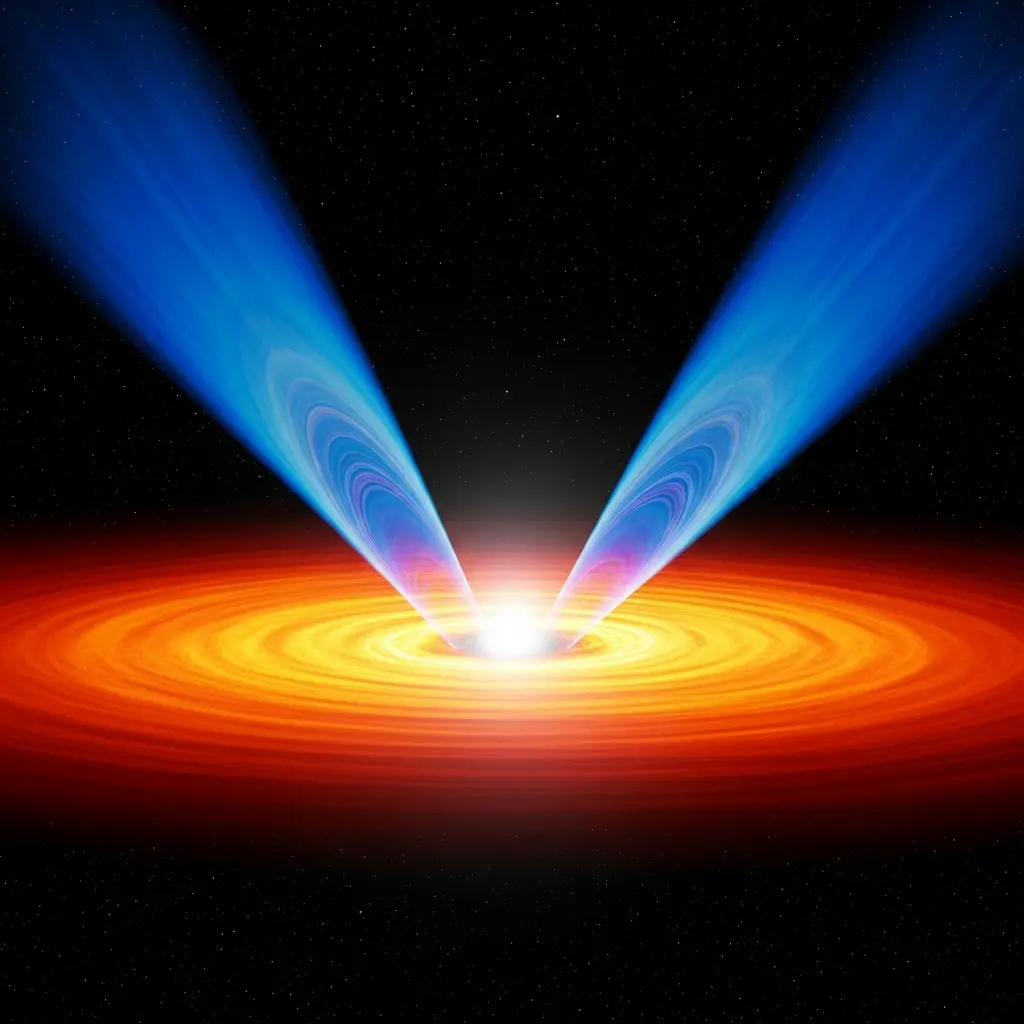
Researchers have, for years, debated the origins of accretion disc winds, crucial components in understanding how matter behaves around black holes and neutron stars. Now, M. Díaz Trigo (ESO), E. Caruso, and E. Costantini et al. present compelling evidence for a highly ionised outflow in the X-ray binary 4U 1624-49, utilising the unprecedented spectral resolution of the XRISM observatory. Their observations confirm the presence of this outflow via phase-resolved spectroscopy, revealing an average velocity of 200-320km/s and a narrow line profile suggesting low turbulence , a significant finding as it supports the theory that these winds are driven by thermal-radiative pressure originating from the outer regions of the accretion disc. This work provides vital insight into the launching mechanisms of these winds and helps to refine our understanding of accretion processes in binary systems.
XRISM Resolve Detects Neutron Star Wind Characteristics
Observing the Powerful Outflowing X-ray Wind
Scientists have definitively detected a powerful outflowing wind emanating from the X-ray binary 4U 1624, 49, a system containing a neutron star and a companion star, using data from the XRISM observatory. This breakthrough establishes the presence of a wind, a stream of material ejected from the accretion disc surrounding the neutron star, and provides crucial insights into its launching mechanism. Researchers leveraged the exceptional spectral resolution of XRISM’s Resolve instrument to conduct phase-resolved spectroscopy, meticulously analysing the X-ray emissions throughout the binary’s orbit, excluding periods obscured by absorption dips. This innovative approach allowed the team to characterise the highly ionised plasma comprising the wind at all observable orbital phases, revealing a clear outflow signal.
Based on detailed analysis of the radial velocity curve, the study determines an average outflow velocity of approximately 200, 320km/s, coupled with a column density exceeding 10 23cm -2 . Importantly, the observed line profiles are remarkably narrow, ranging from roughly 50 to 100km/s depending on the orbital phase, indicating minimal shear or turbulence within the outflow. This suggests the wind originates from a relatively narrow range of radii within the accretion disc, and that turbulence increases as the absorption dip is approached, likely due to turbulent mixing processes. The narrowness of the lines is a key finding, supporting the theory that the wind is launched from the outer regions of the disc.
Connecting Observed Wind Features to Theory
Confirming Thermal-Radiative Pressure Origin Theory
The research establishes a strong connection between the observed wind characteristics, its velocity, launching radius, and lack of stratification, and a thermal-radiative pressure origin. This means the wind is driven by the combined effects of heat and radiation pressure from the accretion disc, rather than magnetic forces. The team’s findings align with theoretical predictions for thermal winds, which are expected to launch at larger radii and exhibit moderate velocities, consistent with the observed values. This discovery significantly advances our understanding of accretion disc winds in X-ray binaries and their role in the broader accretion process.
Experiments show that the detailed analysis of the line profiles, combined with the derived launching radius and wind velocity, provides compelling evidence for a thermal-radiative pressure driven wind. The work opens new avenues for investigating the complex interplay between accretion, winds, and feedback mechanisms in these extreme astrophysical systems. Future observations. Analysis of the radial velocity curve established an average outflow velocity ranging from approximately 200 to 320km/s, alongside a column density exceeding 10 23cm -2 . These measurements provide critical insights into the dynamics of material escaping the system.
Detailed Analysis of Line Profiles and Disc Origin
Experiments demonstrated that the observed line profiles are remarkably narrow, typically spanning 50 to 100km/s depending on the orbital phase. This narrowness suggests minimal shear or turbulence within the highly ionised outflow, indicating a relatively ordered motion. Researchers noted a potential increase in turbulence as the absorption dip is approached, likely caused by turbulent mixing within the outflowing material. The team measured these line profiles across the binary orbit, meticulously characterising the highly ionised plasma at each phase, excluding periods of absorption dips. Results demonstrate a clear consistency between the derived launching radius, wind velocity, and the characteristics of a thermal-radiative pressure driven wind.
Analyzing Wind Characteristics and Launching Radius
The data shows the wind originates from the outer regions of the accretion disc, without significant stratification, supporting the thermal-radiative pressure mechanism. Measurements confirm that the launching radius is consistent with theoretical predictions for thermal winds, exceeding 0.1 of the Compton radius. This finding is significant as it aligns with the expectation that thermal winds are launched at larger radii where the temperature and pressure are sufficient to overcome gravity. Tests prove the narrowness of the line profiles, combined with the measured velocity and launching radius, strongly suggests a low degree of turbulence in the outflow.
Scientists recorded that the observed characteristics are consistent with a wind launched across a limited range of radii, further reinforcing the thermal-radiative pressure origin. The breakthrough delivers a detailed characterisation of the outflowing material, providing crucial data for refining models of accretion disc winds and their impact on binary systems. This work establishes a foundation for future studies aimed at understanding the complex interplay between accretion and outflow in X-ray binaries.
Quantifying Final Outflow Parameters and Implications
Disc Wind Origin and Thermal Driving are key
Quantifying Outflow Velocity and Column Density
Scientists have definitively detected an outflowing wind in the high inclination Low Mass X-Ray Binary 4U 1624-49 using data from the XRISM/Resolve spectrograph. Analysis of phase-resolved spectroscopy revealed an average outflow velocity of approximately 200-320km/s and a column density exceeding 10 23cm -2 . The. Future research could focus on detailed modelling of the wind’s dynamics and composition to refine our understanding of the launching mechanism and its impact on the binary system. These findings are significant as they contribute to resolving the long-standing debate regarding the origin of accretion disc winds in X-ray binaries. By identifying a thermal-radiative pressure driven wind in 4U 1624-49, the study strengthens the evidence for this mechanism and provides valuable constraints for theoretical models. This work highlights the importance of high-resolution spectroscopy, such as that provided by XRISM, in characterising these complex phenomena and furthering our knowledge of accretion processes in binary systems.
🗞 A highly ionised outflow in the X-ray binary 4U 1624-49 detected with XRISM
🧠 ArXiv: https://arxiv.org/abs/2601.19480