

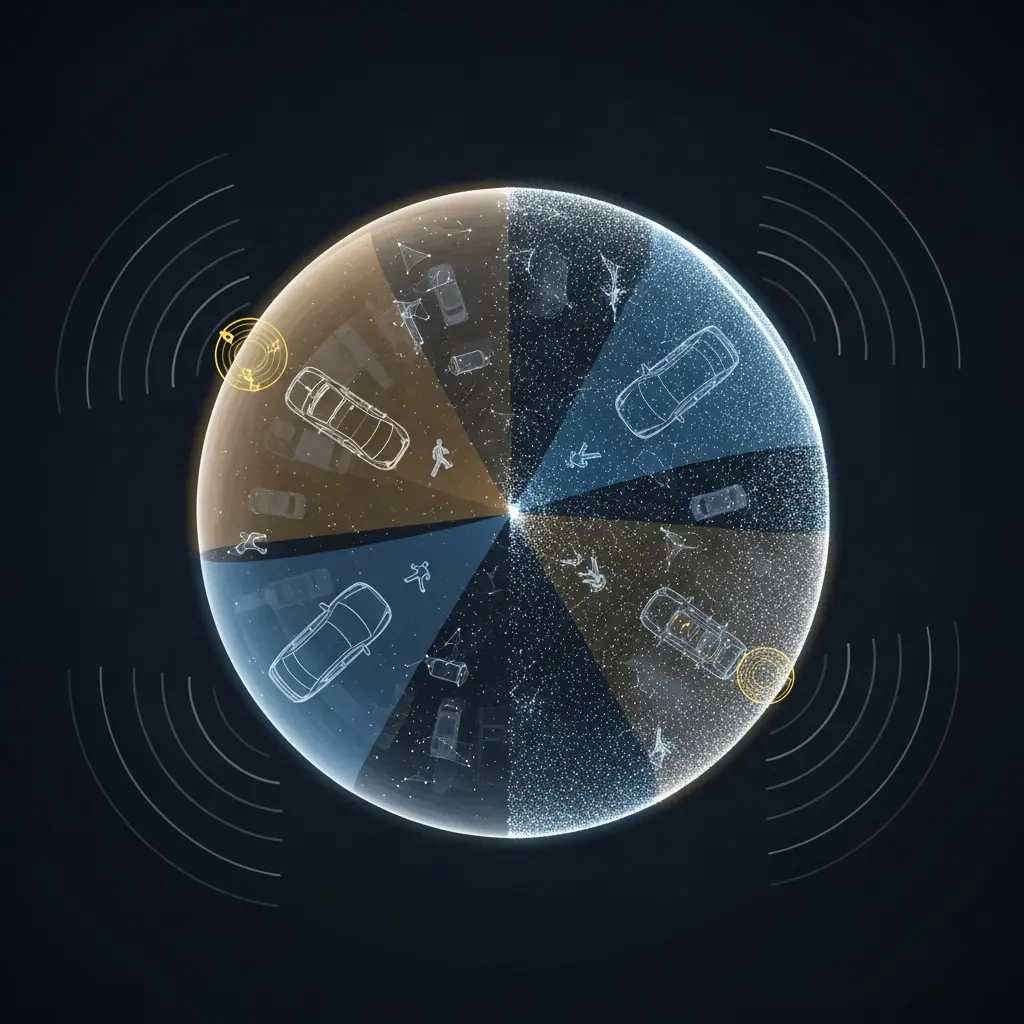
Transformer-based architectures increasingly dominate fields like computer vision and natural language processing, yet their deployment in safety-critical automotive systems demands rigorous attention to reliability. Sven Kirchner, Nils Purschke, and colleagues from the Technical University of Munich, alongside Chengdong Wu and Alois Knoll, address this challenge with a novel framework for building fault-tolerant Transformers. Their research details how multimodal foundation models can exploit the inherent diversity and redundancy of automotive sensors to maintain operational capability even when individual components fail. By fusing information from multiple encoders into a shared representational space, the team demonstrates a pathway towards structurally embedding redundancy , a crucial step in bridging the gap between cutting-edge deep learning and the stringent safety requirements of autonomous driving, ultimately enabling the development of certifiable systems.
The research team addresses the challenges of deploying deep learning in safety-critical applications like autonomous driving by introducing a framework that leverages multimodal Foundation Models and structural redundancy. This innovative approach combines independent, modality-specific encoders which fuse their data into a shared latent space, enabling continued operation even if one sensor modality fails. Experiments demonstrate how diverse input modalities can be effectively integrated to maintain consistent and reliable scene understanding, a crucial element for autonomous vehicle perception.
Bridging AI Deep Learning with Functional Safety Standards
Bridging AI Techniques with Functional Safety Standards
The study establishes a conceptual framework bridging the gap between modern deep learning techniques and established functional safety practices, specifically referencing ISO 26262 standards. Researchers outline how sensor diversity and redundancy can be harnessed through multimodal Foundation Models to improve fault tolerance, a critical requirement for autonomous systems. Their proposed architecture utilizes multiple independent encoders, each dedicated to a specific input modality, such as RGB images, LiDAR point clouds, or monocular depth maps, and maps these raw inputs into a common latent space. This shared latent space facilitates fail-operational behaviour, ensuring the system can continue functioning, albeit potentially at a reduced capacity, even if one or more sensor modalities experience degradation or failure.
This work innovates by embedding redundancy and diversity at the representational level, rather than relying on traditional hardware or software redundancy. The team formally defines the system with modality-specific encoders (Ei) mapping inputs (Xi) to a shared latent space (Z), followed by modality-agnostic decoders (Dj) translating the latent representation to outputs (Yj) like semantic segmentation or driving commands. This decoupling of encoding and decoding allows for modularity, verifiable independence between signal paths, and controlled redundancy, mirroring the principles of ASIL decomposition outlined in ISO 26262. The architecture achieves intrinsic redundancy, maintaining acceptable performance even with sensor failure, and informational enrichment, improving robustness through the fusion of complementary data streams.
Furthermore, the research proves that this approach offers two principal safety benefits: maintaining degraded but acceptable operational performance when a sensor fails and improving the signal-to-noise ratio through the integration of diverse information streams. The independence of the encoder branches structurally aligns with the ISO 26262 requirement for freedom from common cause failures, while the latent-space fusion mechanism provides implicit runtime arbitration of multimodal signals. Ultimately, this multimodal Transformer architecture systematically embeds fault tolerance at the representational level, paving the way for certifiable AI systems and safer autonomous driving technologies.
Multimodal Transformer Architecture for Automotive Safety enhances driver
Scientists engineered a novel multimodal Transformer architecture to enhance fault tolerance and robustness in automotive systems. The research team addressed critical application challenges posed by Transformer-based models by integrating principles of functional safety, specifically those outlined in the ISO 26262 standard. They developed an architecture comprising multiple independent, modality-specific encoders, each mapping raw sensor inputs like RGB images, LiDAR point clouds, and monocular depth maps to a shared latent space Z ⊆ Rd, to support fail-operational behaviour should one modality degrade. These encoders, denoted as Ei : Xi →Z, extract high-level feature representations from heterogeneous sensor data, effectively embedding redundancy at the representational level.
Decoupling Modalities in the Transformer Backbone
Architectural Details: Decoupled Encoding and Fusion
Experiments employed an encoder-decoder design, decoupling modality-specific encoding from latent-space fusion and task-specific decoding via modality-agnostic decoders Dj : Z → Yj. This innovative approach enables modularity and verifiable independence between signal paths, mirroring the architectural redundancy and ASIL decomposition principles of ISO 26262. The study pioneered a method for converting 3D LiDAR point clouds into 2D bird’s-eye-view feature maps, collapsing the data along the z-axis before processing by view-aware Transformer modules. Raw LiDAR data underwent projection onto the camera’s image plane using calibrated extrinsic and intrinsic parameters, followed by refinement stages to densify sparse depth maps and ensure spatial registration with the camera feed.
Furthermore, the team harnessed a standard Vision Transformer to tokenize the fused visual data, creating a unified input stream for the multimodal Transformer backbone. Simultaneously, a Transformer-based language encoder processed textual data, such as driver commands, independently. This ensured coherent contribution of both sensing modalities to the shared latent space by converting LiDAR data into the same representational domain. The system delivers intrinsic redundancy, maintaining degraded but acceptable operational performance even if a sensor fails, and informational enrichment, improving the signal-to-noise ratio through the fusion of complementary data streams. This structural independence of encoder branches directly parallels the ISO 26262 requirement for freedom from common cause failures in redundant subsystems.
Achieving Robust Fail-Operational Automotive Performance
Multimodal Transformers Achieve Automotive Functional Safety by leveraging
Achieving Robust, Fail-Operational Automotive Performance
Scientists have developed a novel multimodal Transformer architecture designed to enhance fault tolerance and robustness in automotive systems. The research demonstrates how multiple independent, modality-specific encoders can fuse representations into a shared latent space, enabling fail-operational behaviour even if one modality experiences degradation. Experiments revealed that by embedding redundancy and diversity at the representational level, this approach bridges the gap between deep learning and established functional safety practices. The team measured the performance of this architecture using principles aligned with the ISO 26262 standard for functional safety, specifically focusing on architectural redundancy and ASIL decomposition.
Results confirm the possibility of decomposing a system into independent subsystems, mirroring conventional safety practices reliant on redundant subsystems and runtime monitoring. Formally, the study defines modality-specific branches, denoted as Ei : Xi →Z, mapping raw inputs to a shared latent space Z ⊆Rd, facilitating attention-based fusion and unified context-rich representations. Downstream tasks are then handled by modality-agnostic decoders Dj : Z → Yj, where Yj represents the target output space, such as semantic segmentation maps or 3D bounding boxes. Data shows that this explicit decoupling of encoding, fusion, and decoding enables modularity and verifiable independence between signal paths.
The research highlights two key safety benefits: intrinsic redundancy, where remaining encoders maintain performance if one modality fails, and informational enrichment, where fusion improves the signal-to-noise ratio and mitigates uncertainty. Measurements confirm that the independence of encoder branches structurally parallels the ISO 26262 requirement for freedom from common cause failures in redundant subsystems. Furthermore, the study details the implementation of this architecture, including the projection of LiDAR point clouds onto the camera’s image plane to generate a sparse depth map, subsequently refined and spatially registered with the camera feed. This process converts LiDAR data into the same representational domain as the camera feed, ensuring coherent contribution to the shared latent space. Tests prove that this design enables robust fallback capabilities, maintaining consistent scene understanding even with degraded camera input, and allows seamless integration with existing pretrained vision, language models without architectural changes.
🗞 Towards Safety-Compliant Transformer Architectures for Automotive Systems
🧠 ArXiv: https://arxiv.org/abs/2601.18850



See today’s quantum computing news on Quantum Zeitgeist for the latest breakthroughs in qubits, hardware, algorithms, and industry deals.



