Researchers are tackling the challenge of maintaining robust communication in rapidly changing Unmanned Aerial Vehicle (UAV) networks. Huixiang Zhang from Lakehead University, alongside Mahzabeen Emu and Octavia A. Dobre from Memorial University of Newfoundland, et al., present a novel two-stage framework that leverages quantum annealing to optimise network topology, a critical step towards reliable, time-sensitive data exchange in dynamic environments. This work is significant because it moves beyond traditional, computationally expensive methods, offering a faster and more adaptable solution by generating a diverse range of potential network configurations and swiftly selecting the best one based on real-time conditions. Their findings demonstrate a substantial performance improvement, with up to a 6.6% retention increase in dynamic scenarios and a 28.3% boost in solution diversity, paving the way for resilient next-generation UAV communication systems.
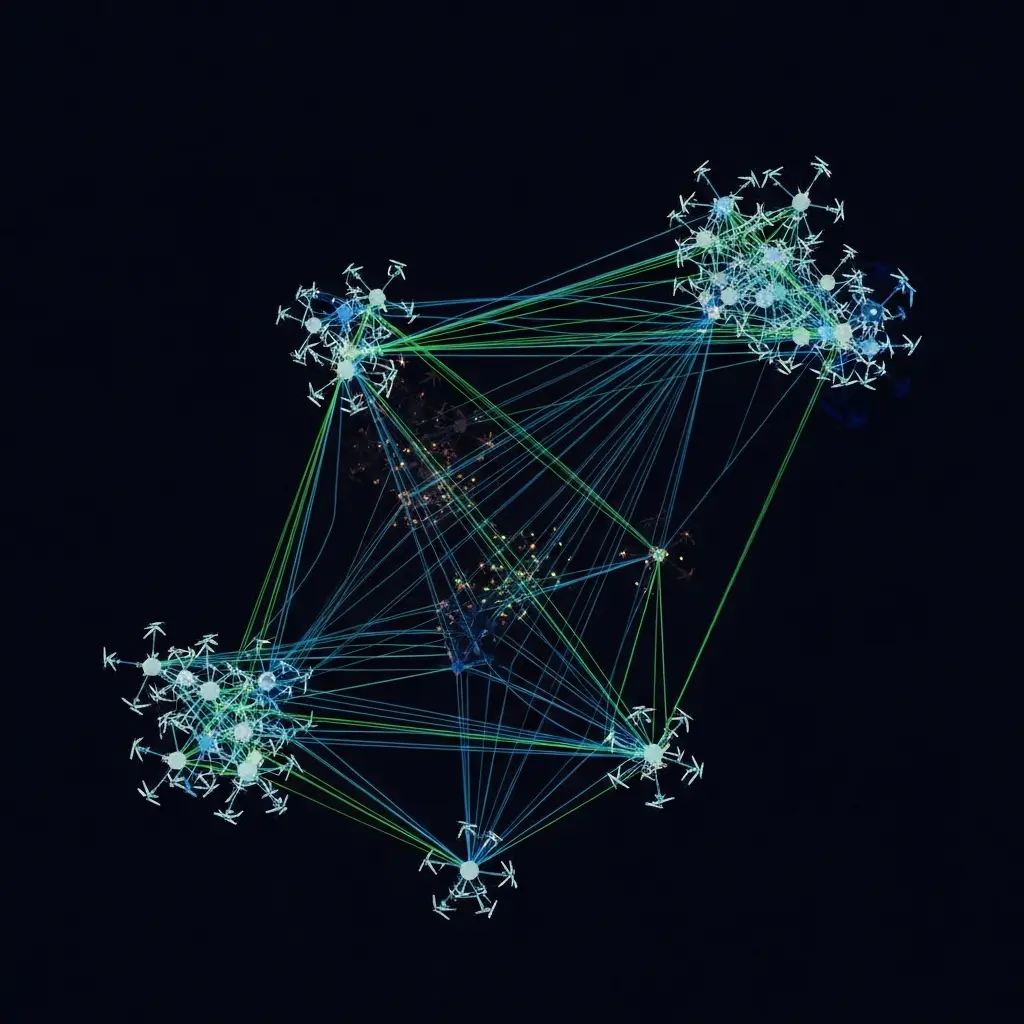
Existing topology control methods often struggle with the rapid changes, fluctuating link quality, and time-critical data exchange inherent in next-generation UAV communication networks, relying on computationally expensive global optimization or single optimal topologies. This research addresses these limitations by exploiting quantum parallelism to generate a diverse set of high-quality candidate topologies, enabling faster and more robust network reconfiguration. The team achieved this by formulating the UAV topology control problem as a Quadratic Unconstrained Binary Optimization (QUBO) model, perfectly suited for execution on Quantum annealing (QA) hardware.
In the offline stage, the researchers utilized QA to simultaneously sample multiple high-quality and structurally distinct topologies, creating a rich solution space for adaptive decision-making, a significant departure from classical methods that explore configurations sequentially. This innovative approach incorporates penalty terms within the QUBO model to ensure balanced load distribution, mitigate node overload risks, and prevent single-point failures, all critical for maintaining stability in dynamic environments. The study unveils that this quantum-assisted framework generates a structurally diverse set of topologies, providing the online stage with more options to match current network conditions and improve overall resilience. A lightweight classical selection mechanism then rapidly identifies the most suitable topology based on real-time link stability and Signal-to-Interference-plus-Noise Ratio (SINR), substantially reducing computational delay and enabling continuous adaptation.
Experiments show that, compared to a single static optimal topology, the proposed framework improves performance retention by 6.6% within a 30-second dynamic window. Moreover, relative to the classic simulated annealing method, quantum annealing achieves an additional 5.15% reduction in objective value and a remarkable 28.3% increase in solution diversity. These findings demonstrate the potential of QA to enable fast and robust topology control, paving the way for next-generation UAV communication networks capable of operating reliably in challenging and unpredictable conditions. The research establishes a clear path towards integrating quantum computing with UAV network management, offering a significant advancement in the field of aerial communications and coordination. The research team formulated the UAV topology control problem as a Quadratic Unconstrained Binary Optimization (QUBO) model, specifically designed for implementation on quantum annealing (QA) hardware. This QUBO formulation enabled parallel exploration of potential topologies, a significant departure from sequential classical methods like simulated annealing. During the offline stage, researchers harnessed the power of quantum annealing to simultaneously sample multiple high-quality and structurally diverse topologies, creating a robust solution space for real-time adaptation.
The QUBO model incorporated penalty terms to enforce
The QUBO model incorporated penalty terms to enforce load balancing across the UAV network, minimising the risk of node overload and single-point failures, critical considerations in rapidly changing environments. To further enhance diversity, an iterative similarity penalty mechanism was employed within the QA process, encouraging the generation of complementary topologies and preventing convergence on similar solutions. This innovative approach yielded a 28.3% increase in solution diversity compared to classic methods. Subsequently, the study pioneered a lightweight classical selection mechanism for the online stage, rapidly identifying the optimal topology from the pre-computed set based on real-time link stability and Signal-to-Interference-plus-Noise Ratio (SINR) measurements.
Experiments employed a 30-second dynamic window to evaluate performance, demonstrating a 6.6% improvement in performance retention when utilising the proposed framework compared to a single static optimal topology. Furthermore, QA achieved a 5.15% reduction in objective value, indicating a more efficient and optimised solution. The research addresses the challenge of maintaining reliable connectivity amidst rapid topology changes and fluctuating link quality, a critical need for next-generation UAV communication. Experiments revealed that, compared to a single static optimal topology, the proposed framework improves performance retention by 6.6% within a 30-second dynamic window, demonstrating a significant advancement in network stability. The team formulated the UAV topology control problem as a Quadratic Unconstrained Binary Optimization (QUBO) model, enabling parallel exploration of potential solutions using quantum annealing.
This approach contrasts with sequential classical methods, allowing the system to simultaneously assess numerous topologies and escape locally optimal, fragile configurations. Measurements confirm that QA achieves an additional 5.15% reduction in objective value, indicating a more efficient optimisation process, and a substantial 28.3% increase in solution diversity, providing a richer selection of adaptable network configurations. This diversity is crucial for mitigating the impact of node failures or changing channel conditions. Results demonstrate the framework’s ability to generate a set of high-quality, structurally diverse candidate topologies offline, decoupling intensive computation from real-time decision-making.
A lightweight classical selection mechanism then rapidly identifies the most suitable topology based on real-time link stability and Signal-to-Interference-plus-Noise Ratio (SINR), substantially reducing computational delay during deployment. The study highlights the potential of QA to enable fast and robust topology control, allowing UAVs to switch configurations with minimal cost and maintain continuous adaptation to dynamic environments. Furthermore, the work incorporates penalty terms within the QUBO model to ensure load balancing, reduce node overload risk, and avoid single-point failures, critical for preventing communication degradation in rapidly changing networks. The framework aligns with Software-Defined Networking (SDN) and Open Radio Access Network (O-RAN) architectures, suggesting a pathway towards practical implementation and deployment in real-world scenarios. The research introduces a method for generating diverse and robust network topologies offline, then selecting the most appropriate one in real-time based on current conditions. This approach utilises Quadratic Unconstrained Binary Optimisation (QUBO) and quantum annealing (QA) to create multiple high-quality topologies, offering a solution space for adaptive decision-making, a departure from traditional single-optimisation methods. The findings demonstrate a 6.6% improvement in performance retention over a 30-second dynamic window when compared to a static optimal topology.
Furthermore, the QA method achieved a 5
Furthermore, the QA method achieved a 5.15% reduction in the objective value and a 28.3% increase in solution diversity, indicating enhanced robustness and adaptability. The authors acknowledge limitations related to scalability and latency, particularly concerning the size of networks that can be effectively handled by current quantum hardware. Future research will focus on addressing these limitations through a hierarchical hybrid scheme, combining QUBO-based optimisation for intra-swarm topology with classical methods for inter-swarm coordination.
🗞 Quantum Takes Flight: Two-Stage Resilient Topology Optimization for UAV Networks
🧠 ArXiv: https://arxiv.org/abs/2601.19724


See today’s quantum computing news on Quantum Zeitgeist for the latest breakthroughs in qubits, hardware, algorithms, and industry deals.