

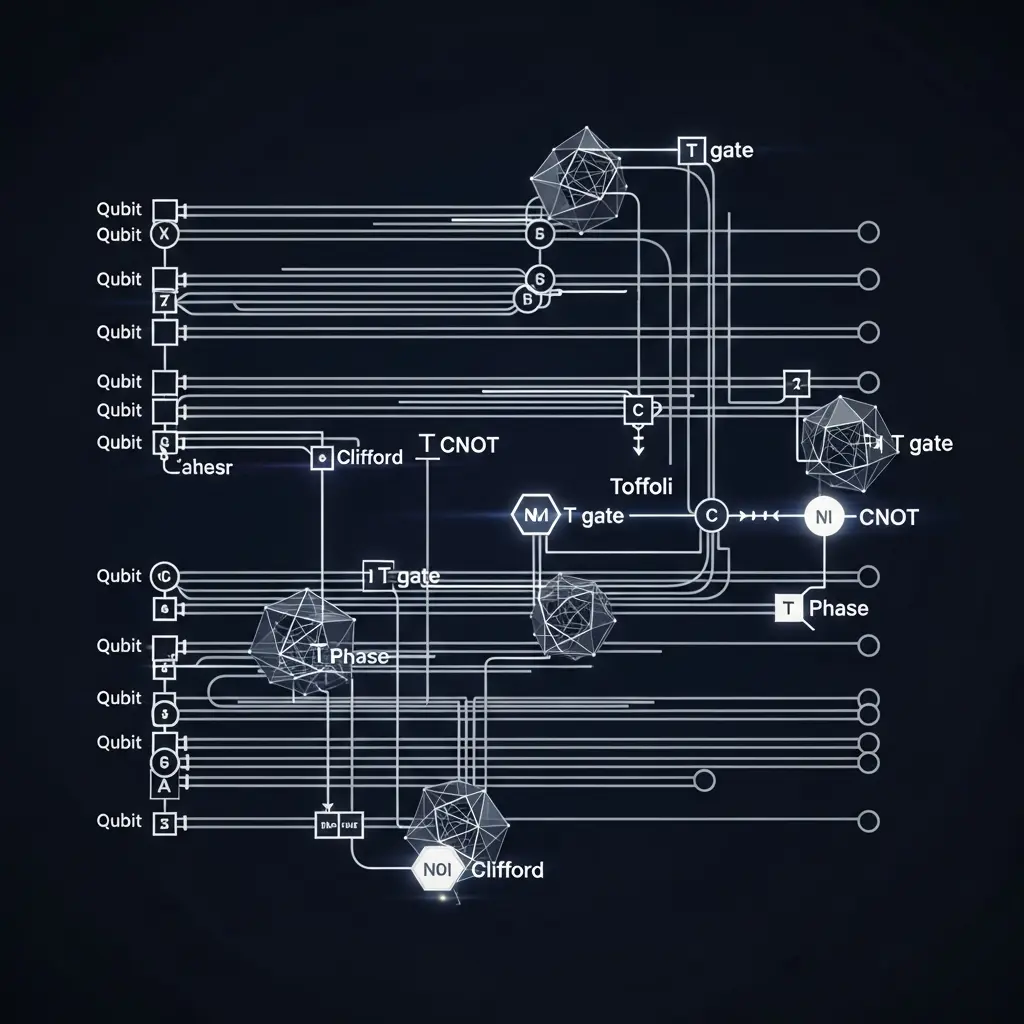
Reducing the number of costly gates remains a critical challenge for realising practical, fault-tolerant quantum computation. Daniele Lizzio Bosco, Lukasz Cincio, and Giuseppe Serra, alongside M. Cerezo, from the University of Udine and Los Alamos National Laboratory, present a novel approach to optimising quantum circuits before they are compiled into fundamental gate operations. Their research introduces Q-PreSyn, a reinforcement learning strategy that intelligently applies local edits to a circuit’s structure, aiming to minimise the resulting -count , a key metric impacting the feasibility of running complex algorithms. By learning effective sequences of these edits, the team demonstrates significant reductions in -count, up to 20% on circuits containing 25 qubits, without compromising computational accuracy, potentially unlocking the ability to execute larger and more sophisticated quantum programs.
Their research introduces Q-PreSyn, a Reinforcement learning strategy that intelligently applies local edits to a circuit’s structure, aiming to minimise the resulting -count, a key metric impacting the feasibility of running complex algorithms.
Reinforcement learning cuts quantum circuit T-gate count significantly
Scientists have demonstrated a groundbreaking strategy to optimise quantum circuits, potentially unlocking significant advancements in fault-tolerant quantum computing. This breakthrough addresses a critical bottleneck in quantum computation, where the sheer number of T gates often determines whether a circuit can be executed successfully. The study unveils a method where equivalent circuit representations are strategically modified through local merge operations, preserving the overall computation while altering its structure to facilitate more efficient synthesis.
This improvement stems from the agent’s ability to discover long-term dependencies between merge operations, surpassing the performance of simpler, greedy approaches. This work contributes a universal pre-synthesis stage compatible with diverse compilation pipelines, offering a significant advantage for near-term quantum devices where T gates dominate computational cost. Furthermore, the researchers have made all code publicly available, enabling the wider quantum computing community to reproduce their results and build upon this innovative methodology. The implications of this research extend beyond immediate performance gains; it opens avenues for developing more sophisticated quantum compilers capable of automatically optimising circuit representations for specific hardware architectures. This innovative approach promises to be a valuable tool for researchers and developers working to overcome the challenges of building practical quantum computers.
Reinforcement Learning for T-gate Reduction in Circuits
The research tackles the challenge of minimising T-gate count, a dominant cost in near-term implementations, by intelligently reshaping circuits before applying standard synthesis algorithms. The study pioneered a method where the RL agent learns sequences of local edits, specifically merge operations, that preserve circuit equivalence while altering its structure. Experiments employed a planning problem formulation, framing the reduction of the final T-count as a goal for the RL agent to achieve. The team engineered a system where the agent iteratively applies merge operations, evaluating the resulting circuit’s T-count after synthesis to refine its strategy.
Researchers harnessed a dataset of quantum circuits with up to 25 qubits to validate Q-PreSyn’s performance. Crucially, the method is designed as a universal pre-processing step, compatible with diverse compilation pipelines and synthesis algorithms. The work demonstrates that learning-guided structural transformations can significantly enhance synthesis efficiency across various applications, including Clifford+T synthesis of general unitaries, real-time evolutions, and matchgate synthesis.
Q-PreSyn reduces T-count in quantum circuits by optimizing
The team measured the impact of Q-PreSyn by exploring equivalent circuit representations through unitary-preserving merge operations. These operations modify the circuit’s local structure, influencing the efficiency of subsequent synthesis. Results demonstrate that formulating the task of minimising T-count as a planning problem, and employing reinforcement learning (RL), effectively identifies advantageous sequences of these merge operations. Specifically, the RL agent learns to identify circuit representations that yield a reduced T-count upon synthesis, showcasing a consistent improvement across various Clifford+T synthesis scenarios.
Tests prove that the method consistently improves post-synthesis efficiency across general unitaries, real-time evolutions, and diverse circuit structures. Data shows that Q-PreSyn successfully navigates the space of equivalent circuit representations, identifying those that enable more efficient synthesis and lower T-counts. The research formalised the problem of finding advantageous merge sequences as a plan optimisation task, allowing the RL-based strategy to outperform greedy approaches and uncover long-term dependencies between merges.
Q-PreSyn Reduces T-Count via Reinforcement Learning, achieving state-of-the-art
This represents a substantial improvement in compilation pipelines for fault-tolerant quantum computing, potentially enabling the execution of circuits previously considered too resource-intensive. The authors acknowledge that the performance of Q-PreSyn is dependent on the specific circuit representation and synthesis algorithm used, and further investigation is needed to explore its scalability to larger and more complex circuits. Future research directions include exploring different reinforcement learning algorithms and reward functions to further optimise the merge sequence selection process, and investigating the application of Q-PreSyn to other quantum circuit optimisation tasks.
👉 More information
🗞 Quantum Circuit Pre-Synthesis: Learning Local Edits to Reduce -count
🧠 ArXiv: https://arxiv.org/abs/2601.19738




See today’s quantum computing news on Quantum Zeitgeist for the latest breakthroughs in qubits, hardware, algorithms, and industry deals.



