

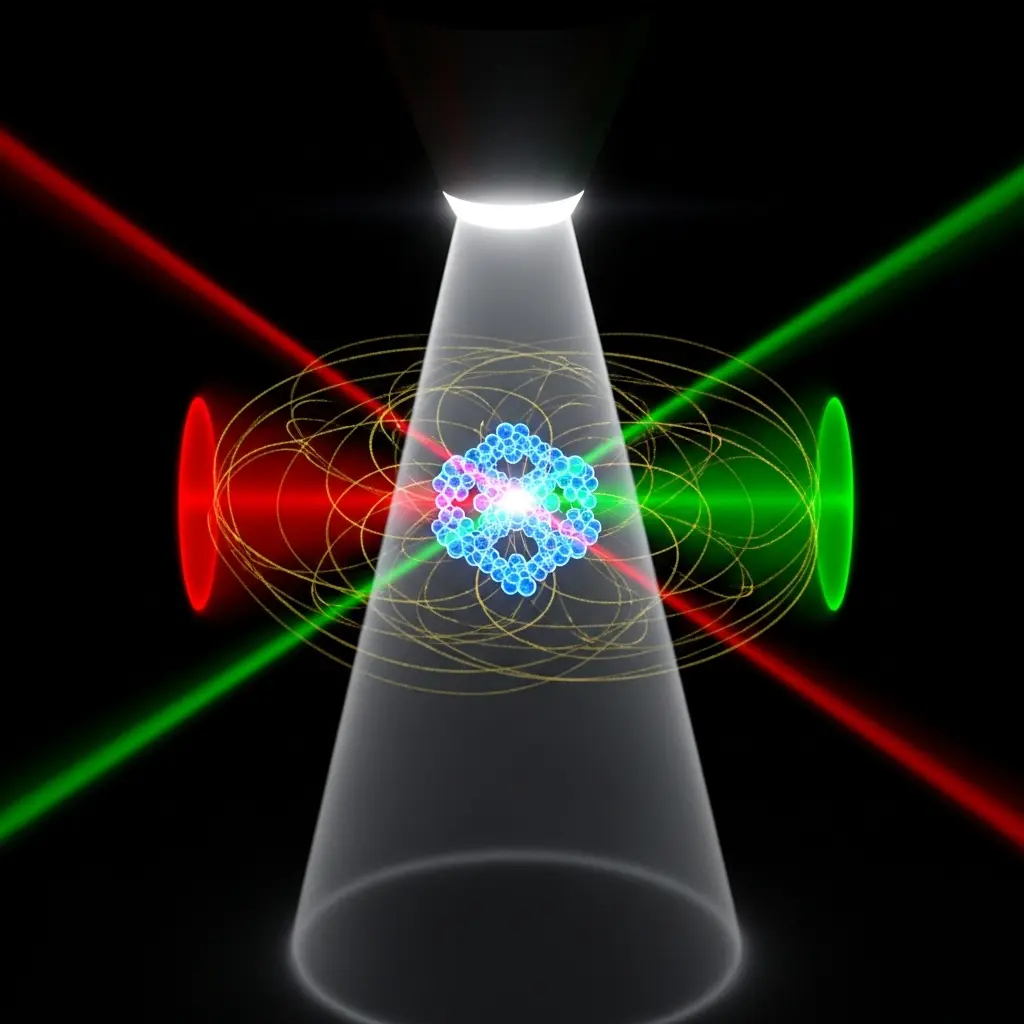
Researchers are tackling a critical challenge in scaling up quantum computers based on neutral atoms, specifically the loss of coherence in qudits, quantum bits with more than two levels. Enrique A. Segura Carrillo (JILA, NIST, and University of Colorado), Eric J. Meier (Los Alamos National Laboratory), and Michael J. Martin (University of New Mexico) et al. demonstrate a novel approach using ‘bichromatic tweezers’ to create ‘magic trapping’ conditions. This innovative technique suppresses disruptive light shifts across multiple energy levels, effectively stabilising qudits encoded in strontium atoms and paving the way for more complex and reliable quantum computations. By carefully balancing two wavelengths of light, the team achieves unprecedented control over atomic interactions, promising enhanced cooling, improved loading and significantly extended coherence times essential for building powerful qudit-based quantum processors.
demonstrate a novel approach using ‘bichromatic tweezers’ to create ‘magic trapping’ conditions. By carefully balancing two wavelengths of light, the team achieves unprecedented control over atomic interactions, promising enhanced cooling, improved loading and significantly extended coherence times essential for building powerful qudit-based quantum processors.
Bichromatic Tweezers Suppress Light Shifts for Qudits
Current methods for creating these stable trapping conditions are inadequate for hyperfine qudits, compromising their coherence and limiting their potential for quantum computation. The team achieved this breakthrough by meticulously controlling the interaction between light and strontium-87 atoms, leveraging the atom’s large nuclear spin manifold. Experiments show that by utilizing bichromatic tweezers, it is possible to mitigate the detrimental effects of tensor light shifts, which typically lead to unwanted qudit operations and reduced state fidelity. The researchers developed a Hamiltonian describing the system, incorporating Zeeman and light shift terms, and demonstrated how precise control of light polarization and wavelength can effectively cancel out differential light shifts.
The study unveils that this method not only enhances coherence times but also paves the way for new loading protocols and improved cooling efficiency. By suppressing light-shift induced dephasing, the research establishes a pathway to enhance nuclear spins’ coherence times, thus facilitating qudit-based quantum computing in strontium-87 within the 5s5p 3P2 manifold. This advancement is particularly significant given strontium-87’s large nuclear spin manifold (dimension d = 10), which offers a promising platform for developing advanced quantum computing architectures. The work opens exciting possibilities for building more stable and scalable quantum computers based on neutral atoms. By addressing the critical issue of light-shift induced decoherence, this technique promises to unlock the full potential of qudits as competitive quantum computing resources. Scientists anticipate that this approach will not only improve the performance of existing quantum systems but also enable the development of novel state-selective potentials and large-scale, controllable atomic arrays via optical tweezers, ultimately accelerating progress in the field of quantum information science.
Bichromatic Tweezers Suppress Light Shifts in Strontium Qudits
Scientists engineered a novel bichromatic tweezer technique to address decoherence in strontium-87 (⁸⁷Sr) qudits, crucial for advancing qudit-based quantum computing. Experiments employed a bichromatic optical tweezer setup, meticulously designed to control the polarization and intensity of the tweezer beams. The team selected two wavelengths, optimizing their ratio to cancel out the differential light shifts experienced by the ⁸⁷Sr atoms in various hyperfine states.
This precise control was achieved through careful calibration of laser power and wavelength, ensuring the suppression of unwanted light-induced transitions and maintaining coherence. The technique reveals a pathway to enhance cooling efficiency and extend nuclear spin coherence times, vital for scaling up qudit-based quantum computations. Researchers harnessed the large magnetic dipole moment of the 5s5p ³P₂ state for potentially faster gate operations, while simultaneously mitigating the detrimental effects of tensor light shifts. The experimental setup involved precise control over the magnetic field and laser polarization, allowing for the accurate manipulation of the atomic states and the verification of the achieved magic conditions. This work details the implementation of a Hamiltonian, H = HZeeman + HLS, where HZeeman represents the Zeeman interaction and HLS the light shift Hamiltonian, expressed in a coordinate-invariant form to accurately model the atomic energy levels and light-induced perturbations.
Bichromatic Tweezers Suppress Light Shifts for Qudits, enhancing
The team measured a quadratic light shift dependency on the nuclear spin mF, finding it to be on the scale of 0.3MHz for a 1mW laser power and 1.0 micron beam waist. Specifically, calculations confirm that the combined wavelengths yield a highly robust tensor shift null, where off-diagonal elements of the light shift Hamiltonian are negligible, demonstrating optical tweezer insensitivity to power and angle fluctuations to second-order. This level of control is crucial for maintaining qudit coherence during manipulation and computation. Researchers achieved this by simultaneously implementing conditions that reduce total differential light shift in three ways: selecting wavelengths with opposite tensor light shift signs, balancing intensity to eliminate the net tensor shift, and tuning β to β0 with δβ = 2 × 10⁻² radians under practical magnetic field magnitudes. The work demonstrates a 99.9% state fidelity, achieved through suppression of tensor-induced dephasing.
Bichromatic Tweezers Stabilise Strontium Qubit Coherence times
This approach addresses a significant limitation of current methods, which struggle to maintain coherence in qudits encoded in hyperfine states. Detailed calculations, including estimates of Rayleigh scattering and decoherence rates presented in Table IV, confirm the mitigation of decoherence when operating at the magic angle. The significance of this research lies in its potential to enhance the fidelity and scalability of qudit-based quantum technologies. By suppressing light-induced dephasing, a major source of error in atomic qubit systems, the technique promises to improve the performance of quantum sensors, simulators, and computers. The authors acknowledge that maintaining the required magnetic field of less than 5 Gauss is crucial for optimal performance, and that the technique necessitates operation within the Paschen-Back regime. Future research directions include exploring the implementation of this scheme in larger atomic arrays and investigating its compatibility with other quantum control techniques, ultimately aiming to unlock the full potential of qudit-based quantum information processing in strontium.
👉 More information
🗞 Bichromatic Tweezers for Qudit Quantum Computing in Sr
🧠 ArXiv: https://arxiv.org/abs/2601.16328




See today’s quantum computing news on Quantum Zeitgeist for the latest breakthroughs in qubits, hardware, algorithms, and industry deals.



