

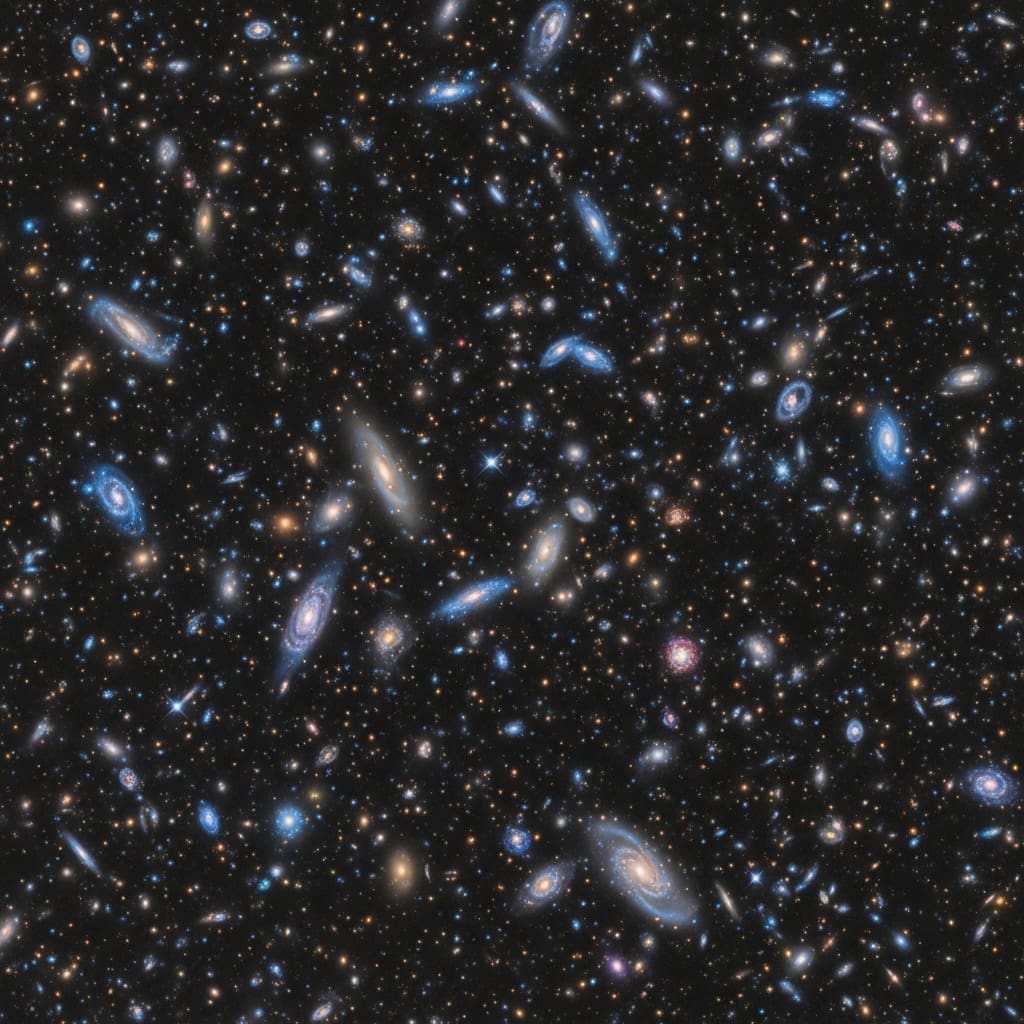
Scientists have unveiled the most detailed photometric catalogue to date, stemming from the JWST Advanced Deep Extragalactic Survey (JADES) Data Release 5. Led by Brant E Robertson from the University of California, Santa Cruz, alongside Benjamin D Johnson and Sandro Tacchella of the Kavli Institute for Cosmology, University of Cambridge, et al, this comprehensive dataset combines over 1250 hours of observations from the James Webb Space Telescope and Hubble Space Telescope. The resulting catalogue, publicly available via the Mikulski Archive, significantly advances our understanding of early galaxy formation by providing precise measurements of source characteristics and photometric uncertainties , crucial for accurately determining distances and properties of the most distant galaxies ever observed.
They employed custom signal-to-noise-based algorithms optimized for the depth, resolution, and complex point-spread-function structure of JWST imaging. For every source in each band, the study provided forced circular-aperture photometry, ellipsoidal Kron photometry, and curve-of-growth measurements. Experiments revealed a novel approach to source detection and deblending, employing custom signal-to-noise-based algorithms optimized for the unique characteristics of JWST imaging. The team measured photometric data using forced circular-aperture photometry, ellipsoidal Kron photometry, and curve-of-growth measurements for every source in each band, providing a comprehensive dataset for further investigation. This framework allows for more precise uncertainty estimation, crucial for accurate redshift determination and characterization of faint sources.
Tests prove the efficacy of the Gaussian regression method in accurately modeling source profiles, as illustrated by object ID=615 in the GOODS-S region. The team recorded that the method provides estimates of source sizes used for constraining photometric apertures and delivers an actual model for the source SNR profile, allowing for direct assessment of accuracy via residual analysis. Specifically, the algorithm converged to within floating-point precision within a maximum of ten iterations, showcasing its computational efficiency and stability. The χ2W metric, defined as X i [zi log zi −zi(αx2 i + 2βxiyi + γy2 i + δ)]2, was utilized to optimize the Gaussian fitting process, ensuring a precise determination of source parameters. The apodization process, employing a circular Tukey filter with α = 0.1 and λ = 0. Additionally, the forced circular-aperture and ellipsoidal Kron photometry, along with curve-of-growth measurements, offer robust and comprehensive data on source properties. However, the authors acknowledge some limitations, such as the need for further validation of the detection completeness at very faint magnitudes. Future research directions include extending these methodologies to other fields and integrating them into broader astronomical surveys to improve our overall understanding of the cosmos.
👉 More information
🗞 JWST Advanced Deep Extragalactic Survey (JADES) Data Release 5: Photometric Catalog
🧠 ArXiv: https://arxiv.org/abs/2601.15956


