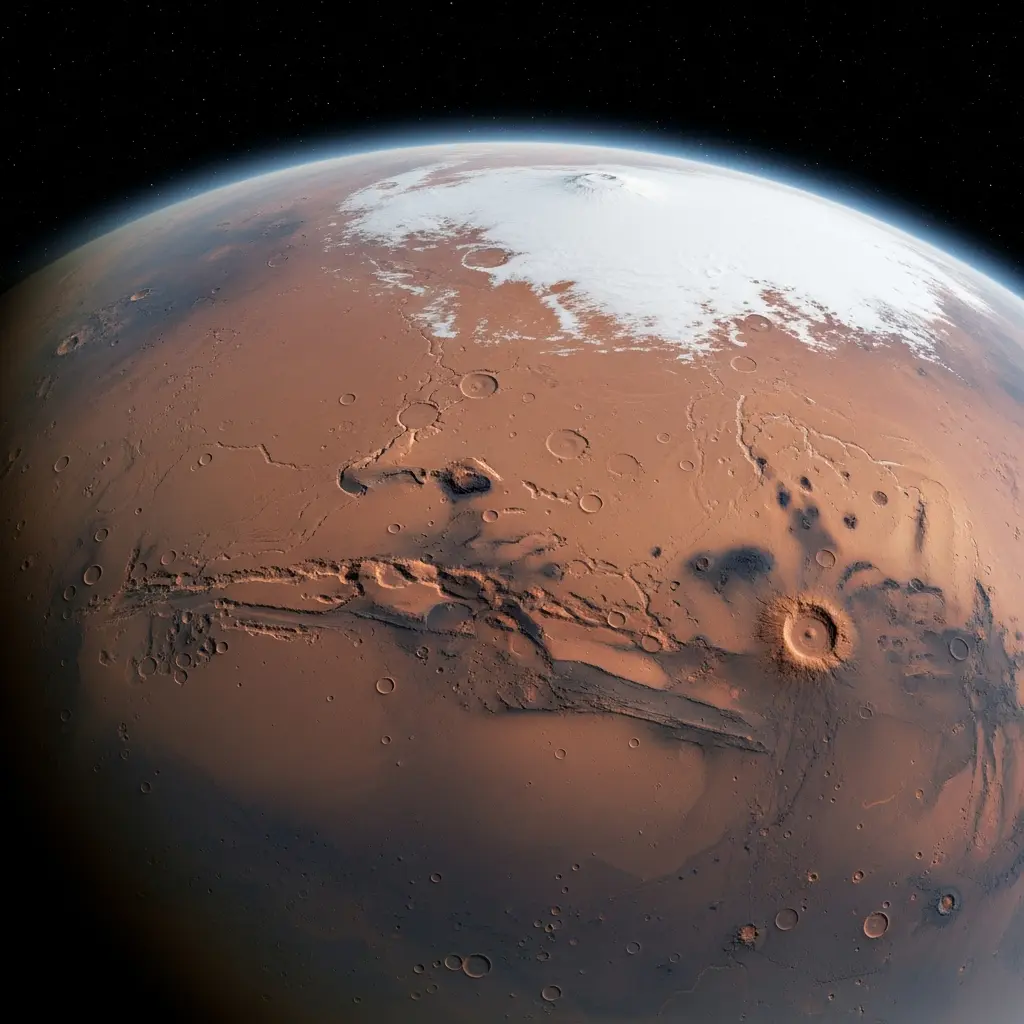
Scientists are tackling the challenge of efficiently analysing planetary surfaces, often relying on broad semantic concepts despite image archives being organised at the pixel level. Yiran Wang, Shuoyuan Wang, and Zhaoran Wei, from the School of Science at Southern University of Science and Technology, alongside Jiannan Zhao, Zhonghua Yao, and Zejian Xie et al., have developed MarScope , a novel vision-language framework for natural language-driven mapping of Martian landforms. This research is significant because it moves beyond pre-defined classifications, allowing users to query the entire Martian surface with flexible semantic searches in just five seconds, achieving impressive F1 scores up to 0.978. By aligning images and text in a shared semantic space, trained on over 200,000 curated pairs, MarScope establishes a new paradigm for scientific discovery using massive geospatial datasets and facilitates both process-oriented analysis and similarity-based geomorphological mapping at a planetary scale.
At its core, MarScope employs a contrastive vision-language encoder, learning high-dimensional embeddings that capture the diagnostic aspects of surface morphology, effectively bridging the gap between visual patterns and linguistic concepts. This transition from pixel-based imaging to structured semantic understanding enables the global mapping of any feature at any given time, unlocking new possibilities for planetary science. To cater to diverse scientific needs, MarScope supports three distinct query modes: text-based, image-based, and multimodal, allowing for targeted searches based on landform names, formation processes, morphological similarity, or combinations thereof.
Operating on a global mosaic of CTX data, subdivided into overlapping tiles at 0.2° and 0.02° resolutions, the platform efficiently compresses the dataset by a factor of approximately 160, enabling near-instantaneous retrieval. Incoming queries are compared against these tiles using cosine similarity, with the highest-scoring matches projected onto a global map, visualised as point distributions or heatmaps, and readily available for download as training samples for further analysis. Experiments demonstrate MarScope’s exceptional retrieval capabilities when compared against six published global catalogues representing diverse surface processes, including alluvial fans, glacier-like forms, landslides, pitted cones, yardangs, and dark slope streaks. Evaluation using dynamic F1 scores reveals that no single query mode consistently outperforms others across all landforms, highlighting the system’s adaptability and the complexity of Martian geomorphology. This work not only accelerates geomorphological mapping but also lowers the barrier to dataset construction, fostering the development of specialised AI models and ultimately advancing our understanding of the Red Planet’s history and evolution.
Scientists Method
This innovative approach enables arbitrary user queries across the entire Martian surface in just 5 seconds, achieving peak F1 scores of 0.978, demonstrating a significant leap in efficiency and accuracy. Researchers rigorously evaluated slope streaks, due to their small scale, using high-resolution imaging modes to test three distinct retrieval strategies: text queries utilising only the landform name, image queries employing six representative examples, and multimodal queries combining both text and images. Dynamic F1 scores were computed as a function of the top-K retrieved tiles to quantify retrieval fidelity, providing a nuanced assessment of performance across different landform types. The team discovered that no single query mode consistently outperformed others, highlighting the importance of adapting the approach to the specific characteristics of each landform and its representation within the training data.
Pitted cones and yardangs achieved their highest F1 scores with text queries, indicating that their diagnostic morphology is effectively captured by semantic labels, while alluvial fans and landslides benefited from multimodal queries, where visual constraints enhanced performance. Although image-only queries generally underperformed, they still retrieved relevant matches using only six exemplars, demonstrating the robustness of MarScope’s visual embedding space and its ability to generalise from limited visual data. This flexibility, combined with the close spatial correspondence between MarScope outputs and existing catalogues, confirms the framework’s reliability and generalisability for reconstructing Martian landforms rapidly and accurately. The study harnessed MarScope to generate global maps of key Martian landforms across aeolian, glacial-periglacial, volcanic, and tectonic systems, providing a unified framework for investigating broad surface processes. Detailed mapping revealed latitudinal partitioning within the aeolian system, with extensive sand dunes at the poles, dust devil trails forming high-activity belts near 60° N and 60° S, and transverse aeolian ridges and yardangs dominating lower latitudes. Furthermore, the team demonstrated that MarScope reframes geomorphological mapping as an open-ended semantic retrieval problem, enabling coherent, cross-system analysis of Martian surface processes at a planetary scale.
MarScope swiftly maps Mars using natural language
The breakthrough delivers a new paradigm where natural language directly interfaces with scientific discovery over massive geospatial datasets. MarScope utilizes a contrastive vision-language encoder, learning high-dimensional embeddings that capture diagnostic aspects of surface morphology. Tests confirm the platform operates on a global mosaic of CTX data, subdivided into overlapping tiles at 0.2° and 0.02° resolutions, compressing the dataset by a factor of approximately 160. Incoming queries, text, image, or combined, are compared against these tiles using cosine similarity, with results visualized as point distributions or heatmaps.
Researchers evaluated MarScope’s retrieval capabilities against six published global catalogues representing diverse surface processes: alluvial fans, glacier-like forms, landslides, pitted cones, yardangs, and dark slope streaks. The team measured retrieval fidelity using dynamic F1 scores as a function of the top-K retrieved tiles, revealing systematic variations in performance based on landform type. Pitted cones and yardangs achieved peak F1 scores with text queries, indicating strong semantic label capture, while alluvial fans and landslides benefited from multimodal queries with added visual constraints. Image-only queries, despite using only six exemplars, still retrieved relevant matches, highlighting the robustness of the visual embedding space.
Measurements confirm that MarScope enables global mapping of diverse Martian landforms across aeolian, glacial-periglacial, volcanic, and tectonic systems. Global mapping revealed pronounced latitudinal partitioning within the aeolian system, with extensive sand dunes at the poles, dust devil trails forming belts near 60° N and 60° S, and transverse aeolian ridges and yardangs dominating lower latitudes. Slope streaks and wind streaks were also concentrated in specific regions, providing insights into long-term aeolian processes and ancient wind erosion patterns. This work establishes a powerful tool for accelerating planetary science research and dataset construction for specialized AI models.,.
MarScope unlocks language-guided Martian surface exploration with unprecedented
Scientists have developed MarScope, a new vision-language framework for mapping planetary surfaces using natural language queries. The research establishes a new method for planetary mapping, moving beyond traditional, pre-defined classifications towards an open-ended, language-guided approach. The framework’s adaptability suggests it could serve as a foundation for specialized models tailored to specific mission goals or scientific questions, reducing the need for extensive custom model development. Acknowledging limitations, the authors note that MarScope prioritises broad discovery over precise detection, meaning it doesn’t offer pixel-level accuracy in feature delineation. The system’s performance is also influenced by the quality and diversity of its training data, with fixed tile sizes potentially underrepresenting very large or very small features. Future work will focus on expanding the training corpus with higher-resolution imagery and more diverse descriptions to improve robustness and retrieval fidelity, further establishing MarScope as a valuable exploratory interface for planetary science.
👉 More information
🗞 Natural Language-Driven Global Mapping of Martian Landforms
🧠 ArXiv: https://arxiv.org/abs/2601.15949



See today’s quantum computing news on Quantum Zeitgeist for the latest breakthroughs in qubits, hardware, algorithms, and industry deals.