

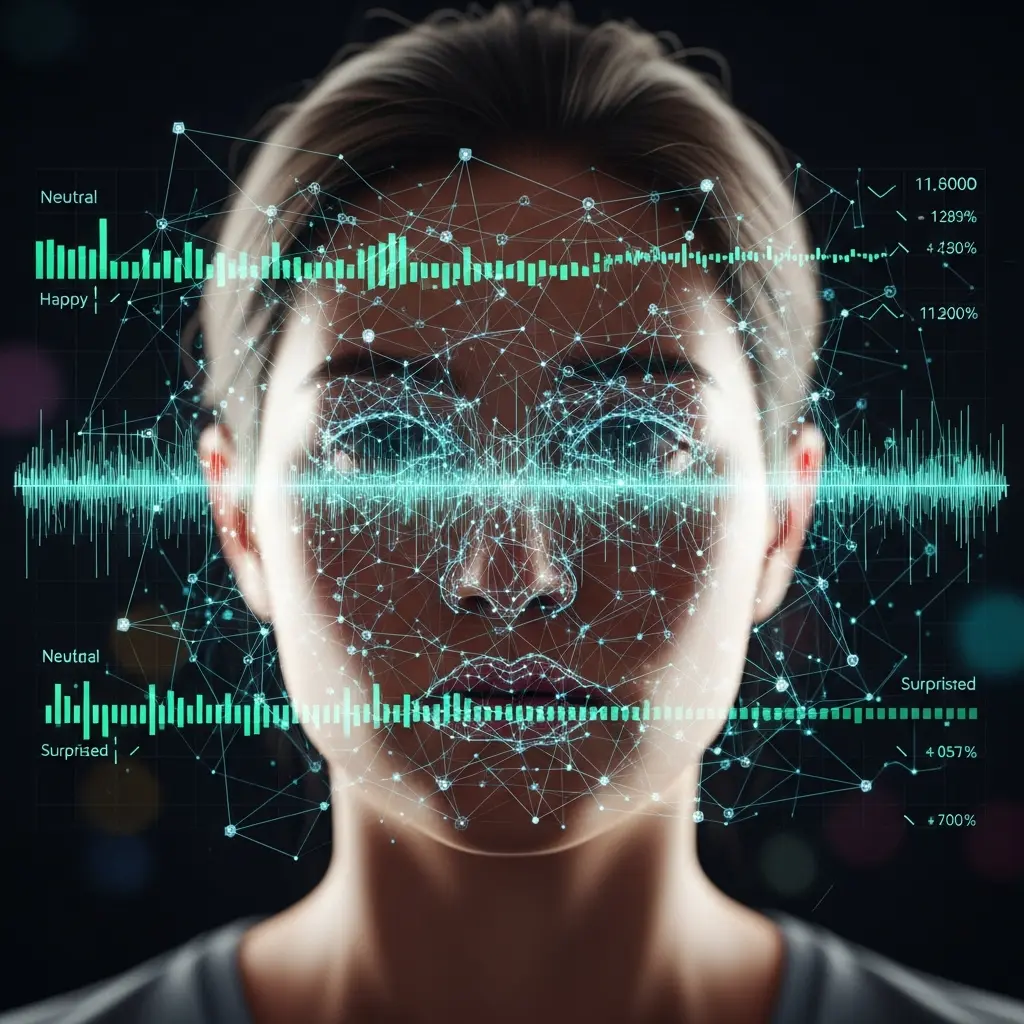
Researchers are increasingly focused on leveraging real-time emotion recognition to enhance social skills training, particularly for individuals with Autism Spectrum Disorder. Yarin Benyamin from Ben-Gurion University of the Negev, alongside colleagues, investigated the feasibility of using readily available Deep Learning models for facial expression recognition on virtual avatars. Their work, detailed in a new benchmarking study utilising the UIBVFED dataset, reveals a significant “Latency Wall” hindering the deployment of accurate and responsive systems , existing models often prioritise precision over the crucial timing needed for effective VR therapy. While face detection proves robust, the team demonstrates that general-purpose Vision Transformers struggle to meet both speed and accuracy requirements, underlining the need for specifically designed, lightweight architectures to unlock accessible, real-time AI in therapeutic applications.
This work establishes a baseline for accessible VR therapy by assessing the performance of various models on commodity hardware, specifically CPU-only inference, to determine viable options for real-time applications. The team achieved a comprehensive analysis of face detection and emotion classification pipelines, employing Medium and Nano variants of YOLO (versions v8, v11, and v12) for initial face identification. Alongside these, general-purpose Vision Transformers, CLIP, SigLIP, and ViT-FER, were rigorously tested to determine their suitability for the task.
Experiments show that while face detection on stylized avatars proved remarkably robust with 100% accuracy, a significant “Latency Wall” emerged during the emotion classification stage. This study reveals a stark contrast in performance between detection and classification, highlighting the difficulty of achieving both low latency and high accuracy with existing models. General-purpose Transformers like CLIP and SigLIP consistently failed to meet the necessary criteria, exhibiting accuracy below 23% and processing times exceeding 150 milliseconds, rendering them unsuitable for real-time VR loops. The research establishes that a significant hurdle exists in deploying accessible, real-time AI for therapeutic settings, demanding the development of lightweight, domain-specific architectures.
A two-stage pipeline was implemented, separating face detection from emotion classification to enable localized emotion inference for multiple faces within a single image. The evaluation focused on zero-shot or pre-trained models, avoiding task-specific fine-tuning to assess their immediate applicability. This methodology allowed for a direct comparison of model performance against the critical 140ms latency threshold, informing the development of future VR-based therapeutic interventions.
Virtual Avatar Emotion Recognition on CPU
To ensure applicability in accessible VR settings, all experiments were conducted on CPU-only inference using a Pop._OS 22.04 LTS machine equipped with a 12th Gen Intel® CoreTM i7-1265U CPU (10 cores, 12 threads) and 32.0 GiB. Results demonstrate that general-purpose Vision Transformers, including CLIP and SigLIP, struggled to meet the requirements for real-time applications, achieving less than 23% accuracy and exceeding 150ms in processing time. Data shows a clear trade-off between latency and accuracy in emotion recognition for virtual characters, highlighting the need for specialized architectures. Tests prove that maintaining contingency, the real-time connection between action and response, is crucial for effective VR therapy, necessitating low motion-to-perception (MTP) latency below 140ms.
Measurements confirm that the two-stage pipeline, consisting of face detection followed by emotion classification, is a viable approach for localized emotion inference at the individual face level. The YOLOv8m, v11m, and v12m models were evaluated for face detection, alongside the Nano variants, to investigate the speed-accuracy trade-off. The breakthrough delivers insights into the limitations of off-the-shelf Deep Learning models when applied to the specific constraints of accessible VR therapy. Further analysis of the UIBVFED dataset, comprising seven categorical emotions, surprise, provided a standardized benchmark for evaluating model performance. The study utilized a zero-shot or pre-trained setting, allowing for immediate assessment of model applicability without task-specific fine-tuning.
Latency limits VR emotion recognition accuracy
Results demonstrated robust face detection across all tested architectures, achieving 100% accuracy, but revealed a significant performance disparity between detection and classification stages. Specifically, the study identified a “Latency Wall” hindering emotion classification, with standard Transformer models exhibiting latencies exceeding the crucial 140ms threshold for maintaining therapeutic agency. YOLOv11n emerged as the most efficient architecture for virtual domains, balancing speed and accuracy, while YOLOv8n proved more versatile for mixed-reality scenarios involving human input. The authors acknowledge limitations stemming from CPU-only inference and the use of a single dataset, potentially impacting generalisability.
Future work should concentrate on knowledge distillation and quantization techniques to create lightweight, domain-specific convolutional neural networks, bridging the gap between accurate perception and real-time responsiveness. This work underscores the necessity for specialized architectures tailored to the constraints of commodity hardware in VR therapy. The findings highlight that off-the-shelf transfer learning approaches are currently unsuitable for achieving the required real-time performance, necessitating a shift towards optimized pipelines and hardware-aware solutions.
👉 More information
🗞 The Latency Wall: Benchmarking Off-the-Shelf Emotion Recognition for Real-Time Virtual Avatars
🧠 ArXiv: https://arxiv.org/abs/2601.15914




See today’s quantum computing news on Quantum Zeitgeist for the latest breakthroughs in qubits, hardware, algorithms, and industry deals.



