

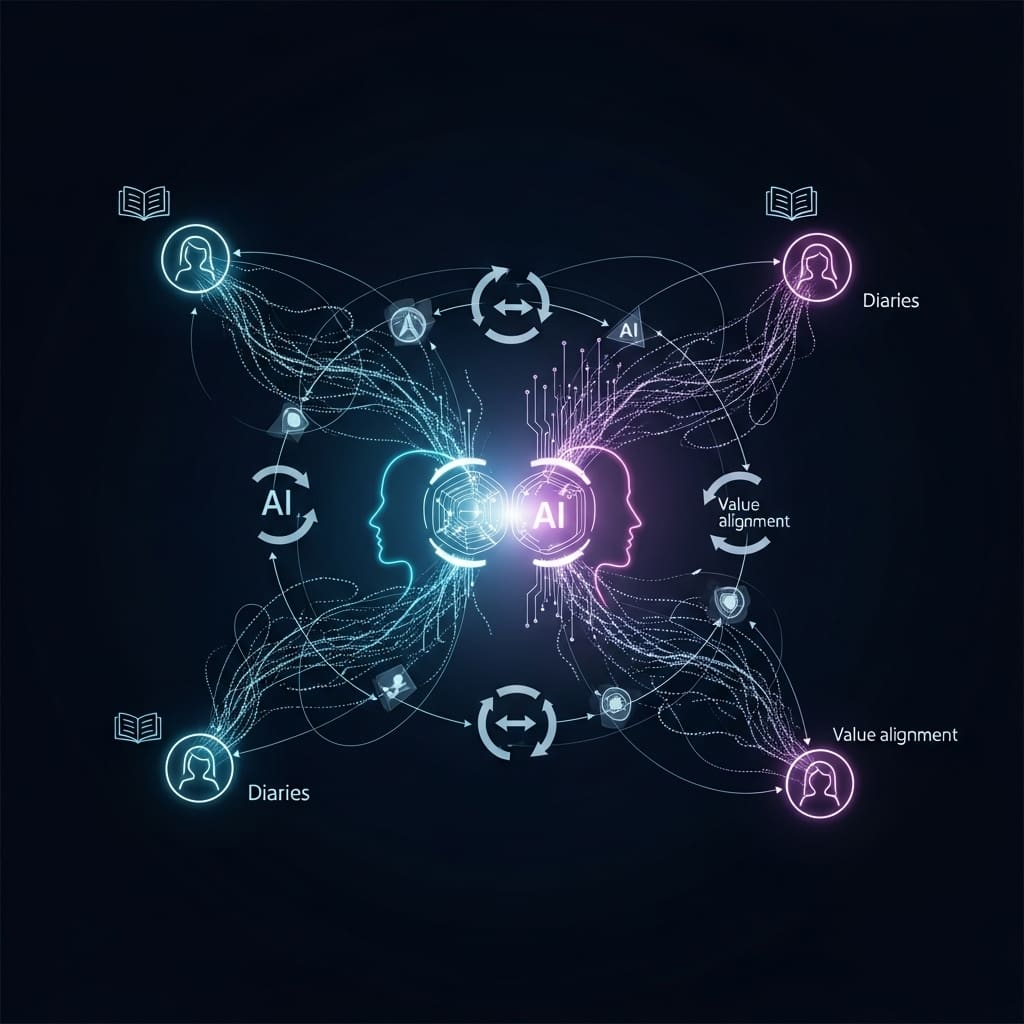
Researchers are increasingly focused on the critical issue of value misalignment as artificial intelligence systems become pervasive in daily life. Anne Arzberger, Enrico Liscio, and Maria Luce Lupetti (Delft University of Technology and Politecnico di Torino), alongside Íñigo Martínez de Rituerto de Troya, Jie Yang, and colleagues, present a novel approach that challenges traditional, model-centric perspectives on AI values. Their study reframes alignment not as a fixed set of rules, but as a dynamic practice co-created through human interaction, investigating how users perceive and respond to discrepancies in AI behavior.
By combining misalignment diaries with generative design workshops, specifically focusing on users employing Large Language Models (LLMs) as research assistants, the team found that misalignments manifest less as ethical failings and more as practical disruptions. These disruptions prompted varied user responses, ranging from behavioral adjustments to deliberate disengagement. This research advances our understanding of how AI systems can support ongoing, shared, and contextually relevant alignment processes.
The study frames alignment as an interactional practice co-created between users and AI, recognizing that human values are deeply situated and context-dependent. Misalignments are often experienced not as abstract ethical breaches but as unexpected model responses that cause task or social breakdowns, highlighting the importance of designing interventions focused on practical interaction challenges.
The team employed a participatory workshop methodology combining misalignment diaries with generative design activities. Twelve participants from diverse research disciplines documented real-world misaligned interactions, identified the specific values at risk, and collaboratively designed actions and interface features to support ongoing co-construction of alignment. This approach moves beyond passive feedback collection, empowering participants to actively shape future AI interactions. Users articulated a range of engagement strategies, from fine-tuning model outputs to deliberately disengaging when misalignment was severe.
Participants proposed interface mechanisms such as “maps” or “sliders” to monitor and adjust model behavior, emphasizing the need for tools that enable active understanding and modification of AI outputs. This work reframes users as epistemic agents rather than passive recipients of pre-defined values, establishing a critical link between situated values and user agency.
The study also foregrounded user reflexivity. Participants meticulously documented misaligned AI outputs using a bespoke Misalignment Diary, capturing instances of inappropriate, misleading, or harmful behavior in real time. Generative design workshops then prompted participants to envision solutions, including new interaction mechanisms, to support ongoing alignment. Participants articulated desired roles ranging from adjusting and interpreting model behavior to non-engagement as a strategic response. Researchers carefully documented these sessions, producing a rich dataset of user-defined alignment strategies.
Crucially, the methodology prioritized situated values, avoiding pre-defined options and allowing participants to freely express needs and preferences. Data analysis focused on concrete instances of misalignment, including task breakdowns, social difficulties, and unexpected AI outputs. For example, participants reported LLMs fabricating theoretical details, citing non-existent sources, or generating inaccurate multimodal outputs. Other misalignments included a lack of grounding in primary literature, overly American-centric summaries in historical prompts, or ethically problematic guidance. Interactional breakdowns also occurred, with models exhibiting overconfidence or requiring excessive prompting for minimal gains.
User interventions were measured to understand coping strategies. Technically proficient participants often adjusted prompts iteratively, provided concrete examples, or initiated new sessions to avoid contamination. Some participants explicitly chose non-intervention, expressing disinterest in prompt engineering, highlighting the need for optional support in co-constructive alignment. Overall, the findings demonstrate that misalignment emerges from human-AI interaction, grounded in concrete breakdowns rather than abstract harms, and that user responses span active adjustment to deliberate disengagement.
This work delivers a nuanced understanding of AI alignment as an ongoing, shared, and participatory process. By treating misalignment as a dynamic and interactional phenomenon, the study provides critical insights for designing AI systems that support continuous, user-driven alignment practices, fostering more trustworthy, collaborative, and context-sensitive AI-human partnerships.
User Responses Shape AI Misalignment Experiences, influencing future
Researchers investigated value misalignment in increasingly embedded AI systems, moving beyond model-centric approaches to focus on how users actively respond to these issues during interactions. They framed misalignment not as a simple ethical failure, but as an interactional practice co-constructed between humans and artificial intelligence. Through participatory workshops combining misalignment diaries and generative design, the study explored how users understand and wish to contribute to addressing these misalignments, specifically in the context of large language models used as research assistants. The findings indicate that users experience misalignments primarily as unexpected responses or breakdowns in tasks and social interactions, rather than abstract ethical violations.
Participants articulated diverse roles in addressing these issues, ranging from adjusting and interpreting model behavior to deliberately disengaging from the system. This research introduces the concept of user–AI co-construction of value alignment, where alignment is actively supported through user participation during runtime rather than solely through model optimization. Importantly, the study suggests that enabling this co-construction does not necessarily require new technological infrastructure, but rather a shift in design priorities toward supporting ongoing, situated, and shared practices. The authors note the challenges faced by non-designers in translating abstract values into actionable interface features.
The study also highlights the potential risk of shifting alignment labor onto users and emphasizes that co-construction should remain an optional mode of engagement, respecting individual needs and constraints. Future work will explore extending this approach to different contexts and implementing the identified interaction strategies, with the goal of developing deployable methods for value alignment. Overall, the research underscores the need for ethically responsible AI systems that are attentive to timing, selectivity, and proportionality when soliciting user input, while maintaining clear accountability for system designers and developers.
👉 More information
🗞 Co-Constructing Alignment: A Participatory Approach to Situate AI Values
🧠 ArXiv: https://arxiv.org/abs/2601.15895

