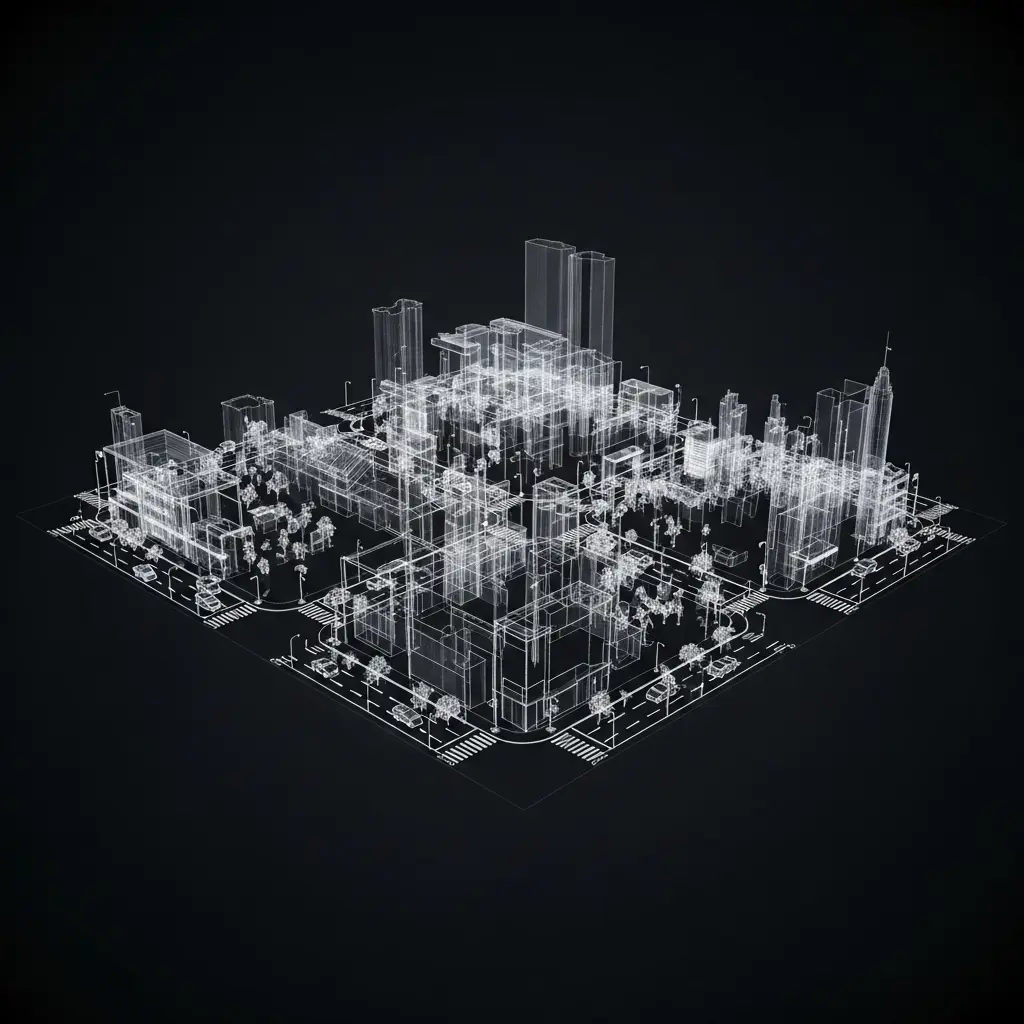
Researchers are tackling the difficult problem of semantic scene completion from single images, a crucial step towards enabling machines to truly ‘understand’ the 3D world around them. Zichen Xi, Hao-Xiang Chen (Tsinghua University), and Nan Xue (Ant Group) et al. present FlowSSC, a novel generative framework that directly addresses limitations in existing methods by realistically inferring occluded geometry and maintaining spatial relationships between objects. This work is significant because it’s the first to apply generative modelling directly to this task, and importantly, achieves high-fidelity scene completion in a single step using a new ‘Shortcut Flow-matching’ technique , paving the way for real-time deployment in applications like autonomous driving. Demonstrating state-of-the-art performance on the SemanticKITTI dataset, FlowSSC substantially outperforms current baseline approaches.
FlowSSC completes 3D scenes from single images
A Generative Framework for Semantic Scene Completion
Scientists have developed FlowSSC, a groundbreaking generative framework for monocular semantic scene completion, addressing the long-standing challenge of inferring complete 3D scenes from single images. This innovative research tackles the inherent ambiguity of reconstructing occluded geometry by treating the task as a conditional generation problem, seamlessly integrating with existing feed-forward methods to significantly enhance their performance. The team achieved real-time inference speeds without compromising quality by introducing Shortcut Flow-matching, a technique operating within a compact triplane latent space, a crucial step towards practical deployment in autonomous systems. Unlike conventional diffusion models requiring hundreds of iterative steps, FlowSSC leverages a shortcut mechanism to generate high-fidelity completions in a single pass, representing a substantial leap forward in efficiency.
This work establishes a universal generative enhancement framework, capable of boosting the performance of any existing semantic scene completion method through a rapid, generative refinement process. To overcome the limitations of operating in high-dimensional voxel spaces, researchers employed a VecSet VAE architecture, compressing semantic voxels into a compact triplane latent space and achieving superior reconstruction fidelity of 85.89% IoU while dramatically reducing computational complexity. The core innovation lies in the Triplane Diffusion Transformer, designed to effectively aggregate 3D contextual information and facilitate real-time inference through the Shortcut Models training strategy. This allows the model to learn a direct mapping from noise to clean data, bypassing the need for a pre-trained teacher and enabling single-step, high-fidelity generation.
Experiments conducted on the SemanticKITTI dataset demonstrate that FlowSSC achieves state-of-the-art performance, consistently surpassing existing baseline methods and validating the effectiveness of the one-step generative strategy. The research introduces several key contributions, including the first universal generative framework for monocular SSC, a powerful VecSet VAE utilizing Cross-Attention for efficient compression, and a Shortcut Latent Diffusion model enabling real-time, high-quality generation. By compressing 3D scenes into a compact triplane representation, the team has unlocked the potential for efficient high-resolution generative modeling, paving the way for advancements in autonomous driving, robotic navigation, and augmented reality applications. This breakthrough promises to deliver comprehensive environmental understanding essential for safe and intelligent decision-making in dynamic real-world scenarios.
Shortcut Flow-matching for real-time scene completion leverages
Scientists introduced FlowSSC, a novel generative framework for monocular semantic scene completion, addressing the challenges of inferring occluded 3D geometry from single images. The study pioneers a method treating SSC as a conditional generation problem, seamlessly integrating with existing feed-forward SSC techniques to enhance performance significantly .To achieve real-time inference without sacrificing quality, researchers developed Shortcut Flow-matching, operating within a compact triplane latent space. Unlike conventional diffusion models demanding hundreds of steps, this method employs a shortcut mechanism, enabling high-fidelity generation in a single step for practical deployment in autonomous systems.
Compressing 3D Volumetric Data into Latent Spaces
Experiments employed the SemanticKITTI dataset, demonstrating FlowSSC’s state-of-the-art performance and substantial improvement over existing baseline methods. The team engineered a VecSet VAE architecture to compress 3D voxels into a compact triplane latent space, achieving 85.89% IoU reconstruction fidelity while reducing computational. Experiments demonstrate that FlowSSC significantly outperforms existing baselines, marking a substantial advancement in the field. The team measured reconstruction fidelity, achieving an impressive 85.89% IoU (Intersection over Union) using their VecSet VAE architecture, a key component in compressing 3D semantic voxels into a compact triplane latent space.
Results demonstrate the effectiveness of a VecSet VAE, which leverages Cross-Attention to compress 3D scenes, drastically reducing computational complexity for the diffusion model. This compression allows for efficient high-resolution generative modeling, a critical step towards real-time applications. The breakthrough delivers a high-efficiency generative refiner, employing a Triplane Diffusion Transformer to effectively aggregate 3D contextual information. Measurements confirm that the Shortcut Latent Diffusion model achieves high-fidelity generation in a single step, a significant improvement over standard diffusion models that require hundreds of function evaluations.
Achieving Single-Step Inference for Real-Time Systems
Tests prove that the Shortcut Models training strategy enables the DiT (Diffusion Transformer) to learn a direct mapping from noise to clean data without a pre-trained teacher. This single-step inference capability is crucial for practical deployment in autonomous systems, augmented reality, and navigation applications. The study recorded a substantial performance gain by integrating FlowSSC with existing feed-forward SSC methods, showcasing its versatility as a universal generative enhancement framework. Data shows that the compact triplane latent space facilitates real-time inference without compromising quality, a key requirement for time-critical applications.
Scientists achieved a breakthrough in speed and quality by optimizing the Self-Consistency objective, allowing the model to perform a direct “Shortcut” jump in the latent space. The research details how the model learns a continuous flow from noise to data, enabling both single-step and multi-step refinement. Measurements confirm the ability to generate high-fidelity 3D semantic scenes with fine details, addressing the limitations of previous feed-forward methods that often produced blurry or mean-valued predictions in occluded regions. This work establishes a new benchmark for monocular semantic scene completion, paving the way for more robust and intelligent autonomous systems.
FlowSSC delivers real-time 3D scene completion with remarkable
Scientists have developed FlowSSC, a new generative framework for monocular semantic scene completion that addresses the challenge of inferring complete 3D scenes from single images. This research reconciles high-fidelity generation with real-time efficiency, a significant advancement in the field of 3D perception. The core innovation lies in compressing 3D scenes into a compact triplane latent space using a VecSet VAE and employing a teacher-free Shortcut Flow Matching training objective. This allows the model to learn a direct, one-step mapping for generative refinement, effectively recovering fine-grained geometry and semantics from monocular input.
Experiments on the SemanticKITTI dataset demonstrate that FlowSSC achieves state-of-the-art performance while maintaining practical inference speeds suitable for applications like autonomous driving. Acknowledging limitations, the authors note that the Flow Matching training process remains computationally intensive and demands significant GPU memory. Future research will focus on reducing model complexity and exploring techniques to accelerate convergence through self-consistency objectives. Scaling training to larger, more diverse datasets and extending the prediction paradigm to video inputs for improved temporal consistency are also key areas for further investigation. Ultimately, FlowSSC establishes a universal paradigm for generative 3D perception, paving the way for real-time, high-fidelity scene understanding.
🗞 FlowSSC: Universal Generative Monocular Semantic Scene Completion via One-Step Latent Diffusion
🧠 ArXiv: https://arxiv.org/abs/2601.15250

See today’s quantum computing news on Quantum Zeitgeist for the latest breakthroughs in qubits, hardware, algorithms, and industry deals.