Researchers are increasingly focused on understanding how light can carry angular momentum, a property that is crucial for applications ranging from optical trapping to advanced communication technologies. Sophie Vo, together with Konstantin Y. Bliokh (Donostia International Physics Center and Centre of Excellence ENSEMBLE3 Sp. z o.o.) and Miguel A. Alonso (Aix Marseille University, CNRS, Centrale Méditerranée, Institut Fresnel, and Université de Toulon), present a novel approach to quantifying this property in spatiotemporal vortex pulses (STVPs), which are complex wave packets exhibiting swirling spatiotemporal behavior.
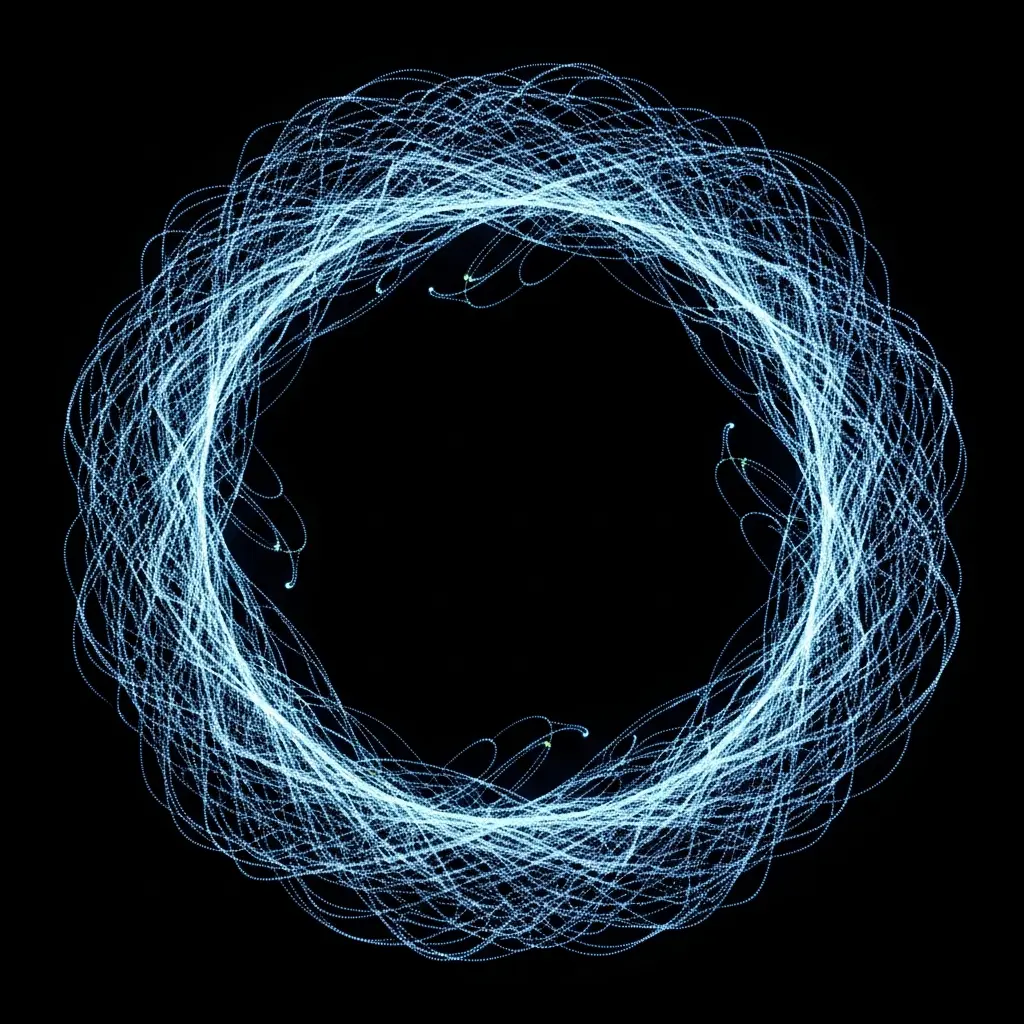
Their work introduces a remarkably simple yet powerful mechanical model that represents STVPs as a loop of particles, effectively bridging the gap between ray optics and wave optics. By establishing a clear analogy between particle dynamics and established wave-based calculations of orbital angular momentum (OAM), the study provides fresh insight into a long-standing debate and offers an intuitive framework for manipulating the angular momentum of light. This approach has the potential to streamline the design and analysis of future optical technologies.
The study reveals that the choice of coordinate origin plays a crucial role in the quantification of transverse orbital angular momentum, a factor that has contributed to discrepancies in previous theoretical treatments. The proposed mechanical model offers a transparent explanation for these differences, clarifying how transverse OAM is distributed within STVPs. Numerical and analytical tests show that the model accurately reproduces results obtained from more complex wave-based analyses, validating its effectiveness as a practical and intuitive tool for studying STVP behavior.
A direct correspondence is established between the dynamics of the particle loop and the propagation of spatiotemporal vortex pulses, providing a new way to visualize and interpret these wave packets. Importantly, the work resolves long-standing controversies regarding the magnitude of transverse OAM carried by STVPs by introducing a consistent and origin-aware quantification method.
The authors demonstrate the reconstruction of STVP dynamics using ray-optics-style modeling in both space and time. For xz-oriented STVPs, initial particle conditions were defined by an ellipse in the zx plane at t = 0, while xt-oriented STVPs were modeled using an ellipse in the xt plane at z = 0. Visualization of particle propagation shows that the model successfully captures the dynamic evolution of STVPs.
Analysis of cross-sections at z = 0 and t = 0 reveals the expected elliptical structures and reference points within the particle distributions. These results confirm that the mechanical model faithfully reproduces the complex behavior of STVPs and provides an intuitive explanation for discrepancies reported in earlier transverse OAM calculations. Overall, this work delivers a compelling mechanical interpretation of spatiotemporal vortex phenomena, offering a valuable framework for studying vortex dynamics not only in optics but also in related fields such as acoustics and quantum mechanics.