

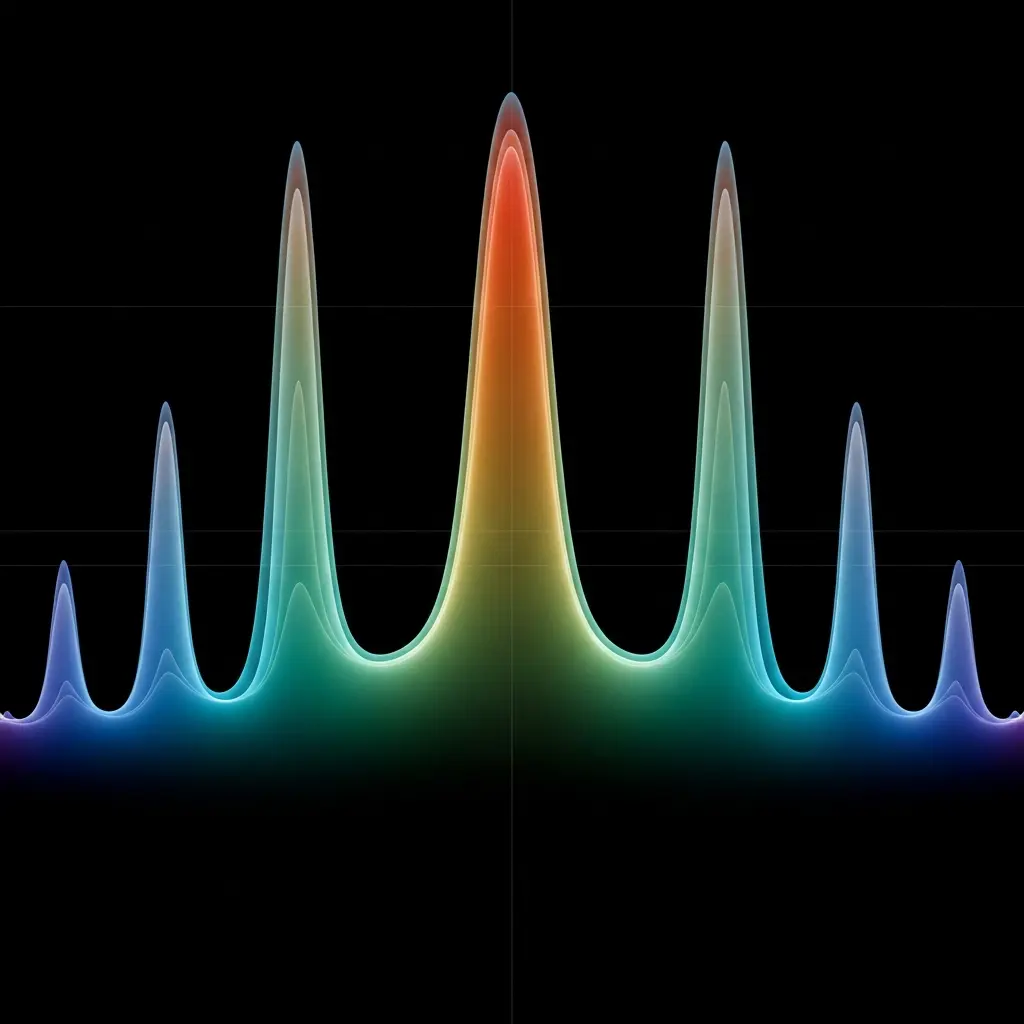
Scientists are increasingly focused on understanding the behaviour of quantum materials under periodic, or ‘Floquet’, driving, and a new study directly compares two key theoretical methods for analysing the resulting sidebands. Karun Gadge, Marco Merboldt, and Michael Schüler, alongside colleagues including Jan Philipp Bange, Wiebke Bennecke, and Michael A. Sentef from the Georg-August-Universität Göttingen, the Paul Scherrer Institute, and the University of Bremen, have meticulously assessed both a perturbative approach and time-dependent nonequilibrium Green’s functions (tdNEGF) using a Dirac system model. Their research, published today, is significant because it clarifies when simplified perturbative calculations can accurately predict experimental results , specifically in time-resolved angle-resolved photoemission spectroscopy (tr-ARPES) , and highlights the crucial role of factors like photoemission matrix elements and screening effects, paving the way for more efficient analysis of complex quantum phenomena.
Floquet sidebands in graphene via two methods
Comparing Two Frameworks for Sideband Analysis
Scientists have demonstrated a comparative study of two theoretical methods for understanding Floquet sidebands in periodically driven quantum materials, employing both a first-order perturbative. The research establishes a detailed understanding of photoemission matrix elements, polarization, incidence angle, and near-surface screening, all supported by robust theoretical modelling. The team incorporated Fresnel reflection and transmission coefficients to account for electromagnetic boundary conditions, addressing refraction and field mixing between in-plane and out-of-plane components. Furthermore, they introduced phenomenological screening parameters to renormalize effective field amplitudes, bridging the gap between idealized theory and realistic experimental environments, such as graphene on dielectric supports. This innovative approach allows for sensitivity checks against assumptions regarding substrate permittivity, providing a controlled framework for connecting theoretical predictions with experimental observations. The work opens avenues for more accurate interpretation of pump-probe tr-ARPES experiments, crucial for mapping the transient electronic band structure of driven solids with femtosecond resolution.
Floquet Sidebands via PB1 and tdNEGF
Scientists employed two complementary theoretical frameworks, the first-order perturbative Born approximation (PB1) and time-dependent nonequilibrium Green’s functions (tdNEGF), to investigate Floquet sidebands in periodically driven quantum materials. The study used a Dirac system model to disentangle Floquet-dressed initial states, Volkov-dressed final states representing the laser-assisted photoelectric effect, and their interference in pump–probe setups. Researchers quantified how photoemission matrix elements, light polarization, incidence angle, and near-surface screening influence the momentum-resolved sideband intensity observed in time-resolved angle-resolved photoemission spectroscopy (tr-ARPES).
Deriving Sideband Dynamics Using PB1 and tdNEGF
Using PB1, the team derived an analytical expression for the momentum-dependent sideband intensity, accurately capturing symmetry trends and the interference between Floquet and Volkov states when photoemission matrix elements are included. In parallel, the tdNEGF approach reproduced full energy- and momentum-resolved spectra, incorporating hybridization gaps and spectral-weight redistribution, thereby providing a more complete description of the system’s behavior.
Qualitative agreement between PB1 and tdNEGF was achieved when photoemission matrix elements were taken into account. However, quantitative discrepancies emerged near hybridization regions and at specific emission angles, where higher-order processes and self-energy effects become significant. These findings indicate that PB1 and tdNEGF can be used in a complementary manner for systems with simple band structures and away from these critical regions.
The study modeled the dynamics of a quantum mechanical state under periodic driving by solving the time-dependent Schrödinger equation with a time-periodic Hamiltonian, assuming a temperature of 0 K. Applying Floquet’s theorem, the time-evolution operator over one driving period T was written as U(t₀ + T, t₀) = e⁻ⁱH_FT/ħ,where is a time-independent Hermitian Floquet Hamiltonian. Its eigenvalues take the form e⁻ⁱεₙT/ħ, where the quasi-energies εₙ are defined modulo integer multiples of ħω, with ω = 2π/T. These quasi-energies are analogous to quasi-momentum in spatially periodic systems.The corresponding solutions, known as Floquet states, are expressed as ψ(t)⟩ = e⁻ⁱεₙ(t − t₀)/ħ |uₙ(t)⟩, where |uₙ(t)⟩ is a time-periodic Floquet mode with period T. The experimental geometry involved a monochromatic, real-valued electric field given by E(t) = Re[ e⁻ⁱωt] = cos(ωt), with amplitude determined by the incident field strength and angles of incidence and polarization. Incident, reflected, and transmitted electromagnetic fields were explicitly defined using Snell’s law to ensure phase matching across the interface, leading to the appropriate Fresnel amplitude coefficients.
Overall Significance and Theoretical Framework Summary
Overall, the study provides a detailed and consistent theoretical framework for interpreting Floquet sidebands in tr-ARPES experiments, clarifying the respective roles of Floquet and Volkov states and establishing the conditions under which different theoretical approaches are applicable.
🗞 A comparative study of perturbative and nonequilibrium Green’s function approaches for Floquet sidebands in periodically driven quantum systems
🧠 ArXiv: https://arxiv.org/abs/2601.14443


See today’s quantum computing news on Quantum Zeitgeist for the latest breakthroughs in qubits, hardware, algorithms, and industry deals.



