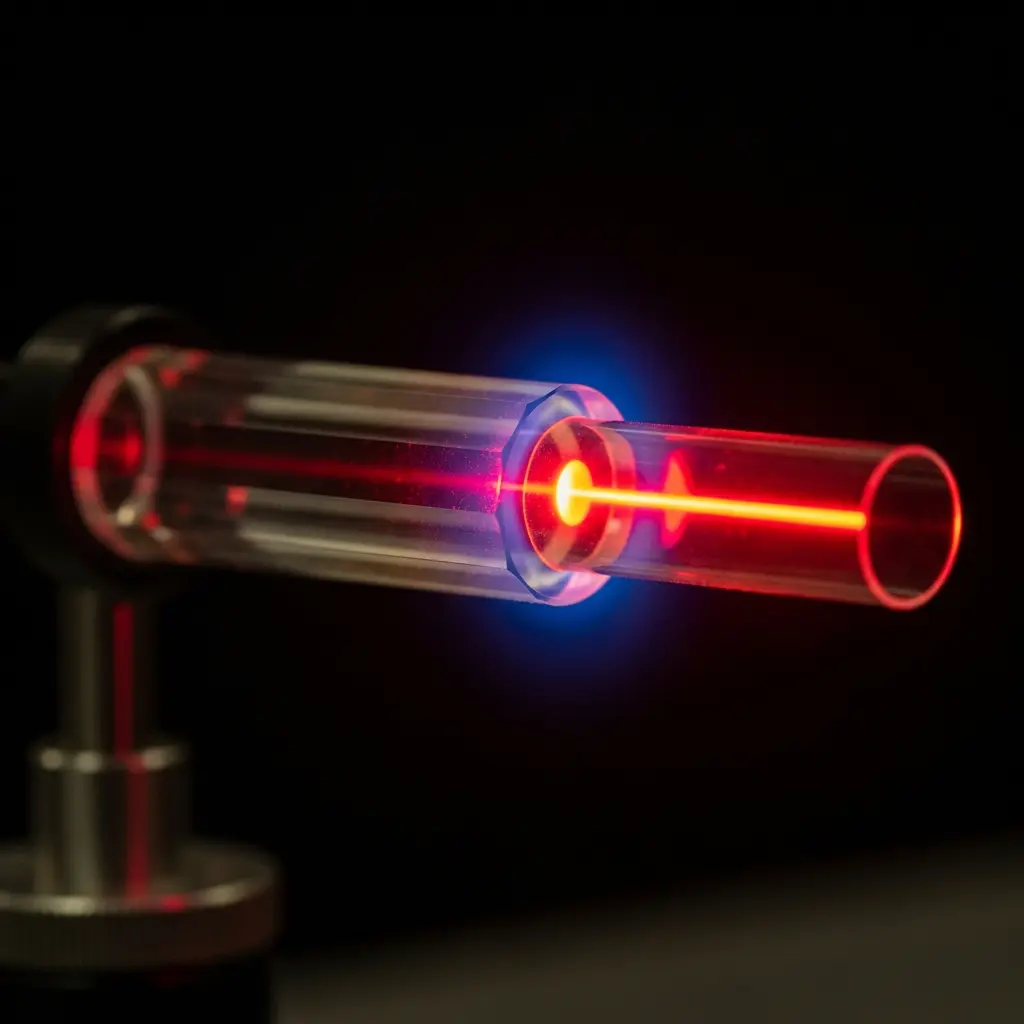
Researchers are increasingly focused on developing high-power ultrafast lasers emitting at 2.1μm, and a new study details significant progress using holmium-doped CALGO crystals as a promising gain medium. Anna Suzuki, Pavel Loiko, and Weichao Yao, alongside their colleagues from Ruhr-Universität Bochum and the Centre de Recherche sur les Ions, les Matériaux et la Photonique (CIMAP), demonstrate how these crystals uniquely combine high gain with excellent thermal conductivity, paving the way for ultrashort pulse generation and amplification at unprecedented power levels. This research is particularly significant as it addresses the growing demand for efficient ultrafast laser technology in this crucial wavelength region, with potential applications spanning medical imaging, spectroscopy and remote sensing , and the team’s detailed spectroscopic characterisation offers valuable insight into future performance scaling.
The research team achieved detailed spectroscopic characterisation of Ho:CALGO, providing crucial insights into its properties and potential for laser development. Experiments show that this material offers a compelling alternative to traditional methods like optical parametric amplification, which often rely on complex and expensive systems dedicated to specialised scientific applications. This breakthrough reveals a pathway towards more compact, economical, and simpler laser systems capable of delivering high performance in the short-wavelength infrared (SWIR) range, typically defined as 1.7-2.5μm. The study unveils the potential of Ho:CALGO to enable nonlinear processing of narrow bandgap semiconductors like silicon and germanium, materials opaque in the near-infrared, opening doors to in-volume or through-substrate material modification.
Furthermore, the work establishes Ho:CALGO as an efficient driver for nonlinear frequency conversion, particularly for accessing the extreme ultraviolet (XUV) and soft X-ray regions via high-harmonic generation, which is a key tool for time-resolved studies of electron and nuclear dynamics. Researchers prove that SWIR sources based on Ho:CALGO also serve as efficient drivers for down-conversion to the mid-infrared (MIR) region, crucial for molecular spectroscopy, chemical sensing, and environmental monitoring. The study highlights that, traditionally, accessing this spectral region required high-energy, complex systems; however, Ho:CALGO offers a promising route to achieve this with greater efficiency and simplicity. The research establishes a record-high average power of 52W at a 2.1-μm wavelength and 52.6-kHz repetition rate achieved via a 5-stage optical parametric amplifier (OPA) driven by a 500-W Yb-based disk amplifier system, serving as a benchmark for comparison.
The highest pulse energy of over 50 mJ was reported at 2.44-μm and 10-Hz repetition rate, utilising a dual-chirped OPA technique with a high-energy Ti:sapphire laser driver. This detailed analysis of existing0.7±0.5ms for the 5I7 state, aligning closely with Judd-Ofelt analysis and confirming a luminescence quantum efficiency approaching unity. Researchers determined that at wavelengths suitable for laser operation, the stimulated-emission cross-section reached 0.94×10⁻²⁰ cm2 at 2076nm and 0.25×10⁻²⁰ cm2 at 2120nm for π-polarized light, indicating a preference for π-polarization in laser operation. To investigate luminescence dynamics, the team finely ground the crystals to minimize reabsorption effects, then measured nearly single exponential decay from both the 5I7 and 5I6 Ho3+ manifolds under nanosecond excitation.
These measurements revealed lifetimes of τlum = 5.27ms (5I7) and 0.237ms (5I6) for 1 at. % Ho3+ doping at ambient temperature, supporting a “quasi-center” model for structurally disordered crystals. The work further extended to calculating polarization-resolved gain spectral profiles, σgain = βσSE, (1, β)σabs, where β represents the inversion ratio, to assess gain bandwidth and predict laser wavelengths. Scientists identified two distinct operation regimes: a high-inversion regime (β 0.25) expected for low-doped, short crystals, and a regime supporting laser emission at 2.08μm in π-polarization.
CALGO Crystals Enable High-Power Ultrafast 2.1m Lasers
Researchers have identified that high-power ultrafast lasers operating in the short-wavelength infrared (SWIR) range, typically defined as 1.7-2.5μm, offer significant potential across diverse scientific and industrial applications. For instance, these lasers enable nonlinear processing of narrow bandgap semiconductor materials like silicon and germanium, which are opaque in the near-infrared, thereby opening avenues for in-volume or through-substrate material modification. Moreover, they are highly sought after as driving sources for nonlinear frequency conversion, such as accessing the extreme ultraviolet (XUV) and soft X-ray regions via high-harmonic generation, a key tool for time-resolved studies of electron and nuclear dynamics. SWIR sources also efficiently drive down-conversion to the mid-infrared (MIR) region using non-oxide nonlinear crystals, crucial for molecular spectroscopy, chemical sensing, and environmental monitoring.
Traditionally, accessing this spectral region required high-energy, high-power systems utilising parametric conversion of near-infrared drivers, such as parametric oscillators and amplifiers. A record-high average power of 52W was achieved at a 2.1-μm wavelength with a 52.6-kHz repetition rate via a 5-stage optical parametric amplifier (OPA) driven by a 500-W Yb-based disk amplifier system. The highest pulse energy reported was over 50 mJ at 2.44-μm and 10-Hz repetition rate, achieved using a dual-chirped OPA technique with a high-energy Ti:sapphire laser driver. However, these systems are complex and costly, largely confined to specialised scientific institutions with expertise in ultrafast laser operation, hindering widespread deployment and slowing application progress. In contrast, efficient 2-μm laser sources based on direct emission and amplification, utilising various active ions and host materials, have demonstrated significant progress, offering a promising alternative with higher efficiency and more compact, economical systems. Various mode-locked laser oscillators and ultrafast amplifiers employing Tm3+-, Ho3+-, and Cr2+-doped gain materials have been demonstrated in recent decades, fuelled by advances in gain materials, pump source power scaling, and coating technologies for this wavelength range.
Scientists Conclusion
The findings establish Ho:CALGO as a leading platform for next-generation mid-infrared ultrafast lasers, exhibiting exceptionally short pulse durations alongside high average power, outperforming other holmium-based laser systems. Detailed spectroscopic characterisation has revealed peak stimulated emission cross-sections of 5.00×10, 20 cm2 at 2861nm for π-polarization and 2.74×10, 20 cm2 at 2862nm for σ-polarized light, highlighting its favourable emission properties. While acknowledging rapid progress, the authors note that further improvements are possible through advanced spectroscopic investigations of energy-transfer processes and the development of comprehensive laser operation models. Future research should focus on optimising doping concentrations, crystal dimensions, and cavity designs to enhance laser efficiency and reduce thermal load, potentially reaching the hundred-watt level. Exploration of advanced gain geometries, such as thin-disk and slab configurations, alongside cryogenic operation, offers opportunities for scaling power and pulse energies, particularly addressing challenges like excited-state absorption and heat generation.The disordered nature of CALGO maintains broad bandwidth even at cryogenic temperatures, preserving ultrafast capability, and positioning Ho:CALGO-based systems to drive innovation in high-power ultrafast sources within the 2-μm region.
👉 More information
🗞 Ho3+-doped CALGO crystals for high-power ultrafast 2.1-μm lasers
🧠 ArXiv: https://arxiv.org/abs/2601.14854