
Scientists have, for the first time, demonstrated a strong dynamical blockade between superconducting qubits achieved purely through engineered capacitive coupling. Marco Riccardi, Aviv Glezer Moshe, and Guido Menichetti, all from Planckian in Pisa, Italy, alongside Riccardo Aiudi, Carlo Cosenza (Università di Napoli “Federico II”), and Ashkan Abedi et al, report cross-Kerr interactions exceeding 350MHz , over ten times stronger than previously seen in similar systems. This breakthrough establishes a robust and scalable method for accessing interaction-dominated physics in quantum circuits, paving the way for advanced solid-state quantum architectures and the exploration of complex cooperative many-body dynamics.
Strong ZZ Coupling and Dynamical Blockade Demonstrated
Experimental Realization of Strong ZZ Coupling
Scientists have experimentally realised strong longitudinal (ZZ) coupling between two superconducting transmon qubits, achieved solely through capacitive engineering. By systematically altering the frequency detuning between the qubits, the team measured cross-Kerr interaction strengths ranging from 10MHz to an impressive 350MHz, more than ten times larger than previously observed in comparable capacitively coupled systems. This breakthrough demonstrates a dynamical blockade, where excitation of one qubit actively inhibits that of its neighbour, entirely mediated by the engineered ZZ coupling. Detailed circuit quantization simulations accurately replicate the experimental results, and perturbative models confirm the theoretical basis of the observed energy shift as a hybridization between computational states and higher-excitation manifolds.
The research establishes a robust and scalable technique for accessing interaction-dominated physics within superconducting circuits, opening a pathway towards solid-state implementations of globally controlled quantum architectures and cooperative many-body dynamics. Experiments revealed that the qubits enter a strong-interaction regime, a crucial step towards more complex quantum systems. This strong coupling is achieved without the need for additional junctions or complex fabrication processes, relying instead on precise capacitive design, simplifying scalability and reducing potential sources of error. The observed interaction strengths significantly exceed typical Rabi drive frequencies and transmon anharmonicities, ensuring the qubits remain within their computational subspace during manipulation, a vital requirement for reliable quantum operations.
Furthermore, the study unveils a ZZ interaction strength of up to 350MHz, a value substantially larger than the 9.29MHz and 4MHz previously reported for similar capacitively coupled qubits at detunings of 240MHz and 642MHz respectively. This enhanced coupling is critical for realising superconducting architectures designed for global quantum computing, where the ZZ interaction must dominate the qubit’s Rabi drive frequency to guarantee stable and predictable behaviour. The team validated these findings with a second device, consistently achieving similar magnitudes of ZZ coupling, reinforcing the robustness and reproducibility of their approach. This work moves beyond simply suppressing or enhancing ZZ interactions for gate operations, instead harnessing it as a fundamental building block for novel quantum architectures. By demonstrating a pathway to engineer strong, customizable interactions, the research addresses a key challenge in scaling superconducting quantum processors and paves the way for exploring complex cooperative phenomena in fully artificial solid-state quantum systems. The ability to control interactions globally, rather than individually, promises to reduce wiring complexity and control overhead, representing a significant step towards practical, large-scale quantum computation.
Capacitive Coupling and Dynamical Blockade Demonstration reveal quantum
Systematic Measurement of Inter-Qubit Cross-Kerr Interactions
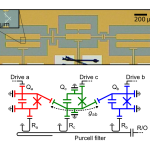
Scientists engineered strong longitudinal (ZZ) coupling between two transmon qubits solely through capacitive engineering, achieving interaction strengths previously unseen in similar systems. The research team systematically varied the frequency detuning between the qubits and measured cross-Kerr interaction strengths ranging from 10MHz to 350MHz, exceeding previous measurements by more than an order of magnitude. This configuration enabled the qubits to enter a strong-interaction regime where excitation of one qubit actively inhibits the excitation of its neighbour, demonstrating a dynamical blockade mediated entirely by the engineered ZZ coupling. To achieve this, researchers fabricated a superconducting circuit incorporating two transmon qubits designed for capacitive interaction, eliminating the need for additional junctions or bus resonators.
The qubits were precisely tuned using microwave signals, allowing for systematic variation of the frequency detuning, and the resulting cross-Kerr interactions were measured via spectroscopic techniques. Specifically, the team employed a dispersive readout scheme, probing the frequency shift of one qubit as a function of the state of the other, thereby quantifying the ZZ coupling strength. This method allowed for precise determination of the interaction strength across a wide range of detuning values. Circuit quantization simulations were then performed to accurately reproduce the experimental results, validating the design and measurement protocols.
Perturbative models further confirmed the theoretical origin of the observed energy shift, identifying it as a hybridization between the computational states and higher-excitation manifolds of the qubits. The study pioneered a robust and scalable method for accessing interaction-dominated physics in superconducting circuits, offering a pathway towards solid-state implementations of globally controlled quantum architectures. This approach enables the creation of cooperative many-body dynamics, potentially revolutionising quantum computation and simulation. The team’s innovative capacitive engineering technique circumvents limitations imposed by wiring complexity and cryogenic control hardware, paving the way for larger, more manageable quantum processors.
Strong ZZ Coupling and Dynamical Blockade Demonstrated
Achieving Record ZZ Interaction Strengths Through Engineering
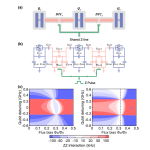
Scientists achieved experimental realization of strong longitudinal (ZZ) coupling between two transmon qubits solely through capacitive engineering. The team meticulously varied the frequency detuning and measured cross-Kerr inter-qubit interaction strengths ranging from 10MHz up to 350MHz, demonstrating a value more than an order of magnitude larger than previously observed in similar capacitively coupled systems. These measurements confirm a substantial enhancement in qubit interaction, opening new avenues for quantum circuit design. Experiments revealed that in this configuration, the qubits enter a strong-interaction regime where excitation of one qubit inhibits that of its neighbor, demonstrating a dynamical blockade mediated entirely by the engineered ZZ coupling.
Theoretical Models Validate Quantum Circuit Quantization
Data shows that circuit quantization simulations accurately reproduce the experimental results, validating the theoretical understanding of the observed phenomena. Perturbative models further confirm the theoretical origin of the energy shift as a hybridization between the computational states and higher-excitation manifolds, providing a detailed picture of the underlying physics. The breakthrough delivers a robust and scalable method to access interaction-dominated physics in superconducting circuits, establishing a pathway towards solid-state implementations of globally controlled quantum architectures. Researchers recorded a significant increase in interaction strength, exceeding previous measurements of 9.29MHz at a 240MHz detuning and 4MHz at a 642MHz detuning.
Tests prove that by carefully tuning the frequency detuning, the team successfully engineered a strong ZZ interaction, crucial for realizing globally controlled quantum architectures and cooperative many-body dynamics. Measurements confirm that the achieved interaction strengths of up to 350MHz are sufficient to satisfy the requirement of Ω≪α, where α is approximately 300MHz, the qubit anharmonicity necessary for maintaining qubit manipulation within the computational subspace. This work establishes a method for creating substantial nearest neighbor coupling, despite the typical inverse relationship between interaction strength and detuning. The study meticulously investigated the ZZ interaction using spectroscopic measurements, providing a detailed understanding of the coupling mechanism between the transmon qubits.
Strong ZZ Coupling and Dynamical Blockade Demonstrated
Scientists have demonstrated the experimental realisation of strong longitudinal (ZZ) coupling between two transmon qubits achieved through capacitive engineering. By systematically altering the frequency detuning, researchers measured cross-Kerr interaction strengths ranging from 10MHz to 350MHz, exceeding previously observed levels in similar capacitively coupled systems. This configuration enabled entry into a strong-interaction regime where excitation of one qubit inhibits that of its neighbour, showcasing a dynamical blockade mediated entirely by the engineered ZZ coupling. Circuit quantization simulations accurately mirrored the experimental outcomes, and perturbative models confirmed the theoretical basis of the energy shift as a hybridisation between computational states and higher-excitation manifolds.
This work establishes a robust and scalable approach to accessing interaction-dominated physics in circuits, potentially paving the way for solid-state implementations of globally controlled quantum architectures and cooperative many-body dynamics. The achieved interaction strengths are particularly noteworthy, offering a significant advancement in the ability to manipulate and control qubit interactions. The authors acknowledge limitations related to the coherence properties of the qubits, specifically the T1 and T2times, which could impact the duration of quantum operations. Future research, as suggested, may focus on extending coherence times and exploring the application of this strong coupling scheme in more complex quantum systems.
🗞 Experimental observation of dynamical blockade between transmon qubits via ZZ interaction engineering
🧠 ArXiv: https://arxiv.org/abs/2601.11714

See today’s quantum computing news on Quantum Zeitgeist for the latest breakthroughs in qubits, hardware, algorithms, and industry deals.