

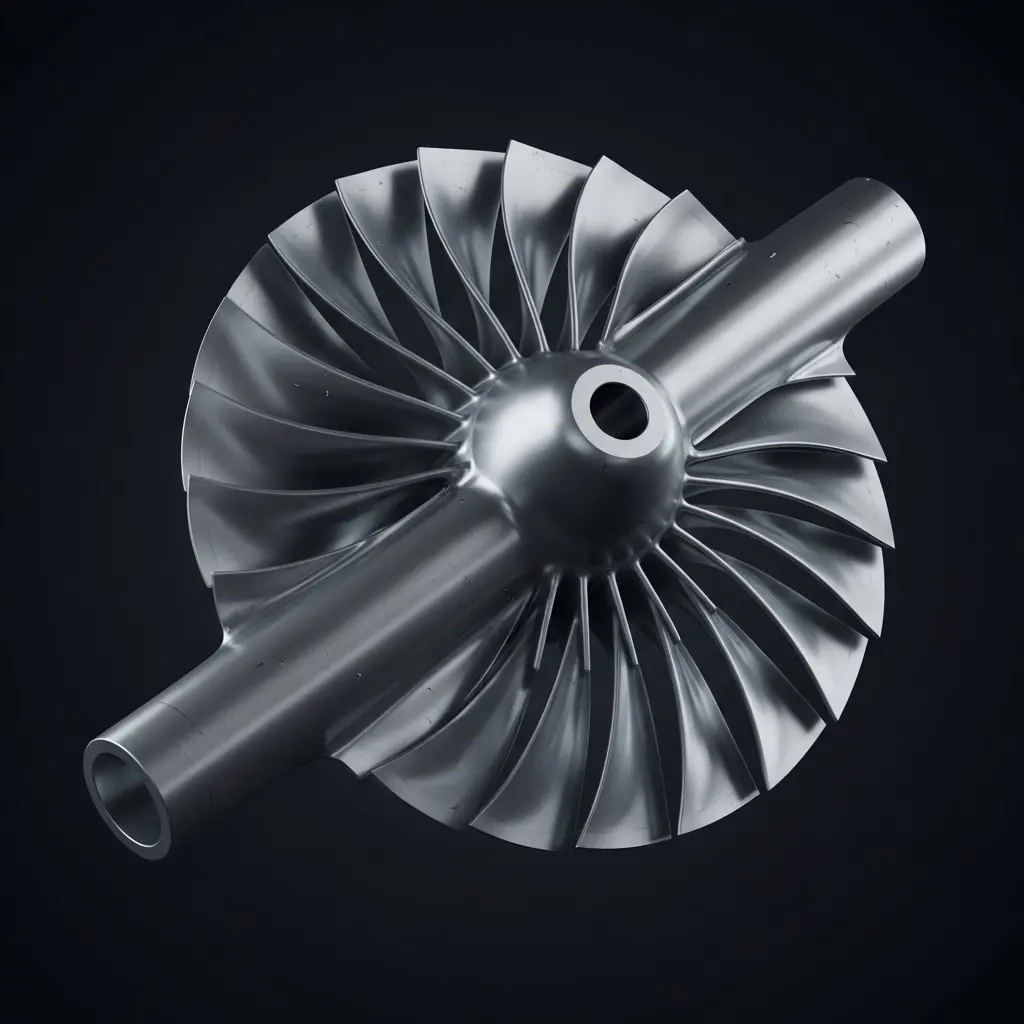
Turbine blade geometry design presents a significant challenge in engineering, demanding both high performance and manufacturability. Researchers Ashish S. Nair (GE Aerospace Research & University of Notre Dame), Sandipp Krishnan Ravi (GE Aerospace Research), and Itzel Salgado (GE Aerospace Research & Northwestern University), alongside colleagues Sun, Ghosh, Wang et al, have developed a novel generative modelling framework , BladeSDF , to tackle this complex problem. Their work introduces a domain-specific, implicit approach using Signed Distance Functions (SDFs) and DeepSDF to automatically create and refine blade designs with quantified accuracy and smooth, watertight geometries. This is particularly significant as it moves beyond traditional design pipelines by integrating performance metrics directly into the generative process, allowing for controlled exploration of designs and the potential for data-driven concept generation with interpretable parameters like taper and chord ratios.
Generating Ground-Truth SDF from Point Clouds
From Point Clouds to SDF Ground Truth In this setting, each blade design is available as a point cloud with both near-surface samples and interior samples, so a convex-hull proxy is used to obtain the inside/outside signs and a KD-tree for distance magnitudes. Let P = {pi}N i=1 ⊂R3 be the point cloud and its convex hull is defined as, H = conv(P) = n N ∑ i=1 λipi: λi≥0, N ∑ i=1 λi= 1 o (4).
The boundary ∂H is a triangular mesh with faces f= 1, . ,. g., { x : | s(x)| ≤δ} with δ= 0.1) and the remaining 50% uniformly in the bounding box, and clamp targets with δ= 0.1 when forming sδ(x). Figure 1 visualizes the ground-truth SDF samples for a representative blade, generated from its point cloud via the convex-hull sign and KD-tree distance pipeline, only points within the truncation band |s| ≤δ= 0.2 after each hidden layer[7, 17].
Training (Joint Optimization of Decoder and Latents) For
Training Optimization and Reconstruction Fidelity
Training (Joint Optimization of Decoder and Latents) For each training design i= 1, ., ntrain, an SDF supervision set Di= {(xij, sδ(xij))}Ni j=1 is formed as described in Section II. A0.2 (clamp δ= 0. Experiments demonstrate high reconstruction fidelity, with surface distance errors consistently contained within a maximum blade dimension, a significant achievement in geometric accuracy. This SDF equals the Euclidean distance to the surface, indicating whether a point is inside or outside the solid, and the study employed a clamped SDF with a truncation distance of δ= 0.1 to focus supervision near the blade surface. A compact neural network successfully maps engineering descriptors, including maximum directional strains, to latent codes, facilitating the generation of performance-informed geometry, a crucial step towards optimised blade performance. The decoder-only formulation, utilising an 8-layer MLP with a latent dimension of k= 256, achieved robust generalization to unseen designs. Tests prove the effectiveness of the joint optimisation of the decoder and latent codes, minimising a clamped reconstruction loss with a quadratic latent prior, defined as L(θ, {zi}) = 1 Í iNi ∑ i ∑ j clip( fθ(zi, xij), −δ, δ − sδ(xij) + λz 1 ntrain ∑ i ∥zi∥2 2.
The training dataset comprised ntrain = 222 designs, each contributing 20,000 labelled SDF pairs, and Adam optimisation was employed with an initial step size of 10−3. At test time, the decoder remained frozen while a new code was optimised to fit SDF observations, demonstrating the learned representation’s effectiveness.
Conclusion and Further Research in Blade Design
🗞 BladeSDF : Unconditional and Conditional Generative Modeling of Representative Blade Geometries Using Signed Distance Functions
🧠 ArXiv: https://arxiv.org/abs/2601.13445




See today’s quantum computing news on Quantum Zeitgeist for the latest breakthroughs in qubits, hardware, algorithms, and industry deals.



