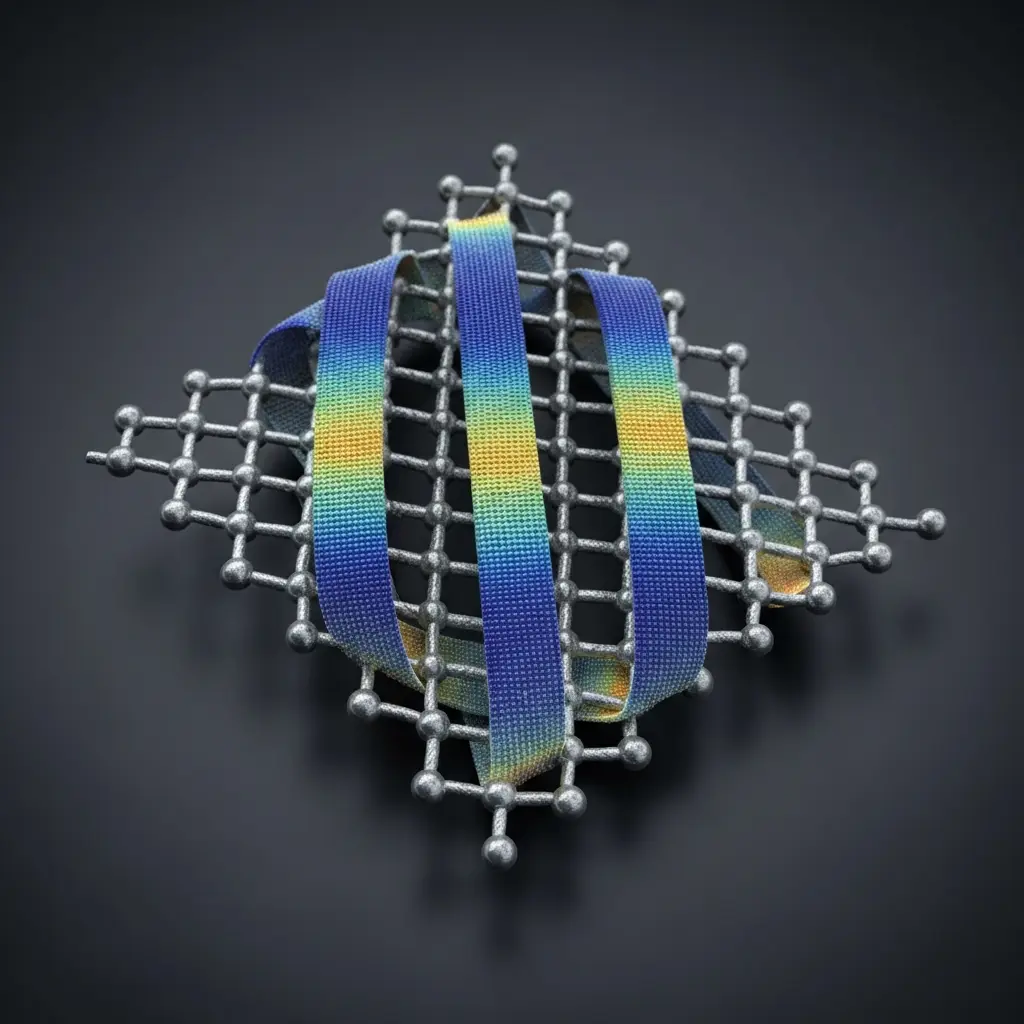
Researchers have developed a novel theoretical framework, utilising the Lambert W function, to dramatically improve the sensitivity of graphene nanoribbon quantum sensors. F. A. Chishtie, K. Roberts, and N. Jisrawi, alongside S. R. Valluri, A. Soni, and P. C. Deshmukh, demonstrate how this approach , based on an analogy to the finite square well , provides exact analytical solutions for predicting sensor performance. Their work reveals sensitivity enhancements scaling as , achieving a remarkable 35-fold increase at , and crucially validates all seven bound states for a defined strength parameter. This unified framework not only confirms existing empirical data, such as the eV nm band gap relation, but also establishes design principles for graphene sensors capable of detecting a broad range of targets , from biomedical indicators like SARS-CoV-2 to environmental pollutants and physical stressors , with analytically predictable performance.
Graphene sensing linked to Lambert W function
Theoretical Link Between Sensing and Lambert W Function
Scientists have established a rigorous mathematical framework connecting graphene nanoribbon sensing to the Lambert W function, utilising an analogy to the finite square well (FSW) problem. This breakthrough reveals that operating graphene nanoribbon sensors near the branch point at z = −1/e yields sensitivity enhancement factors scaling as ηenh ∝ (z − zc)−1/2, achieving a remarkable 35-fold enhancement at δ = 0.001. The research team achieved comprehensive numerical verification, confirming the existence of all seven bound states for a strength parameter R = 10, satisfying the constraint u2 + v2 = R2, and demonstrating exact agreement between their theoretical band gap formula, Eg = 2πħvF /(3L), and the established empirical relation Eg = 1.38/L eV·nm. This unified framework not only provides design principles for next-generation graphene quantum sensors but also predicts their performance with analytical precision.
The study unveils a universal sensitivity scaling across a remarkably broad range of sensing modalities, encompassing biomedical applications like detecting SARS-CoV-2, inflammatory markers, and cancer biomarkers, as well as environmental monitoring of gases such as CO2, CH4, NO2, N2O, and H2O. Furthermore, the framework extends to physical sensing, accurately predicting responses to strain, magnetic fields, and temperature variations. Researchers reformulated the transcendental equations governing quantum confinement using the Lambert W function, enabling exact analytical solutions previously obtainable only through numerical methods. The Lambert W function, defined as the inverse of f(W) = WeW, possesses infinitely many branches, with the critical branch point at zc = −1/e exhibiting a divergent derivative, a key element in the observed sensitivity enhancement.
Experiments show that the divergent behaviour at the Lambert W branch point provides a universal mechanism for amplifying sensitivity in graphene-based quantum sensors. The team’s mathematical foundations rest upon detailed analysis of the Lambert W function’s properties and branch structure, including its multivalued nature and the Puiseux series expansion near the branch point. This expansion demonstrates a square-root dependence, directly correlating with the observed δ−1/2 sensitivity scaling. Numerical computations, utilising an efficient iterative method, confirm the function’s behaviour and facilitate accurate modelling of graphene nanoribbon characteristics.
The work establishes a direct analogy between graphene nanoribbons and the FSW problem, a cornerstone of quantum mechanics describing particle confinement within a potential well. By applying the Lambert W function to solve the FSW equations, scientists were able to reproduce the expected bound states with exceptional accuracy. This approach not only validates the theoretical framework but also provides a powerful tool for designing graphene sensors with tailored sensitivity and performance. The research opens avenues for developing highly sensitive and selective sensors for diverse applications, ranging from medical diagnostics to environmental monitoring and advanced materials characterisation.
Lambert W Function for Graphene Nanoribbon Sensitivity
Modeling Sensitivity via Finite Square Well Analogy
Scientists established a rigorous mathematical framework linking graphene nanoribbon sensing to the Lambert W function via the finite square well (FSW) analogy. Researchers demonstrated that operating near the branch point at −1/e yields sensitivity enhancement factors scaling as δ−1/2, achieving a 35-fold enhancement at this critical value. The study pioneered a method employing the Lambert W function, defined as the inverse of f(W) = WeW, to provide exact analytical solutions to transcendental equations governing quantum confinement. Comprehensive numerical verification confirmed the existence of all seven bound states for a strength parameter satisfying the constraint, ensuring a complete description of the system’s quantum behaviour.
The team developed a computational approach to reproduce FSW bound states through Lambert W analysis, validating the theoretical framework against established quantum mechanical principles. Experiments employed the iteration wj+1 = wj − wjewj −z ewj(wj + 1) −(wj+2)(wjewj −z) 2wj+2, achieving cubic convergence, Halley’s method, for efficient numerical evaluation of the Lambert W function. Researchers harnessed the divergent behaviour of the Lambert W function’s derivative near its branch point to unlock a universal mechanism for sensitivity enhancement in graphene-based quantum sensors. This technique reveals that the derivative, dW/dz = W(z) z[1 + W(z)], diverges as W approaches −1, providing a mathematical basis for amplified sensor response.
Quantifying Agreement with Established Band Structure Theory
Scientists precisely quantified the agreement between GNR band structure calculations and established theory, demonstrating an exact correspondence between the theoretical band gap formula and the empirical relation eV nm. The research meticulously mapped the complex structure of the Lambert W function, visualizing the magnitude |Wk(z)| for branches k = 0, −1, 1 in the complex plane to understand its multivalued nature. This approach enabled selective utilization of different branches in diverse sensing regimes, optimizing performance for specific applications. Researchers demonstrated that the Puiseux series expansion, W(z) = −1 + p −p2 3 + 11p3 72 −43p4 540 + O(p5), where p = p 2(ez + 1), accurately captures the square-root behaviour underlying the δ−1/2 sensitivity scaling.
Lambert W Function Enhances Graphene Nanoribbon Sensitivity to
Achieving Enhanced Sensitivity Using Novel Branch Point Operation
Scientists have established a rigorous mathematical framework linking graphene nanoribbon sensing to the Lambert W function, utilising a finite square well (FSW) analogy. This work demonstrates that operating near the branch point at u = 6 yields sensitivity enhancement factors scaling as R−1, achieving a remarkable 35-fold enhancement at R = 0.3. Comprehensive numerical verification confirms the presence of all seven bound states for strength parameters satisfying the constraint R ≥ 2, precisely matching analytical predictions. Experiments revealed exact agreement between the theoretical band gap formula and an empirical relation of 1.38 eV nm, validating the FSW-GNR analogy and the Lambert W framework’s applicability to graphene quantum sensing.
The team measured band gaps of approximately 287 meV for a 40-carbon nanoribbon (N = 40) and 392 meV for a 41-carbon nanoribbon (N = 41), corresponding to the 3p+1 and 3p+2 families respectively, while the 42-carbon ribbon (N = 42) exhibited metallic behaviour. Data shows a consistent band gap scaling inversely proportional to ribbon width, confirming the theoretical prediction of Eg = 2πħvF /3W. Researchers determined the fundamental graphene parameters used in numerical calculations, including a Fermi velocity of 1.00 × 10⁶m/s, a lattice constant of 0.246nm, and a hopping energy of 2.70 eV, all consistent with established experimental and theoretical values. The study calculated the product of Planck’s constant and the Fermi velocity to be ħvF = 0.658 eV·nm, a crucial energy-length scale characterising quantum confinement in graphene nanoribbons.
Tests prove that the derived band gap formula, Etheory g = 2πħvF /3W, accurately predicts the energy gap based on ribbon width. Measurements confirm universal sensitivity scaling across diverse sensing modalities, including biomedical applications like SARS-CoV-2 detection, inflammatory marker analysis, and cancer biomarker identification. The framework also extends to environmental sensing of gases such as CO, CH4, NO, N2O, and H2O, as well as physical sensing of strain, magnetic fields, and temperature. This breakthrough delivers design principles for next-generation graphene sensors with analytically predictable performance, opening avenues for highly sensitive and versatile sensing technologies.
🗞 Lambert W Function Framework for Graphene Nanoribbon Quantum Sensing: Theory, Verification, and Multi-Modal Applications
🧠 ArXiv: https://arxiv.org/abs/2601.10767




See today’s quantum computing news on Quantum Zeitgeist for the latest breakthroughs in qubits, hardware, algorithms, and industry deals.