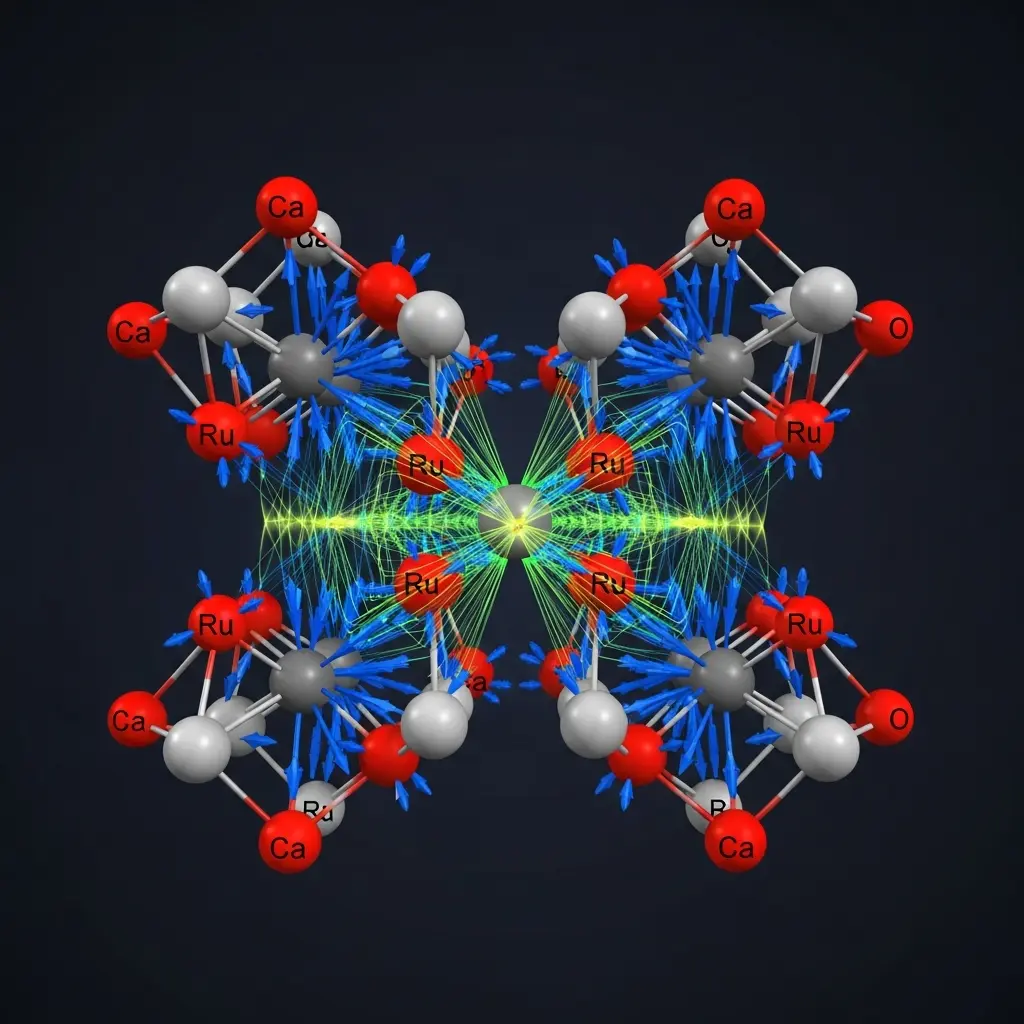
Scientists are increasingly interested in manipulating magnetic properties via subtle changes to material structure, and a new study published in a leading physics journal details how introducing impurities can unlock hidden magnetic excitations. Dirk Wulferding (Sejong University), Francesco Gabriele (CNR-SPIN, University of Salerno), and Wojciech Brzezicki (Jagiellonian University), alongside Cuoco, Kim, and Lettieri et al, demonstrate that doping calcium ruthenate (CaRuO₃) with manganese dramatically alters its magnon spectrum, revealing previously unseen magnetic modes. Their Raman spectroscopy reveals that this doping breaks the material’s mirror symmetry, activating magnon modes normally forbidden by its structure , a crucial finding because it shows how spin-lattice entanglement can be harnessed to control magnetic dynamics and potentially lead to novel spintronic devices.
This research, published recently, unveils a pathway to activate previously hidden magnetic excitations, known as one-magnon modes, through a carefully orchestrated interplay between spin, orbital, and lattice properties. This breakthrough hinges on the ability of manganese doping to break the mirror symmetry of the underlying spin-orbital configuration, effectively unlocking these previously forbidden magnetic modes. The study meticulously demonstrates that the transition-metal substitution induces local structural distortions within the RuO₆ octahedra surrounding the manganese dopant.
Theoretical modelling strongly supports these experimental findings, confirming that the observed effects are directly linked to the spin-orbit-lattice entanglement within the material. This entanglement allows for unprecedented control over collective magnetic excitations, opening doors to manipulating magnetic behaviour beyond conventional spin-only physics. Raman spectroscopy, employed at cryogenic temperatures, provided a detailed map of these excitations, revealing their energies and intensities as a function of manganese content. This precise control over magnetic excitations is achieved through the breaking of mirror symmetry, a subtle yet powerful mechanism for tuning material properties. This work opens exciting possibilities for engineering magnetic properties in correlated oxides, potentially leading to novel devices and technologies. By demonstrating a controlled pathway to activate hidden magnons without inducing a global structural phase transition, the research establishes a viable route for manipulating magnetic dynamics through symmetry breaking and structural perturbations, a frontier that promises innovative approaches to quantum control.
Raman Spectroscopy of Manganese-Substituted Ca2RuO4 Magnons
Scientists investigated the impact of manganese substitution on the magnetic excitations within Ca₂RuO₄ using Raman spectroscopy at cryogenic temperatures. The research team meticulously performed Raman spectroscopic measurements on Ca₂(Ru,Mn)O₄ samples containing 0%, 3%, 5%, and 10% manganese, focusing on excitations within the crystallographic ab plane to identify Ag and B₁g symmetry modes. Temperature-dependent Raman spectra were collected, revealing a clear transition from paramagnetic fluctuations at high temperatures (T T N ) to a gapped background and the emergence of one-magnon peaks below the Néel temperature (T N ). This approach directly probes magnetic excitations, specifically one- and multi-magnon modes, whose energies correlate with the magnetic interactions between ruthenium ions.
The study pioneered a detailed analysis of individual Raman spectra at 4 K, carefully shading the one-magnon contributions and marking overlapping phonons with asterisks.Pure Ca₂RuO₄ exhibited a sharp, intense one-magnon excitation at 12.5 meV, consistent with prior reports, while partial ruthenium substitution with 3% and 5% manganese induced two one-magnon branches with reduced intensity and broadened linewidths.Researchers extracted key parameters, energy, full width at half maximum (FWHM), and intensity, for each one-magnon mode and summarized them in Table I. Plotting these values as a function of manganese content (Figs0.0.1(c) and (d)) revealed that even small substitutions shifted the one-magnon mode to higher energies and created an additional magnetic peak with an approximate 1 meV energy separation.
Manganese doping reshapes Ca2RuO4 magnon spectrum
Scientists achieved a breakthrough in understanding magnetic excitations within a complex material, Ca₂RuO₄, by meticulously investigating the impact of manganese substitution using Raman spectroscopy. The team measured a sharp, intense single one-magnon excitation at 12.5 meV in the pure Ca₂RuO₄ sample, consistent with prior reports, However, substituting ruthenium with 3% manganese yielded two one-magnon branches, while 5% substitution further modified the spectrum. For a 10% manganese content, only a single, broadened, and asymmetric magnon mode at 16.06 meV, with a full width at half maximum (FWHM) of 1.34 meV and intensity of 0.84, could be resolved.
Data shows that the energy and intensity of these one-magnon modes are directly influenced by the manganese concentration, with even minimal substitution shifting the mode to higher energies and creating an additional magnetic peak separated by approximately 1 meV. Table I summarizes the composition-dependent parameters, detailing how the one-magnon energy, linewidth (FWHM), and intensity change with manganese content at 4 K. Specifically, the 0% Mn sample exhibited an energy of 12.59 meV, a FWHM of 0.12 meV, and an intensity of 0.55, while the 3% sample showed values of 13.54 meV, 0.43 meV, and 0.29, respectively, for one of the observed modes. Furthermore, scientists recorded additional low-energy magnetic excitations and a new phononic peak near 48 meV as a consequence of manganese substitution. The work provides a pathway to manipulate magnetic dynamics beyond spin-only physics, potentially leading to novel materials with tailored magnetic properties.
Magnon Control via Spin-Orbit-Lattice Coupling offers novel pathways
The research establishes a critical link between spin-orbit-lattice entanglement and the control of collective magnetic excitations in strongly correlated materials. This sensitivity of spin-orbital magnons to local structural and electronic changes offers a pathway to manipulate magnetic dynamics beyond traditional spin-only physics. The authors acknowledge that their findings are based on specific doping levels and material compositions, and further investigation is needed to explore the full range of accessible magnon modifications. Future work could focus on exploring the effects of different dopants, strain, or other lattice distortions to engineer magnonic spectra and potentially design novel functionalities for quantum and spintronic devices.
👉 More information
🗞 Dopant-Induced Symmetry Breaking Reveals Hidden Magnons in a Spin-Orbit Correlated Material
🧠 ArXiv: https://arxiv.org/abs/2601.13219