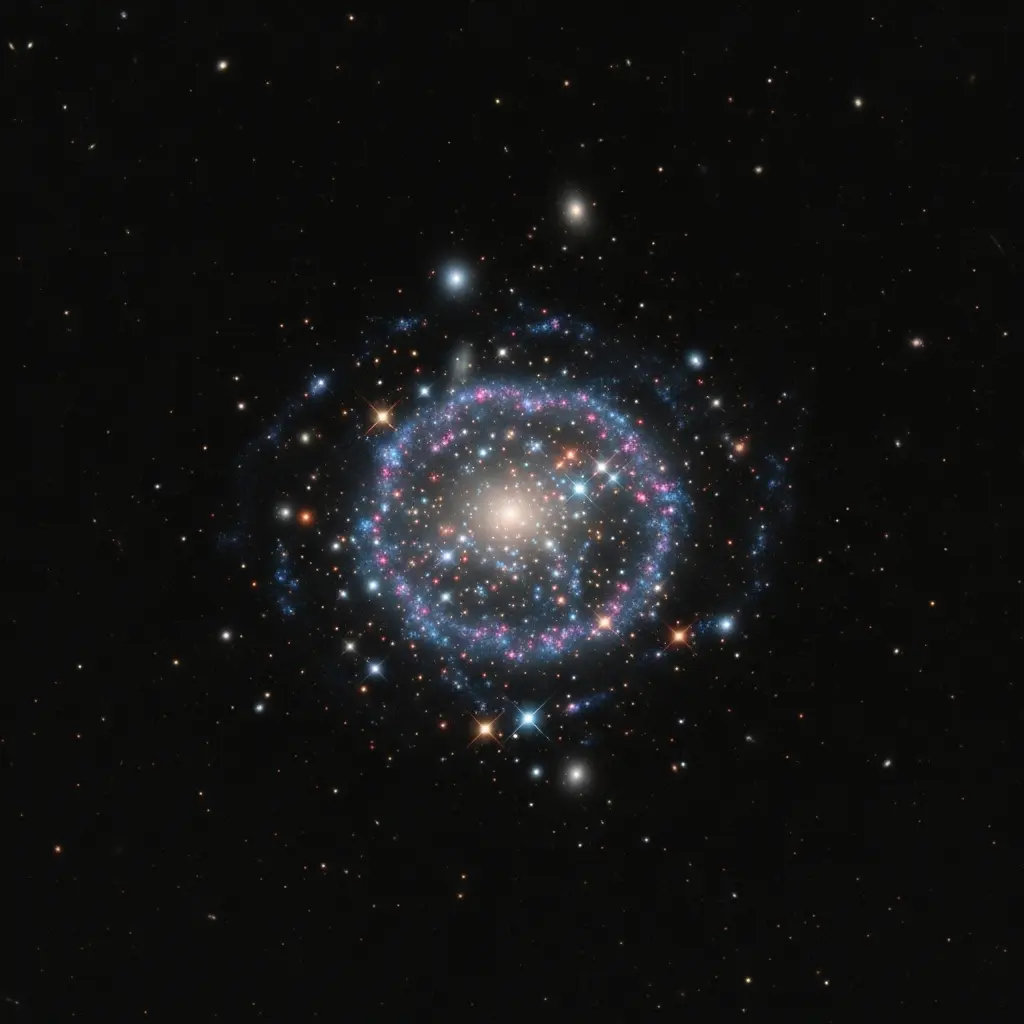
Scientists are increasingly puzzled by dwarf galaxies that appear quenched , having ceased star formation , despite their isolated locations. A new study led by Tehreem N. Hai, Kristen B. W. McQuinn, and Yao-Yuan Mao, from Rutgers University and the University of Utah, details observations of Canes Venatici C (CVn C), a dwarf galaxy in the Local Volume exhibiting this unusual characteristic. Using data from the Hubble Space Telescope, the team, including co-authors Roger E. Cohen, David Shih, and Erik Tollerud et al., determined CVn C’s distance and structural properties, confirming its low mass and lack of ongoing star formation, with no detectable gas present. This discovery is significant because it challenges conventional wisdom suggesting that a galaxy’s environment primarily dictates its fate, and provides a crucial piece in understanding the diverse mechanisms that can quench star formation in low-mass galaxies , even in the relative emptiness of intergalactic space.
Confirming Distance and Quenched Stellar Characteristics
Researchers employed high-resolution HST imaging to meticulously resolve the individual stars within CVn C, allowing for precise measurements of its distance and structural characteristics0.4 (+4.2-2.6) x (10)^6 M⊙ and its distance at 8.43 (+0.47-0.5x (10)^6 M⊙. This lack of gas and recent star formation is particularly intriguing given the galaxy’s isolated location, as traditional theories suggest that environmental factors like ram-pressure stripping are primary drivers of quenching in dwarf galaxies. The team constructed a detailed colour-magnitude diagram from the HST data, combined with archival Far-Ultraviolet (FUV) and neutral hydrogen (HI) observations, to confirm the absence of ongoing star formation and gas content0.4 L⊙) may have played a role in quenching CVn C, potentially flinging it outwards on an extreme backsplash orbit following the disruption of a subhalo group.
Understanding Quenching in Isolated Dwarf Galaxies
However, the researchers emphasize that alternative quenching mechanisms, such as stripping by the cosmic web, cannot be ruled out. This finding adds to a growing population of quenched dwarf galaxies found in under-dense environments, a crucial group for understanding the interplay between mass, environment, and the cessation of star formation. This research is critical for refining our understanding of galaxy quenching, as it demonstrates that factors beyond the immediate local environment can be decisive in halting star formation in low-mass galaxies. The team’s work opens new avenues for investigating the roles of past environmental interactions, large-scale structure, and even internal processes in shaping the evolution of these faint and elusive systems. The study employed the HST Advanced Camera for Surveys Wide Field Camera (ACS/WFC) and Wide Field Camera 3 (WFC3) UVIS during Cycle 31 observations, acquiring data available through MAST under project HST-GO-17481. Primary data consisted of ACS WFC observations in the F606W and F814W filters, totalling 1020 seconds of exposure time per filter, designed to construct a high-fidelity colour-magnitude diagram and measure the galaxy’s distance and star formation history. A 5 × 5 pixel dither pattern, acs wfc dither line pattern #14, was implemented between exposures to facilitate effective rejection of cosmic rays and mitigation of detector defects.
Observing the Stellar Population of CVn C
Researchers centred the ACS field of view on J2000 RA = 12:17:39
Researchers centred the ACS field of view on J2000 RA = 12:17:39.437, Dec = +33:20:49.68, deliberately offsetting it slightly from the galaxy’s centre to maximise coverage within the ACS field of view while avoiding bright stars. Parallel imaging with WFC3, utilising the same F606W and F814W filters, was conducted to quantify background and foreground contamination, although ultimately the ACS data’s off-target regions proved sufficient for this purpose. Photometry was performed using the DOLPHOT software package, adopting parameters consistent with those recommended by Williams et al. (2014, 2021), with a CombineChi value of 07. The team rigorously filtered the DOLPHOT catalogue, accepting only sources with object type ≤2, signal-to-noise ≥4 in both filters, sharpness2 F 606W + sharpness2 F 814W To precisely calibrate photometric results, scientists conducted Artificial Star Tests (ASTs), injecting 500,000 artificial stars into each image, mirroring the spatial distribution of real sources within CVn C. These stars were then photometrically recovered using the same quality cuts applied to the galaxy’s stellar catalogue, allowing for the calculation of recovery fractions in each filter and a determination of 50% completeness. This innovative approach enabled the team to determine that CVn C is a low-mass galaxy with a stellar mass of approximately 3 × (10)^6 M⊙, located at a distance of 8.4(+4.2-2.6) x (10)^6 , placing it firmly within the Local Volume and in an isolated environment where the nearest luminous galaxy lies over 5Rvir away. The team measured a Tip of the Red Giant Branch distance of 8.43(+0.47-0. Measurements confirm a clear over-density of stars within the ACS field of view, defining the main stellar disk of CVn C, which is largely contained within a single chip. The analysis of the HST imaging allowed scientists to quantify the level of background contamination, ensuring the reliability of the derived parameters0.4 L_sun) may have played a role, potentially initiating an extreme backsplash trajectory following the tidal dissolution of a subhalo group. However, alternative quenching mechanisms, such as stripping via the cosmic web, cannot be definitively ruled out0.5x (10)^6 solar masses. The galaxy’s low mass, measured at 3.4x (10)^6 solar masses, combined with its isolation, being over 5 virial radii from the nearest large galaxy, challenges conventional understandings of dwarf galaxy quenching mechanisms.
🗞 A Quenched and Relatively Isolated Dwarf Galaxy in the Local Volume
🧠 ArXiv: https://arxiv.org/abs/2601.14248



See today’s quantum computing news on Quantum Zeitgeist for the latest breakthroughs in qubits, hardware, algorithms, and industry deals.