

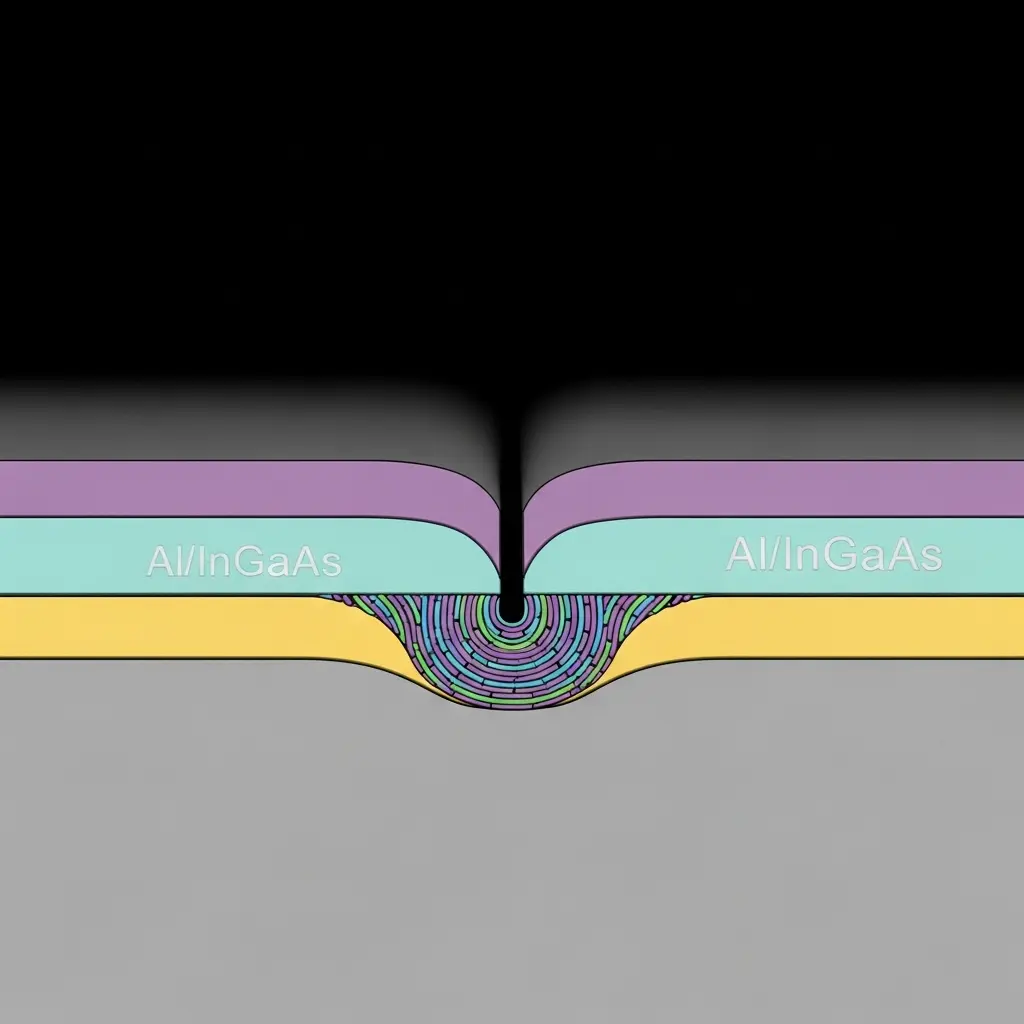
Scientists are tackling a critical challenge in developing advanced quantum devices: creating robust and high-quality interfaces between superconductors and semiconductors. A. Elbaroudy, N. Shaw, and A. Elbaroudy, from the University of Waterloo and its affiliated facilities, alongside B. D. Moreno, F. Sfigakis, J. Baugh, and Z. R. Wasilewski, detail a novel approach to growing epitaxial aluminium films on indium gallium arsenide, a key material combination for hosting exotic quantum states like Majorana bound states. Their research, utilising techniques such as molecular-beam epitaxy and advanced microscopy, reveals how precise control of growth conditions prevents unwanted material mixing and film degradation, instead promoting continuous, superconducting layers. This work is significant because it establishes clear guidelines for fabricating stable hybrid superconductor-semiconductor platforms, paving the way for more reliable and scalable quantum technologies.
Their research, utilising techniques such as molecular-beam epitaxy and advanced microscopy, reveals how precise control of growth conditions prevents unwanted material mixing and film degradation, instead promoting continuous, superconducting layers.
Epitaxial Aluminium on Indium Gallium Arsenide growth
Scientists have achieved a significant breakthrough in fabricating high-quality superconductor, semiconductor hybrid platforms essential for advanced quantum devices. This research addresses a key challenge in realizing robust topological superconductivity, a phenomenon predicted to host Majorana bound states with potential applications in fault-tolerant quantum computing. Further investigation focused on the thermal stability of these films, both under in situ post-growth heating and ex situ following surface oxidation. Notably, the research reveals that unoxidized aluminum films undergo solid-state dewetting at approximately 165°C, resulting in the formation of {111}-faceted aluminum islands.
These findings establish precise growth and annealing conditions for thermally robust epitaxial aluminum on III, V semiconductors, offering practical guidance for fabricating high-quality hybrid platforms. This work establishes a high aluminum deposition rate of 3 Å/s at a near-room-temperature substrate temperature (approximately 14°C) as a viable strategy for achieving uniform, continuous films comparable to those produced using slower, low-temperature deposition methods. The team’s detailed analysis of crystal orientation using TEM and EELS confirms the abrupt interface and minimal indium interdiffusion, validating the effectiveness of their approach. By clarifying the thermal and kinetic limits of these films, the study provides essential insights for optimizing the performance and scalability of future quantum devices based on Al/InGaAs heterostructures, bringing the realization of topological quantum computation one step closer.,.
Aluminium Film Growth via Molecular-Beam Epitaxy
To assess thermal stability, the study investigated films both in situ with post-growth heating and ex situ following surface oxidation. Unoxidized aluminium samples underwent rapid surface diffusion at approximately 500°C, initiating solid-state dewetting and forming -faceted aluminium islands. Experiments employed four-terminal AC lock-in techniques within a helium-3/helium-4 dilution refrigerator (Oxford Instruments TLM, 12 mK base temperature) to precisely measure the superconducting-to-normal transition of 13nm thick aluminium films. The team characterised the in-plane critical magnetic field (Bc,∥) for samples G1001 and G0972, revealing G1001 exhibited a sharper transition at Bc,∥= 0.97 T, consistent with previously reported epitaxial aluminium films.
Sample rotation during growth correlated with improved layer uniformity and enhanced performance in G1001, while secondary transitions were attributed to minor thickness variations. TEM micrographs revealed faceted aluminium agglomerates, with sidewall inclinations of ≈35.8◦, aligning with the theoretical angle of 35.26◦ between the and directions of an fcc lattice, providing compelling evidence for growth along the direction bounded by stable {111} facet planes.,.
Epitaxial Aluminium Films Grown Without Indium Diffusion exhibit
Scientists achieved the epitaxial growth of aluminum films via molecular-beam epitaxy on substrates under near-room-temperature conditions, demonstrating a crucial step towards advanced hybrid superconductor-semiconductor devices. This precise control over film deposition is essential for fabricating high-performance hybrid platforms. Experiments revealed that unoxidized aluminum films undergo rapid surface diffusion triggering solid-state dewetting at approximately 165°C, resulting in the formation of {111}-faceted aluminum islands. Detailed analysis showed that the onset of dewetting is strongly temperature-dependent, indicating a critical threshold for thermal stability.
These findings demonstrate the protective effect of surface passivation against thermally induced degradation. The team precisely quantified the extent of indium migration, establishing a clear correlation between annealing temperature and interfacial contamination. Tests prove that maintaining temperatures below 156.6°C is vital for preserving interface integrity and preventing performance degradation. Researchers recorded that the high aluminum deposition rate of 3 Å/s, combined with a near-room-temperature substrate temperature of approximately 14°C, consistently produced uniform and continuous films. These optimized parameters represent a significant advancement in materials science, enabling the fabrication of devices with enhanced performance and reliability. The study’s findings are directly applicable to the development of Andreev spin qubits, gatemon and transmon devices, and topological-superconductor architectures aimed at realizing Majorana bound states.
Aluminium-on-Indium Gallium Arsenide Growth Parameters Defined
This achievement addresses a key challenge in fabricating hybrid superconductor-semiconductor platforms, essential for exploring exotic quantum phenomena like Majorana bound states. These findings define optimal growth conditions and provide practical guidance for creating thermally robust epitaxial aluminium layers on III-V semiconductors. The authors acknowledge that the observed chevron angles in RHEED patterns require further detailed modelling to definitively determine the specific facet indices. Future research could focus on exploring the impact of different oxide treatments or barrier layers to further improve film stability and interface quality. These advancements are crucial for realising functional devices based on hybrid superconductor-semiconductor heterostructures and advancing the field of topological quantum computation.
👉 More information
🗞 Hybrid Epitaxial Al/InGaAs system: Solid-state dewetting and Al facet formation
🧠 ArXiv: https://arxiv.org/abs/2601.13523



See today’s quantum computing news on Quantum Zeitgeist for the latest breakthroughs in qubits, hardware, algorithms, and industry deals.



