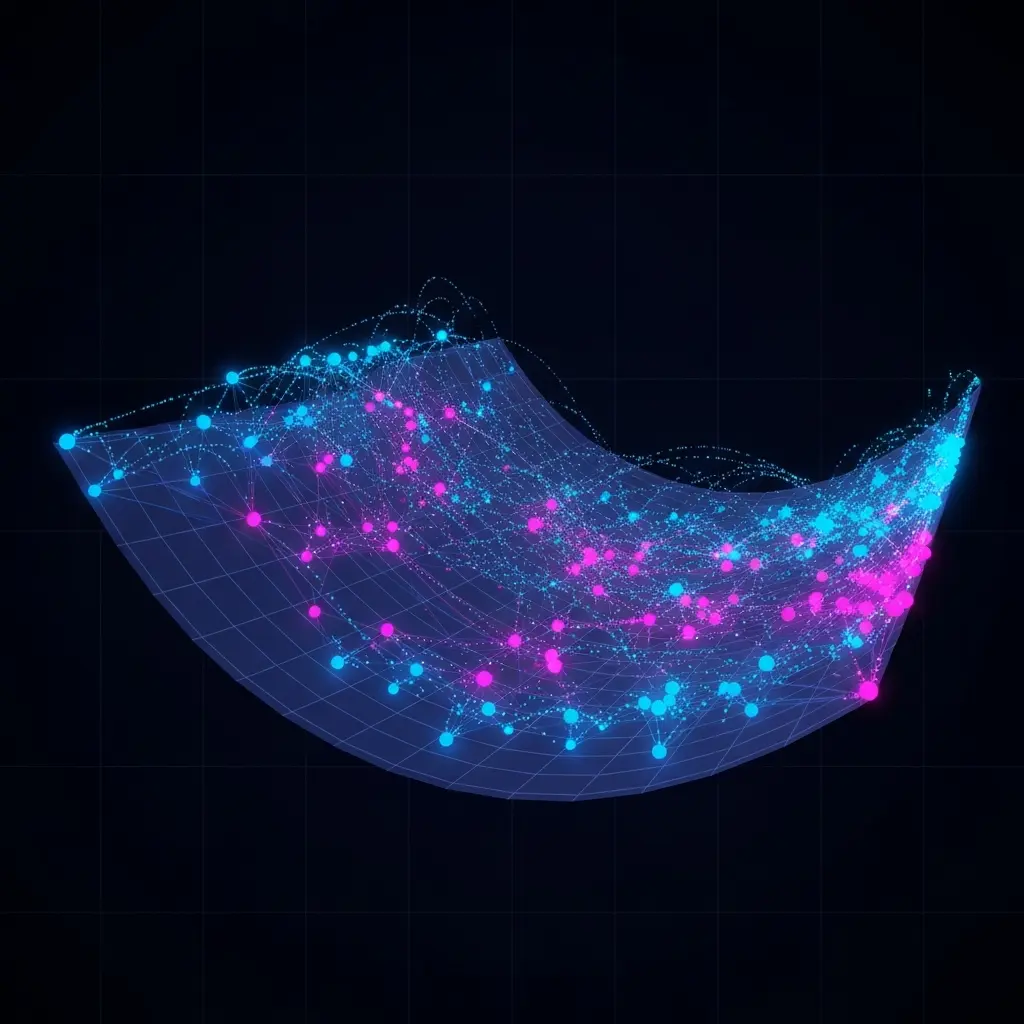
Scientists are tackling the challenge of modelling irregularly-sampled dynamics in non-Euclidean spaces, a common problem when representing real-world data with complex relationships. Liangsi Lu from Guangdong University of Technology, Jingchao Wang from Peking University, and Zhaorong Dai from South China Agricultural University, along with Liu Hanqian and Yang Shi, present a novel framework , the Riemannian Liquid Spatio-Temporal Graph Network (RLSTG) , which blends continuous-time liquid dynamics with the geometric strengths of Riemannian manifolds. This innovative approach overcomes the limitations of existing methods by modelling evolution directly on curved manifolds, preserving intrinsic geometry in both static and dynamic spatio-temporal data. Rigorous theoretical guarantees and extensive experiments on real-world benchmarks confirm that RLSTG significantly outperforms current techniques on datasets with intricate structures, offering a powerful new tool for a range of applications.
This innovative approach allows for a more accurate modelling of complex relationships within data such as social networks, citation graphs, and transportation networks, which often possess inherent hierarchical or cyclical structures. Experiments conducted on real-world benchmarks demonstrate that RLSTG achieves superior performance compared to existing methods when dealing with graphs possessing complex structures and irregularly sampled data. By combining advanced temporal dynamics with a Riemannian spatial representation, the model effectively mitigates the limitations of Euclidean-based approaches.
The work establishes a provably convergent ODE solver specifically designed for stiff dynamics on manifolds, ensuring stable and reliable performance. This innovation opens new avenues for modelling and analysing a wide range of real-world phenomena, from user interactions in social networks to sensor data in traffic monitoring systems. This research introduces a framework that not only addresses the geometric limitations of existing continuous-time graph models but also provides a solid theoretical foundation for its operation. The team’s theoretical contributions include extending stability theorems and quantifying expressive power via state trajectory analysis, solidifying the model’s reliability and capabilities. RLSTG’s ability to handle both irregular temporal sampling and complex spatial geometry positions it as a powerful tool for a diverse range of applications, including anomaly detection, predictive modelling, and knowledge graph reasoning. The project page, accessible at https://rlstg. github. The system delivers a significant advancement over existing methods by accurately representing hierarchical structures with minimal distortion, and capturing cyclical patterns more effectively.
This innovative approach enables more robust and accurate modelling of complex spatio-temporal data, offering a substantial improvement in performance across various applications. Furthermore, the work provides expressivity analyses, demonstrating the model’s ability to represent a wide range of dynamic behaviours. The research highlights that RLSTG not only addresses the geometric limitations of previous models but also offers a theoretically sound and empirically validated solution for continuous-time spatio-temporal graph representation learning. This breakthrough paves the way for more accurate and efficient analysis of complex systems in fields such as social networks, transportation, and molecular biology.
RLSTG captures geometry in dynamic graph modelling
Data shows that on a cycle graph, the Spherical embedding enabled a richer, more intricate trajectory, and the variance explained by principal components was significantly higher in geometrically-aligned spaces compared to Euclidean ones. Specifically, the cumulative variance explained by the first few components in the geometrically-aligned spaces demonstrated increased dimensionality and expressiveness, confirming that aligning model geometry with data structure unlocks expressive potential. Results demonstrate superior performance on node feature regression tasks using three traffic forecasting benchmarks: METR-LA, PEMS03, and PEMS04. The model achieved a Mean Absolute Error (MAE) of 2.77 ±0.01 on the METR-LA dataset, 17.49 ±0.02 on PEMS03, and 24.08 ±0.01 on PEMS04, consistently outperforming existing methods like DCRNN (4.55 ±0.14, 19.53 ±0.17, 26.03 ±0.24) and AGCRN (3.58 ±0.19, 18.21 ±0.08, 25.01 ±0.17).
These measurements confirm that capturing the intrinsic geometry of the traffic network leads to more accurate forecasts. Tests prove RLSTG’s effectiveness in handling evolving network topologies through experiments on the ENRON social network dataset for link prediction. The model achieved an Average Precision of 83.14 ±0.21 in transductive settings and 73.26 ±0.10 in inductive settings, surpassing methods like JODIE (69.89 ±0.21, 66.51 ±0.64) and HG-WaveNet (80.55 ±0.48, 71.42 ±0.38). The breakthrough delivers robust generalization capability for dynamic graphs, as demonstrated by its performance on both transductive and inductive subsets. Ablation studies further quantified the impact of the geometric representation space, solidifying the importance of this novel approach.
RLSTG captures geometry in dynamic graph data effectively
The authors acknowledge limitations including computational cost and the use of fixed geometries, suggesting future work could explore enhanced efficiency, automated manifold selection, and dynamic geometric representations. This work bridges continuous-time dynamics and geometric deep learning, offering a more faithful approach to modelling complex networks and potentially advancing fields reliant on spatio-temporal data analysis.
👉 More information
🗞 Riemannian Liquid Spatio-Temporal Graph Network
🧠 ArXiv: https://arxiv.org/abs/2601.14115




See today’s quantum computing news on Quantum Zeitgeist for the latest breakthroughs in qubits, hardware, algorithms, and industry deals.