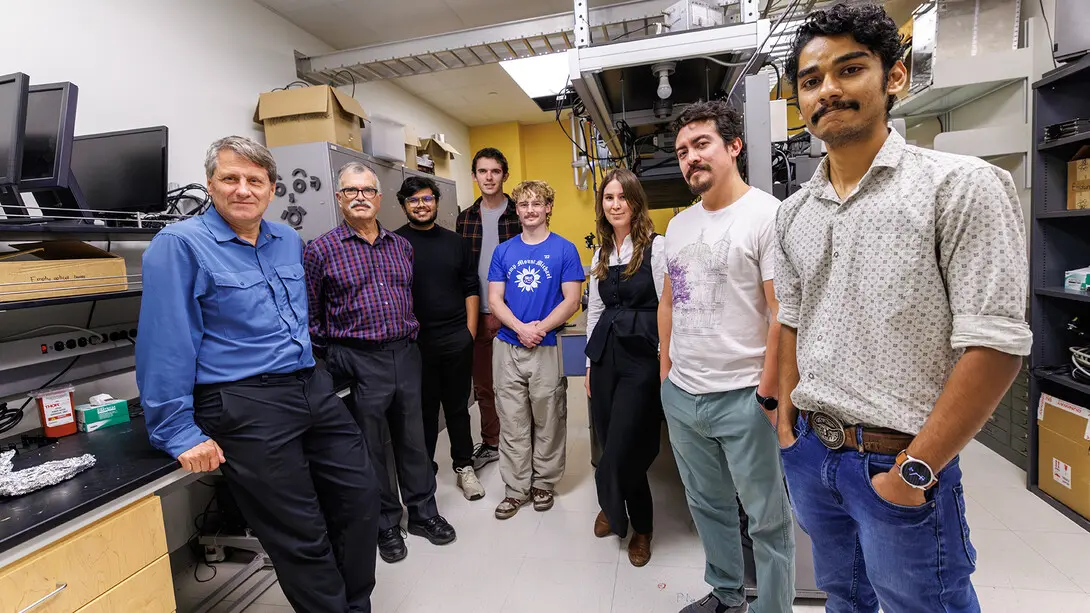
Herman Batelaan of the University of Nebraska–Lincoln has been awarded the 2026 Davisson-Germer Prize for advances in free-electron quantum optics. The prize recognizes his work, including the first demonstration of the Kapitza-Dirac effect where light acts as a diffraction grating for electrons. This honor, presented by the American Physical Society, acknowledges Batelaan’s outstanding contributions to atomic physics and surface science.
Batelaan Awarded 2026 Davisson-Germer Prize in Atomic Physics
Batelaan’s award acknowledges advancements in free-electron quantum optics, a field he helped develop. This reverses the findings of the original 1927 Davisson-Germer experiment, which showed electrons diffracting from matter, earning Davisson a Nobel Prize. His research group’s experiments have also expanded understanding of the Aharonov-Bohm effect, a quantum mechanical phenomenon. Batelaan’s nearly four-decade career has focused on challenging established understandings of quantum mechanics, including investigating a decades-old error in the Stern-Gerlach effect. Currently, he leads NSF-funded research exploring the quantum measurement problem and the limits of the Pauli exclusion principle.
Free-Electron Quantum Optics & Key Experimental Demonstrations
Batelaan’s research has significantly advanced the field of free-electron quantum optics, focusing on fundamental interactions between light and electrons. This work expands understanding of how electrons behave when interacting with light, demonstrating diffraction in a previously unobserved manner. Furthermore, Batelaan’s lab explored the Stern-Gerlach effect with electron beams, uncovering a decades-old error in its conventional understanding. These ongoing efforts aim to challenge established principles and push the boundaries of quantum theory and experimentation.
Stern-Gerlach Effect Reversal & Kapitza-Dirac Diffraction
The team combined experimental work with theoretical analysis to successfully observe this diffraction, expanding understanding of electron behavior. Furthermore, the research reversed a key concept from the original Davisson-Germer experiment, recognized with a Nobel Prize, by demonstrating a new way electrons interact with energy. This work on the Stern-Gerlach effect for electron beams also uncovered a decades-old error in established understanding, further solidifying the significance of this area of quantum optics.
NSF-Funded Research: Quantum Measurement & Pauli Exclusion Tests
NSF-funded research in Batelaan’s lab investigates the quantum measurement problem, focusing on particles existing in multiple states before observation. This work examines the moment a particle “chooses” a single outcome when measured, exploring a fundamental aspect of quantum behavior. Researchers are attempting to understand how observation influences quantum systems and the implications for understanding reality at a subatomic level. Another NSF-supported experiment tests the validity of the Pauli exclusion principle under extreme conditions.
This principle states that no two identical fermions can occupy the same quantum state, but the research probes whether this holds true when a quantum wave is disturbed at speeds exceeding that of light. By pushing the boundaries of established quantum principles, the team hopes to reveal new insights into the foundational laws governing the universe.
The Davisson-Germer Prize is one of the highest honors in atomic physics, and Dr. Batelaan’s selection speaks volumes about the depth and originality of his research.
Pat Dussault
Source: https://news.unl.edu/article/batelaans-quantum-curiosity-draws-national-recognition-to-nebraska

See today’s quantum computing news on Quantum Zeitgeist for the latest breakthroughs in qubits, hardware, algorithms, and industry deals.