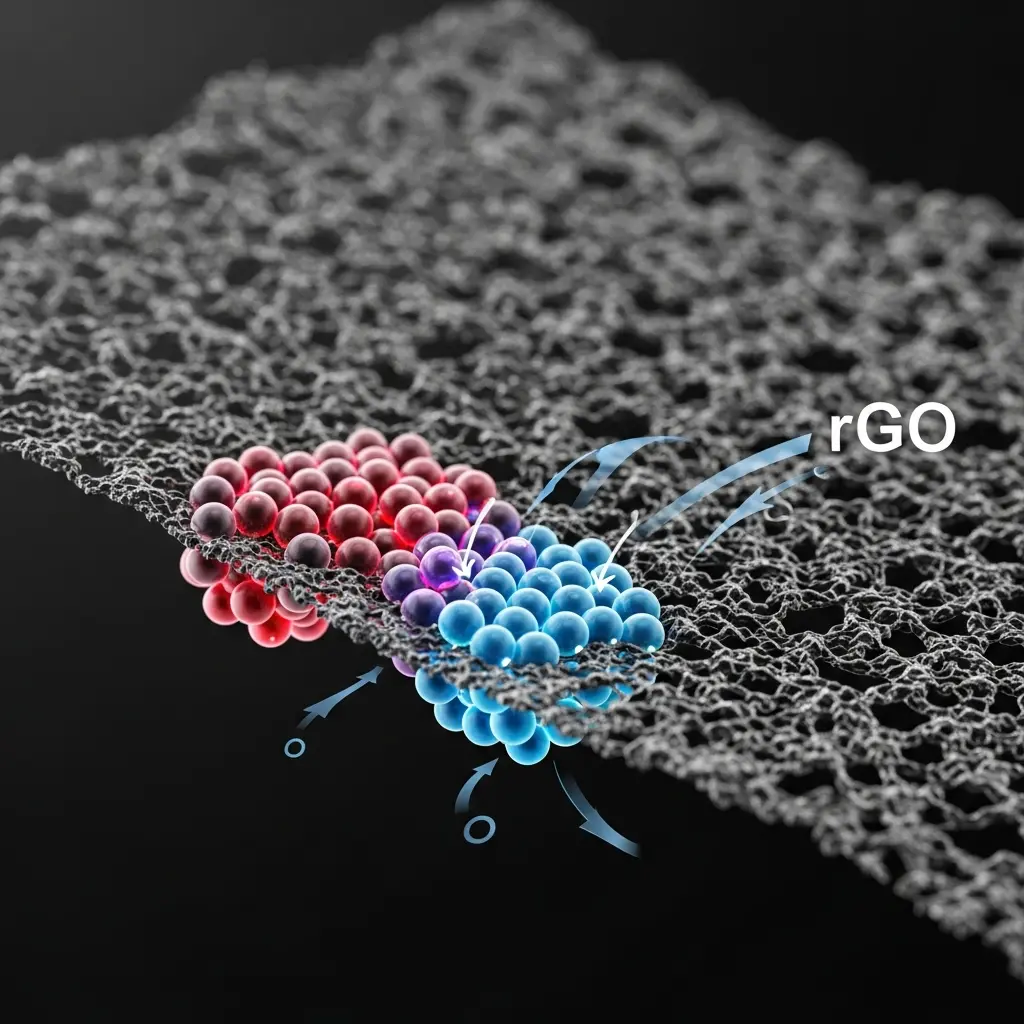
Researchers are increasingly focused on combining quantum dots with graphene oxide to create novel hybrid materials with enhanced optoelectronic properties. Beatriz Martín-García, Anatolii Polovitsyn, and Mirko Prato, alongside Iwan Moreels and colleagues from the Istituto Italiano di Tecnologia and the University of Genoa, detail a new covalent-linking approach to functionalise reduced graphene oxide with quantum dots, specifically PbS, PbS/CdS, and CdSe varieties, enabling versatile hybrid dispersions. Their findings demonstrate remarkably efficient charge transfer from the quantum dots to the graphene oxide, evidenced by up to 95% quenching of photoluminescence and exciton lifetime shortening, which is significant because it paves the way for improved light harvesting and more efficient optoelectronic devices through solution-processed, scalable methods.
Quantum dot functionalisation of reduced graphene oxide
Engineering QD-rGO Hybrid Materials via Covalent Linkers
Scientists have demonstrated a versatile covalent-linking approach to functionalise reduced graphene oxide (rGO), creating a variety of quantum dot, rGO hybrid dispersions with differing quantum dot (QD) sizes, compositions, including PbS, PbS/CdS, and CdSe QDs, and shapes, such as CdSe/CdS dot-in-rods. This research establishes a well-controlled QD coverage of rGO sheets achieved by functionalising the rGO surface with mercapto-silane linkers, paving the way for advanced optoelectronic materials. Spectroscopic investigation of near-infrared PbS QD-rGO materials reveals efficient electronic coupling between the two materials, a crucial step towards enhancing device performance. The team achieved significant quenching of QD photoluminescence emission and shortening of exciton lifetimes by up to 95%, alongside subtle Raman G-band shifts, confirming electron transfer as the dominant relaxation pathway from the QD to the rGO.
This breakthrough reveals a method for tuning charge transfer efficiency using core/shell PbS/CdS QDs, achieving 94% transfer efficiency with a 0.2nm CdS shell, and decreasing it to 30% with a 1.1nm thick shell, demonstrating precise control over material interactions. The work opens possibilities for optimising hybrid material performance by manipulating the shell thickness and, consequently, the electronic coupling between QDs and rGO. Researchers employed a covalent linking method, anchoring QDs to rGO using short-chained silane molecules, ensuring uniform and density-controlled QD coverage. By first optimising each constituent individually, followed by controlled coupling, the team successfully created hybrid materials with tailored optoelectronic properties.
Experiments show that the functionalisation of rGO with (3-mercaptopropyl) trimethoxysilane (MPTS) is key to achieving this uniform QD coverage, enabling the creation of high-performance hybrid materials for potential applications in light harvesting and optoelectronic devices. Further investigation into near-infrared (NIR)-emitting PbS QD-rGO materials demonstrates the efficient electronic coupling between the materials, a critical factor for enhancing charge transport and device efficiency. The observed photoluminescence quenching and exciton lifetime shortening provide strong evidence for efficient carrier transfer, suggesting a promising pathway for developing advanced optoelectronic devices. The study unveils that the charge transfer efficiency can be carefully tuned by varying the thickness of the CdS shell surrounding the PbS QDs, offering a powerful tool for optimising material performance.
Mechanisms for Controlling Charge Transfer Efficiency
Specifically, a thinner shell (0.2nm) promotes more efficient charge transfer, while a thicker shell (1.1nm) reduces it, allowing for precise control over the electronic properties of the hybrid material. Subtle shifts in the rGO Raman G-band upon QD coupling further support the electron transfer mechanism, indicating that electrons are efficiently transferred from the QDs to the rGO, facilitating charge transport within the hybrid material. This research establishes a foundation for developing solution-processed materials with low cost and scalability, crucial for driving the development of future photonic devices such as solar cells, photodetectors, LEDs, and lasers.
Covalent QD-rGO Hybridisation via Mercapto-Silane Linkers enhances stability
Scientists engineered a versatile covalent-linking approach to functionalize reduced graphene oxide (rGO) with quantum dots (QDs) of varying size, composition, and shape, including PbS, PbS/CdS, and CdSe/CdS dot-in-rods, creating a range of QD-rGO hybrid dispersions. The study pioneered a method for achieving well-controlled QD coverage on rGO sheets by initially functionalizing the rGO surface with mercapto-silane linkers, facilitating efficient electronic coupling between the two materials. Researchers employed a solution-processed strategy, crucial for developing low-cost and scalable hybrid materials applicable to light harvesting and opto-electronic devices. To begin, the team reduced graphene oxide (GO) using caffeic acid, a green alternative to hydrazine, achieving an O/C ratio of 0.22 for the resulting rGO, comparable to other green reduction methods while reducing reaction time threefold.
Synthesis Protocols and High-Efficiency Characterization Results
The degree of reduction was meticulously determined using X-ray photoelectron spectroscopy (XPS), analysing the elemental composition of both GO and rGO to confirm successful reduction. Subsequently, rGO was functionalized with (3-mercaptopropyl) trimethoxysilane (MPTS) via a simple mixing process in ethanol at 60°C, creating silane-f-rGO. XPS analysis revealed an average S/C ratio of 0.13, demonstrating a significantly enhanced functionalization degree compared to alternative methods using aminobenzene derivatives, which only achieved an N/C ratio of 0.02. This innovative silane-based coupling method leverages the ability of MPTS to bind to rGO through both Si-O bonds and to QDs via SH groups, ensuring robust QD anchoring.
Spectroscopic investigations of near-infrared PbS QD-rGO materials revealed efficient electronic coupling, evidenced by up to 95% quenching of QD photoluminescence emission and a shortening of exciton lifetime. Subtle Raman G-band shifts observed upon QD linking further supported electron transfer as the dominant relaxation pathway from the QD to the rGO. Furthermore, core/shell PbS/CdS QDs were utilized to tune transfer efficiency, achieving 94% for a 0.2nm CdS shell and reducing it to 30% for a 1.1nm thick shell, demonstrating precise control over charge transfer dynamics.
Quantum Dot-Graphene Oxide Coupling and Electron Transfer enhance
Scientists achieved a well-controlled quantum dot (QD) coverage on reduced graphene oxide (rGO) sheets using a novel covalent-linking approach. The research team successfully functionalized rGO with mercapto-silane linkers, enabling the preparation of diverse QD-rGO hybrid dispersions incorporating PbS, PbS/CdS, and CdSe QDs of varying sizes, compositions, and shapes, including CdSe/CdS dot-in-rods. Spectroscopic investigations of near-infrared PbS QD-rGO materials demonstrated efficient electronic coupling between the two materials, a crucial step towards advanced optoelectronic devices. Measurements revealed a significant quenching of QD photoluminescence emission and a shortening of exciton lifetime by up to 95%, indicating electron transfer from the QD to the rGO as the dominant relaxation pathway.
The team meticulously tuned charge transfer efficiency using core/shell PbS/CdS QDs, achieving 94% transfer efficiency with a 0.2nm CdS shell, and decreasing it to 30% with a 1.1nm thick shell. This precise control over shell thickness demonstrates a pathway for optimizing hybrid material performance. X-ray photoelectron spectroscopy (XPS) confirmed a reduction in the oxygen-to-carbon (O/C) ratio from 0.40 in initial graphene oxide (GO) to 0.22 in rGO, comparable to results obtained with green reducing agents and achieved with a three-fold reduction in reaction time. Detailed XPS analysis of the silane-functionalized rGO (silane-f-rGO) showed a sulfur-to-carbon (S/C) ratio of 0.13, significantly enhancing functionalization compared to alternative approaches using aminobenzene derivatives which only yielded a nitrogen-to-carbon (N/C) ratio of 0.02.
Further analysis of the S2p XPS spectrum of silane-f-rGO revealed that 98 ±2% of the sulfur was present as unbound thiol moieties (-SH), confirming that the chemical interaction between MPTS and rGO occurs via a Si-O-C pathway, leaving the SH group available for QD binding. Transmission electron microscopy (TEM) images of the hybrid materials, using 5.0nm PbS QDs, clearly showed that the QDs exclusively covered the rGO sheets, with no unbound QDs observed. The QD surface density was also controlled by varying the QD/rGO ratio, increasing the density by a factor of 1.7 by changing the ratio from 0.2 to 0.8 nmol QDs per μg of rGO. Control experiments using GO instead of rGO showed a three-fold lower QD density despite similar linker functionalization, highlighting the importance of rGO’s reduced state for efficient QD coupling.
Quantum dot-rGO coupling via silane functionalisation enhances photocatalytic
Scientists have developed a scalable method for assembling colloidal quantum dots (QDs) and reduced graphene oxide (rGO) into hybrid dispersions.This approach utilises silane-functionalised rGO, creating a material containing both light-absorbing QDs and an electron-transporting component in a single solution. Investigations reveal well-defined hybrids with controlled QD coverage on the rGO sheets, demonstrating potential for applications in photovoltaics and optoelectronic devices.The research demonstrates efficient electronic coupling between QDs and rGO, evidenced by a significant reduction in QD luminescence lifetime, up to 95%, and shifts in the rGO Raman spectrum.
Core/shell PbS/CdS QDs were also examined, showing that the thickness of the CdS shell modulates charge transfer efficiency, creating a balance between transfer rate and QD stability. A 0.2nm shell maintained efficient transfer while improving QD surface passivation, suggesting a pathway to more robust hybrid devices. The authors acknowledge a trade-off exists between shell thickness and charge transfer efficiency, requiring careful optimisation for device performance. Furthermore, the study was limited to specific QD compositions and rGO reduction levels, and future work could explore a wider range of materials and processing conditions. Researchers suggest extending this work to investigate the long-term stability of these QD-rGO hybrids under operational conditions and exploring their performance in fully fabricated devices, potentially leading to improved light harvesting and electron transport in future technologies.
.
🗞 Efficient charge transfer in solution-processed PbS Quantum Dot-reduced graphene oxide hybrid materials
🧠 ArXiv: https://arxiv.org/abs/2601.14144



See today’s quantum computing news on Quantum Zeitgeist for the latest breakthroughs in qubits, hardware, algorithms, and industry deals.