

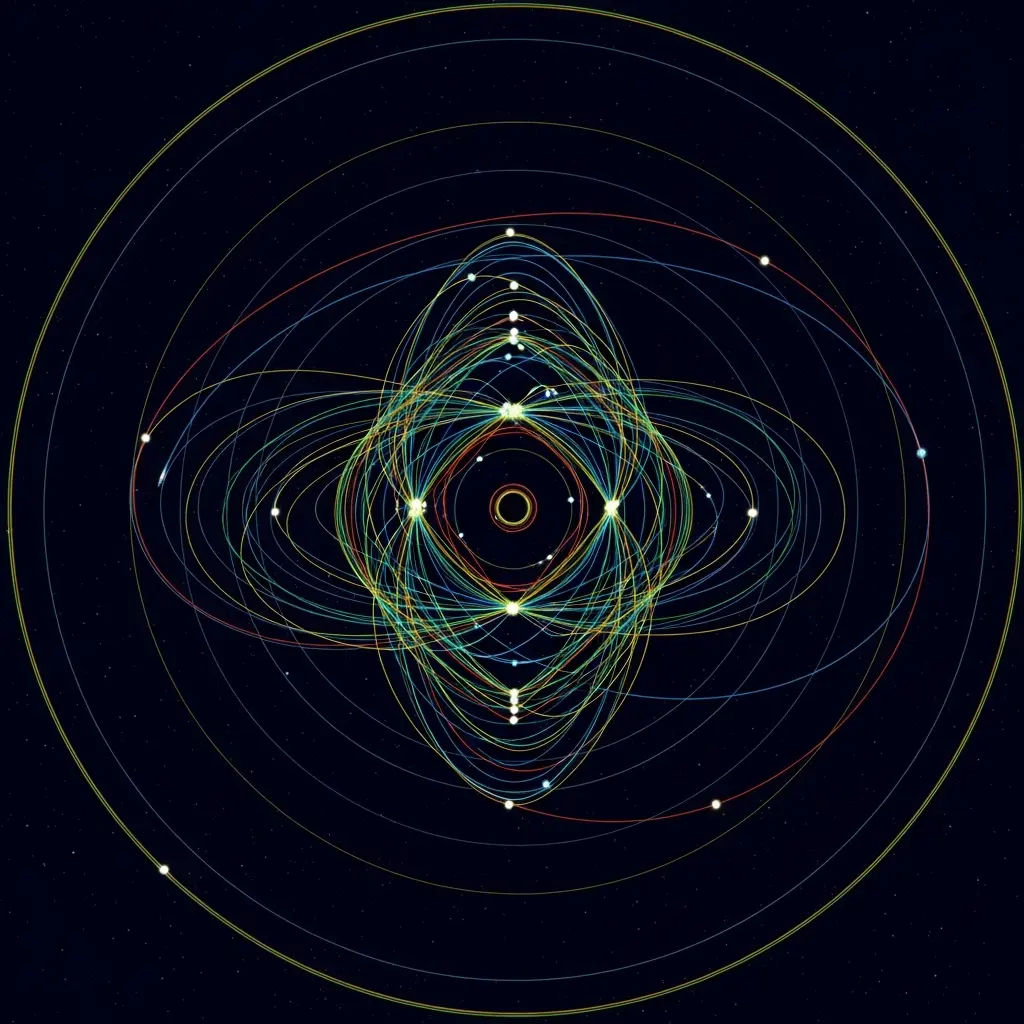
Mean motion resonances, fundamental to understanding the dynamics of celestial bodies, typically demonstrate a predictable strength hierarchy based on resonance order. Elizabeth K. Jones of Harvey Mudd College, Samuel Hadden from the Canadian Institute for Theoretical Astrophysics, and Daniel Tamayo, also of Harvey Mudd College, and their colleagues challenge this established understanding with new research into the cancelling effects of planetary conjunctions. Their work reveals that the strength of higher order resonances is significantly weaker than previously thought, not due to inherent dynamical properties, but because of the way planets interact during close approaches. This research provides a novel, physically intuitive explanation for the observed scaling of resonance strengths, moving beyond traditional mathematical expansions to focus on the impact of specific gravitational interactions. The findings offer a refined model for predicting the influence of resonances in planetary systems and beyond.
The research establishes why certain resonant configurations, such as 3:2 and 4:3, significantly influence planetary systems while others do not. The team achieved this by moving beyond traditional perturbation theory and instead focused on the physical interactions occurring during close encounters between planets. This work unveils that the strength of a resonance scales proportionally to the eccentricity raised to the power of the resonance order, a relationship previously derived through technical means but now explained through a physically intuitive model.
The study reveals that interplanetary interactions are largely negligible except during conjunctions, when planets exert a gravitational “kick” on each other’s orbits. Researchers focused on closely spaced orbits, simplifying the problem by considering only these impulsive gravitational interactions at conjunction, effectively modelling the system as a discrete map. This approach allowed the team to connect the dynamics of two planets to the circular restricted three-body problem, a well-understood simplification that facilitates analytical progress. By focusing on the effects of individual conjunctions, the scientists developed a new derivation of the established scaling law for mean motion resonance strengths.
Experiments show that first-order resonances involve a single conjunction before the orbital configuration repeats, leading to a coherent gravitational effect. However, higher-order resonances involve multiple conjunctions within a single cycle. The research demonstrates that the effects of these multiple conjunctions tend to cancel each other out more effectively as the order of the resonance increases, explaining their diminished strength. This cancellation extends beyond first-order effects in eccentricity, providing a more complete physical understanding of the observed scaling. This breakthrough reveals a fundamental principle governing orbital dynamics, offering a physical answer to why resonance strengths scale as eccentricity to the power of the resonance order. The work opens new avenues for understanding the architecture of planetary systems, rings, and disks, where mean motion resonances play a critical role in stability and evolution. By starting from the effects of a single conjunction, the team provides an alternate, physically motivated derivation of MMR strengths, potentially useful for a range of dynamical problems in astrophysics and celestial mechanics.
Hill Limit Model of Resonance Strength Scaling
The study investigates the dynamics of mean motion resonances (MMRs) and sought to provide a physical explanation for the observed scaling of resonance strength with eccentricity. Researchers began by establishing a dynamical model focused on closely spaced orbits, leveraging the Hill limit to simplify analytical progress. This approach allowed the team to accurately model planetary interactions as discrete, impulsive gravitational “kicks” occurring only at conjunction, ignoring interactions at other times. By focusing on these critical moments, the study effectively transformed the problem into a discrete map of impulses between Keplerian orbits.
Scientists further refined their model by exploiting the equivalence between the two-planet problem in the Hill limit and the circular restricted three-body problem (CR3BP). This simplification enabled analysis of a single planet with mass m and an exterior test particle characterized by eccentricity e and longitude of pericenter π. The team utilized this CR3BP framework to establish a one-to-one mapping with the more complex two-planet system. This innovative approach allowed for a focused analysis of resonant interactions. To quantify eccentricity, the research introduced a normalized eccentricity e = e/ *e c *, representing the eccentricity as a fraction of the orbit-crossing value.
This normalization removes dependence on orbital separation, allowing for direct comparison of MMRs of the same order. The study then meticulously evaluated the effects of individual conjunctions, building upon prior work, to determine the strength of first-order MMRs. Extending this analysis to higher-order resonances, the team demonstrated that the effects of multiple conjunctions within a resonant cycle largely cancel, leading to the traditional e scaling of MMR strengths. This alternate derivation, originating from the effects of individual conjunctions, provides a physical basis for a central principle in orbital dynamics.
Mean Motion Resonance Strength Scales with Orbit Order
Scientists have achieved a refined understanding of mean motion resonances (MMRs), a fundamental phenomenon governing orbital dynamics, by demonstrating a direct physical explanation for the observed scaling of resonance strength. The research reveals that the strength of MMRs scales as 1/n, where n represents the order of the resonance, confirming a long-standing theoretical prediction. However, this work moves beyond purely mathematical derivation to provide intuitive physical reasoning behind this relationship. Experiments focused on closely spaced orbits, revealing that interplanetary interactions are largely confined to brief encounters at conjunction, where planets exert a gravitational “kick” on each other’s mean motion.
The team measured that first-order MMRs, such as 3:2 and 4:3, involve a single conjunction per cycle, allowing for coherent accumulation of these gravitational impulses. Conversely, higher-order MMRs exhibit multiple conjunctions per cycle, with the effects of these interactions cancelling each other out more effectively as the resonance order increases. This cancellation explains why first-order resonances dominate while higher-order ratios remain comparatively weak. Data shows that for a 10:9 MMR, the gravitational interactions at conjunction, even when initially ignored, allow perturbations to accumulate coherently, potentially leading to significant cumulative effects on orbital evolution.
Scientists recorded that the conjunction angle, defined as the difference between the actual conjunction location and the point of closest orbital approach, varies continuously and predictably. This allowed for the development of a pendulum approximation, simplifying the analysis by assuming fixed eccentricity and pericenter, and enabling the derivation of a differential equation governing the resonant angle θ. Measurements confirm that expressing eccentricities as a fraction of the orbit-crossing value normalizes the dynamics, resulting in a single universal coefficient for all MMRs of a given order at close separations. Specifically, the crossing eccentricity for a p:p-q MMR is defined as ec ≈ 2q/3p, providing a physically meaningful measure of orbital proximity. The breakthrough delivers a more intuitive understanding of MMR strength, paving the way for improved modelling of planetary system architectures and long-term orbital stability. This work establishes a foundation for predicting the behaviour of multi-planetary systems and assessing the potential for orbital resonances to influence planetary migration and habitability.
Resonance Strength Explained by Orbital Geometry
This work offers a novel physical interpretation for the established scaling of mean motion resonance strength with eccentricity. Researchers demonstrated that the weakness of higher-order resonances stems from the cancellation of gravitational “kicks” experienced during multiple conjunctions per orbital cycle, a phenomenon not readily apparent from traditional mathematical derivations. By focusing on the geometry of close encounters, they provide an intuitive explanation for why first-order resonances dominate planetary system dynamics. The study successfully reproduced the known relationship defining resonance strength, scaling proportionally to eccentricity, through a physically motivated approach building upon Fourier analysis of orbital perturbations at conjunction.
This geometrical framework offers a valuable alternative to perturbation theory, potentially broadening understanding across a range of dynamical problems involving interacting bodies. The authors acknowledge that their analysis is primarily applicable to closely spaced orbits, representing a limitation to the scope of their findings. Future research could further refine the understanding of resonance widths and oscillation frequencies. While the current work concentrates on the strength of resonances, extending the model to incorporate additional factors influencing orbital stability remains an.
👉 More information
🗞 Canceling Effects of Conjunctions Render Higher Order Mean Motion Resonances Weak
🧠 ArXiv: https://arxiv.org/abs/2601.10585




See today’s quantum computing news on Quantum Zeitgeist for the latest breakthroughs in qubits, hardware, algorithms, and industry deals.



