

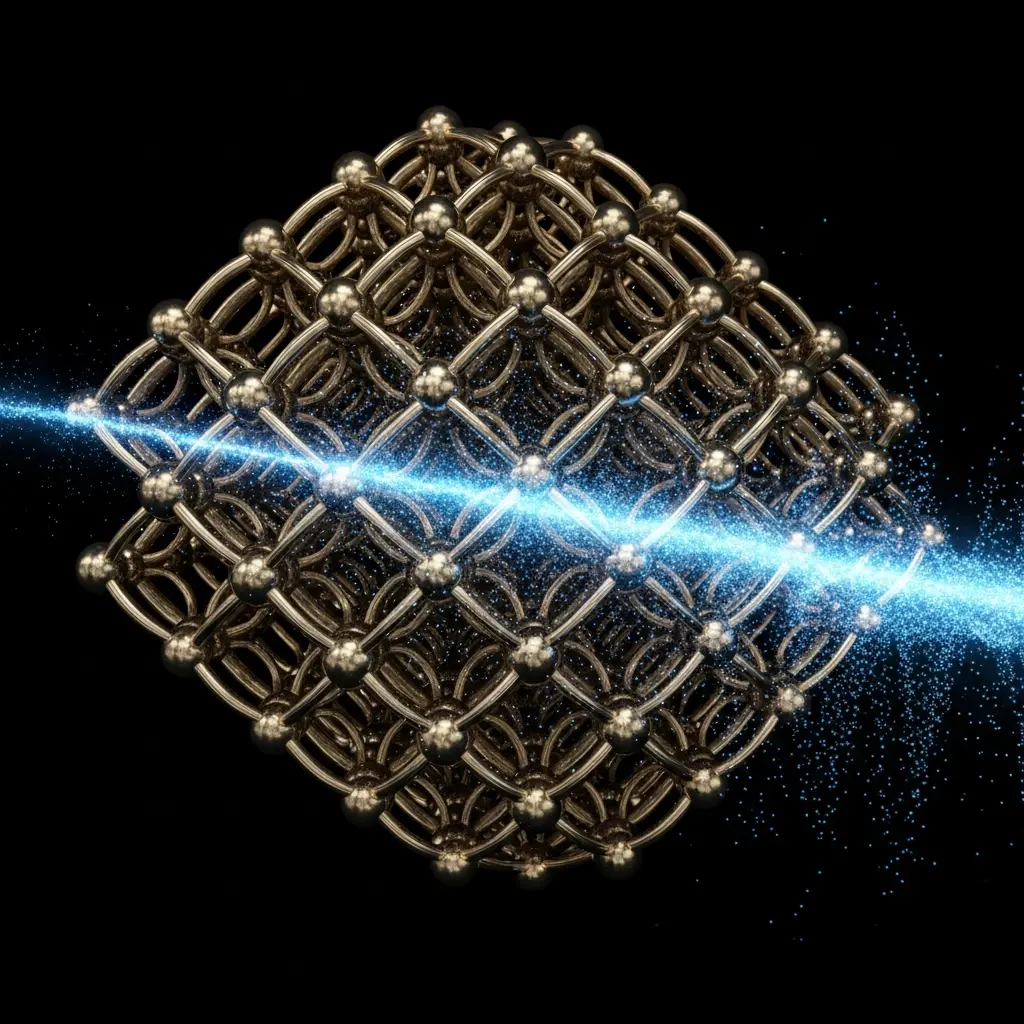
Quasiperiodic systems exhibit unusual transport characteristics that differ significantly from both periodic and disordered materials, and recent research sheds new light on these behaviours. Jinyuan Shang from the Beijing National Laboratory for Condensed Matter Physics, alongside Haiping Hu, investigated transport within the Aubry-André-Harper lattice using a nonequilibrium Green’s function method to evaluate conductance. Their work reveals subdiffusive transport in the extended phase, linked to the emergence of exceptional points at band edges, and demonstrates exponential decay in the localised phase. Significantly, the researchers identified log-periodic oscillations in the critical phase, stemming from the discrete scale invariance of the spectrum, and provide evidence for a finite spectral gap containing the mobility edge, offering a deeper understanding of transport phenomena in these complex systems.
Aubry-André Lattice Exhibits Subdiffusive Quantum Transport
Scientists demonstrate a comprehensive understanding of quantum transport within quasiperiodic lattices, revealing behaviours distinct from those observed in both periodic and disordered systems. The research focuses on the Aubry-André-Harper (AAH) lattice, employing the nonequilibrium Green’s function method to evaluate conductance in a two-terminal setup with zero-temperature reservoirs. This approach allows for detailed analysis of energy-resolved conductance and its scaling with system size, providing insights into the underlying spectral structure governing transport. The study unveils universal subdiffusive transport in the extended phase, specifically a typical conductance scaling of Gtyp ∼L−2 with system size L, attributed to the emergence of an exceptional point within the transfer matrix.
Conductance Behavior in Localized Quasiperiodic Lattices
Experiments show that in the localized phase of the AAH lattice, conductance exhibits exponential decay dictated by the Lyapunov exponent, a characteristic of Anderson localisation. Intriguingly, the research identifies pronounced log-periodic oscillations in conductance as a function of system size within the critical phase, a direct consequence of the discrete scale invariance inherent to the singular-continuous spectrum. This oscillation provides a unique signature of the lattice’s quasiperiodic nature and its impact on electron transport. The team extended their analysis to the generalized Aubry-André-Harper model, providing numerical evidence that the mobility edge resides within a finite spectral gap.
The work establishes a counter-intuitive finding: an exponential suppression of conductance precisely at the mobility edge, challenging conventional expectations of algebraic scaling. This suppression suggests the mobility edge functions as an insulating state embedded within the spectral gap. By systematically examining transport across different phases and spectral regimes, the study elucidates how specific spectral features, band edges, singular continuity, and mobility edges, rigorously dictate anomalous transport behaviours in quasiperiodic systems. This breakthrough reveals a microscopic understanding of how the spectral structure of quasiperiodic lattices governs transport scaling at fixed energy, moving beyond integrated observables used in previous studies. The research establishes a foundation for exploring novel electronic properties and functionalities in engineered quasiperiodic materials, potentially impacting fields such as advanced materials science and quantum technologies. The detailed analysis of energy-resolved conductance and finite-size scaling provides a powerful framework for characterizing transport in complex aperiodic systems and understanding the interplay between spectral properties and transport behaviour.
Detailed Analysis Using Green’s Function Methodology
Aubry-André-Harper Conductance via Nonequilibrium Green’s Function
The study investigates quantum transport within the Aubry-André-Harper lattice, employing a two-terminal setup connected to zero-temperature reservoirs. Researchers evaluated conductance using the nonequilibrium Green’s function method, a technique allowing detailed analysis of electron transport far from equilibrium. This approach facilitates examination of how electrons move through the quasiperiodic structure under applied voltage, revealing subtle transport characteristics. The team systematically varied system size and energy levels to map out conductance behavior across different phases of the lattice.
Uncovering Universal Subdiffusive Transport in Extended Phases
Within the extended phase of the AAH model, the research uncovered universal subdiffusive transport when the reservoir chemical potential aligned with the band edges. Specifically, the typical conductance scaled with system size L as Gtyp ∼ L−2, indicating a slowing of electron movement compared to standard diffusion. Scientists attribute this to the emergence of an exceptional point within the transfer matrix in the thermodynamic limit, a unique mathematical feature influencing transport properties. To characterise the localized phase, the study measured conductance decay, finding it followed an exponential pattern governed by the Lyapunov exponent, quantifying the rate of localization.
Intriguingly, at the critical phase separating extended and localized states, the team identified pronounced log-periodic oscillations in conductance as a function of system size. These oscillations arise from the discrete scale invariance inherent to the singular-continuous spectrum, a signature of the unique mathematical properties of quasiperiodic systems. Extending their analysis to a generalized Aubry-André-Harper model, the work provides numerical evidence that the exact mobility edge resides within a finite spectral gap, resulting in counter-intuitive exponential suppression of conductance precisely at this point. This detailed analysis of energy-resolved conductance provides a microscopic understanding of how spectral structure dictates transport scaling, offering new insights into the behaviour of quasiperiodic systems.
Connecting Subdiffusion to Exceptional Points and Theory
Subdiffusive Transport and Exceptional Points in Lattices
Scientists achieved a comprehensive understanding of quantum transport within quasiperiodic lattices, focusing on the Aubry-André-Harper (AAH) model and its generalized counterpart. The research team meticulously measured the energy-resolved conductance, revealing distinct transport behaviours across different phases of the system. Experiments demonstrated that in the extended phase, transport becomes universally subdiffusive at the band edges, exhibiting a scaling of conductance with system size L as L -2 . This subdiffusive behaviour is attributed to the emergence of an exceptional point within the transfer matrix, a key finding in understanding the underlying mechanisms.
Data shows that in the localized phase, the conductance decays exponentially with increasing system size, governed by the Lyapunov exponent, which quantifies the rate of localization. Intriguingly, at the critical phase, the team recorded pronounced log-periodic oscillations in the conductance as a function of system size. These oscillations arise from the discrete scale invariance inherent to the singular-continuous spectrum, providing a unique signature of the system’s quasiperiodic nature and offering insights into its spectral properties. The period of these oscillations is directly linked to the inflation factor encoded within the system’s symbolic representation.
Further analysis extended to the generalized AAH model, where numerical evidence suggests the exact mobility edge resides within a finite spectral gap. Measurements confirm a counter-intuitive exponential suppression of conductance precisely at the mobility edge, challenging conventional expectations of algebraic scaling. This suppression indicates a more profound localization effect at this specific energy level. The breakthrough delivers a detailed map of transport regimes in quasiperiodic systems, rigorously dictated by the underlying local spectral structure. Results demonstrate that the energy-resolved conductance provides a finer characterization of transport, allowing scientists to observe how transport changes as the chemical potential is scanned across different spectral regimes and phases. The work highlights the intricate relationship between spectral features, including band edges, singular continuity, and mobility edges, and the anomalous transport behaviours observed in these systems. Tests prove that the scaling of conductance with system size provides a powerful tool for characterizing the transport properties and identifying the underlying physical mechanisms.
Subdiffusive Transport and Finite Size Scaling
This research presents a systematic investigation of transport phenomena within the Aubry-André-Harper and generalized Aubry-André-Harper models, both of which exhibit mobility edges. Through a combination of precise eigenenergy location methods and transfer matrix calculations of conductance, the study establishes universal finite-size scaling laws governing transport at larger scales, demonstrating a strong connection between transport behaviour and the local spectral character at the level of the bath chemical potential. The work identifies three principal findings regarding this interplay between spectral geometry and quantum transport. Specifically, the researchers observed universal subdiffusive transport, scaling as conductance proportional to the inverse square of system size, when the bath chemical potential aligns with band edges, attributing this to the emergence of exceptional points within the transfer matrix.
At the critical point of the Aubry-André-Harper model, log-periodic oscillations in conductance were identified, stemming from the discrete scale invariance inherent in the singular-continuous spectrum. Furthermore, analysis of the generalized Aubry-André-Harper model suggests the analytical mobility edge resides within a spectral gap, resulting in an unexpected exponential suppression of conductance at this point, implying it functions as a phase boundary rather than a conducting state. The authors acknowledge that rigorously proving the location of the mobility edge within a spectral gap for all self-dual models remains an open challenge. Future research could extend these findings to other quasiperiodic systems, including those with long-range hopping or different modulation ratios, and potentially offer insights into non-Hermitian and open quasiperiodic systems where the relationship between spectrum and transport may be even more pronounced. These results underscore the fundamental link between quantum transport and local spectral properties in quasiperiodic systems.
🗞 Anomalous transport in quasiperiodic lattices: emergent exceptional points at band edges and log-periodic oscillations
🧠 ArXiv: https://arxiv.org/abs/2601.10056


See today’s quantum computing news on Quantum Zeitgeist for the latest breakthroughs in qubits, hardware, algorithms, and industry deals.



