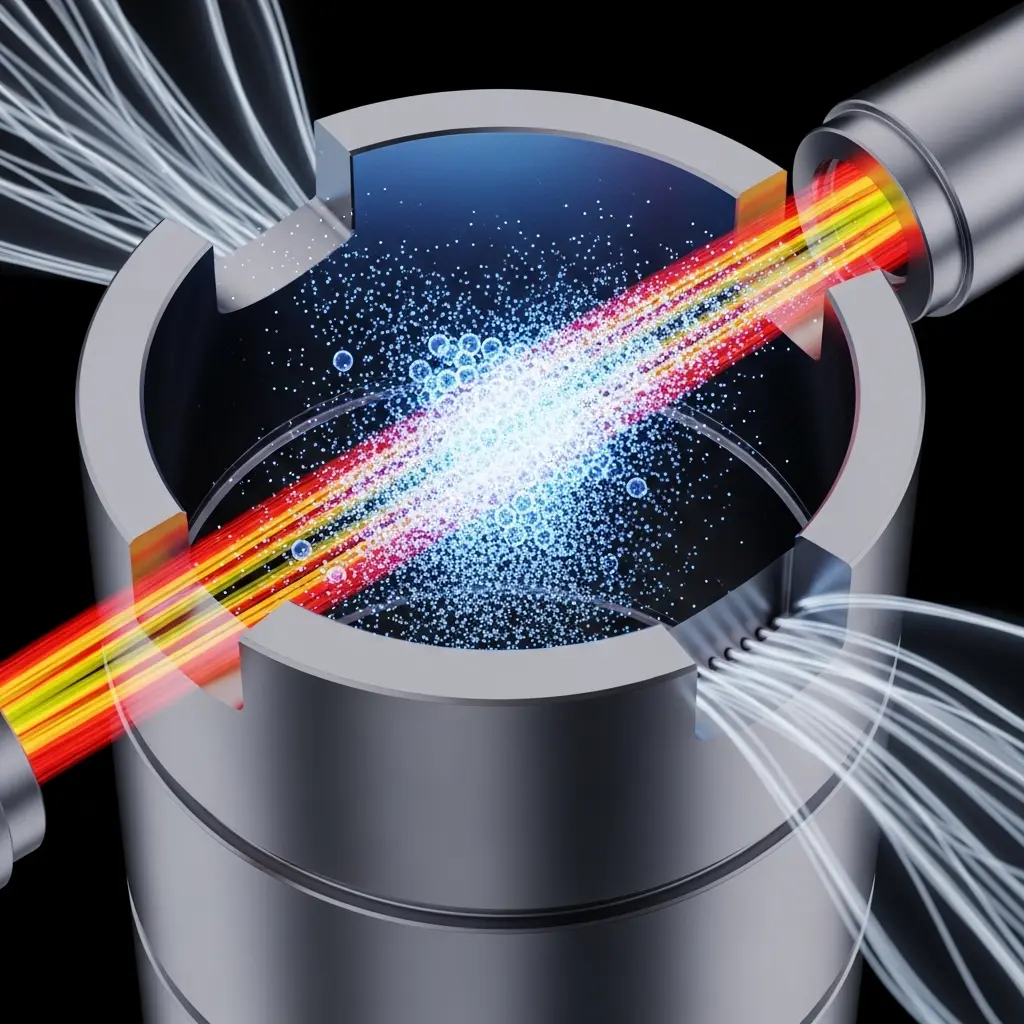
The challenge of rapidly and reliably resetting quantum memories represents a significant obstacle to building practical quantum computers. Eliya Blumenthal, Natan Karaev, and Shay Hacohen-Gourgy, all from the Technion , Israel Institute of Technology, have demonstrated a novel technique to address this issue, achieving substantially faster cooling of a high-quality cavity. Their research details a hardware-efficient Rabi-Driven Reset (RDR) method that continuously cools a cavity mode without requiring measurement, overcoming limitations of existing approaches reliant on weak interactions or lengthy measurement sequences. By engineering an effective coupling between the cavity and a cold readout bath, the team achieved a photon decay time orders of magnitude faster than the cavity’s natural lifetime. This breakthrough paves the way for improved performance in quantum error correction schemes and represents a crucial step towards scalable quantum technologies.
Rabi-Driven Reset for Fast Quantum Memory Cooling
Challenges in High-Q Bosonic Memory Resetting
High-Q bosonic memories are essential for building hardware-efficient quantum error correction systems, yet their inherent isolation presents a significant challenge: fast, high-fidelity reset. Current methods rely on either weak intermode coupling or measurement-based sequences that introduce substantial delays. Scientists have now demonstrated a hardware-efficient Rabi-Driven Reset (RDR) technique, achieving continuous, measurement-free cooling of a superconducting cavity mode. This innovative approach employs a strong resonant Rabi drive on a transmon, combined with sideband drives on both the memory and readout modes, detuned by the Rabi frequency, to transform the dispersive interaction into an effective Jaynes-Cummings coupling between the qubit’s dressed states and each mode.
The team achieved this by engineering a tunable dissipation channel, effectively directing energy from the memory mode to a cold readout bath. Critically, the engineered coupling scales with the dispersive interaction to the qubit and the drive amplitude, rather than relying on the intermode cross-Kerr effect, allowing for rapid cooling even in architectures designed to minimise direct mode-mode coupling. Experiments revealed that RDR can decay a single photon in 1.2 microseconds, exceeding the performance of existing methods by more than two orders of magnitude compared to the intrinsic lifetime of the system. Furthermore, the research demonstrates the ability to reset approximately 30 thermal photons in 80 microseconds, reducing the average photon number to a steady-state value of 0.045 ±0.025.
This breakthrough utilizes a technique that extends a cooling protocol originally developed for qubits, applying a strong Rabi drive alongside sideband drives to induce an effective Jaynes-Cummings interaction. By operating in a displaced frame, the scientists established a Hamiltonian that facilitates efficient energy dissipation from the memory mode to the readout mode, ultimately achieving rapid and continuous cooling. The core innovation lies in the scaling of the coupling rate, which depends on the dispersive coupling to the qubit and the drive amplitude, circumventing the limitations of methods reliant on the cross-Kerr coupling. This allows for faster cooling rates, particularly in weakly coupled systems. The experimental setup involved a high-Q cavity, dispersively coupled to a transmon qubit, which is in turn coupled to a stripline readout resonator, enabling precise control and measurement of the cooling process. This work opens new avenues for developing practical and efficient quantum error correction schemes by addressing the critical bottleneck of fast, high-fidelity reset in bosonic quantum systems.
Rabi-Driven Reset for Continuous Bosonic Cooling
Developing Continuous Rabi-Driven Cooling Mechanism
The research detailed in this work addresses a critical challenge in quantum error correction, the slow reset speed of high-Q bosonic memories. Scientists developed a novel technique, Rabi-Driven Reset (RDR), to achieve continuous, measurement-free cooling of a cavity mode, circumventing limitations of existing methods reliant on weak intermode coupling or lengthy measurement sequences. This innovative approach harnesses a strong resonant Rabi drive applied to a transmon qubit, alongside sideband drives on both the memory and readout modes, all detuned by the Rabi frequency. The core of RDR lies in converting the dispersive interaction between the qubit and cavity modes into an effective Jaynes-Cummings coupling between dressed states.
This engineered coupling, crucially, scales with the dispersive interaction and drive amplitude, rather than the typically limiting intermode cross-Kerr, allowing for rapid cooling even in weakly coupled systems. Experiments employed a high-Q electromagnetic mode resonating at 6.914GHz with a single-photon lifetime of 170 microseconds, dispersively coupled to a transmon qubit at a strength of 57kHz. The qubit, with a transition frequency of 6.33GHz and anharmonicity of 265MHz, is also coupled to a readout resonator at 7.7GHz, possessing a linewidth of 0.382MHz and dispersive shift of 0.635MHz. To implement RDR, the team calibrated drive amplitudes, selecting a Rabi frequency of 9MHz exceeding all other system parameters.
Experimental Implementation and Tuning of Dissipation
Drive-induced Stark shifts were meticulously measured using Ramsey experiments to fine-tune the drive powers, ensuring optimal coupling. The resulting effective Hamiltonian facilitates a tunable dissipation channel, directing energy from the memory mode to a cold readout bath. This method achieved a decay time of for a single photon reset, representing an improvement of over two orders of magnitude compared to the intrinsic lifetime. Furthermore, the study demonstrated the ability to reset approximately 30 thermal photons in around to a steady-state average photon number of, showcasing the efficiency and scalability of the RDR technique.
Rabi-Driven Reset Achieves Photon Cooling Breakthrough
Enabling Quantum Error Correction Through Fast Reset
Scientists achieved a breakthrough in quantum error correction with the demonstration of a hardware-efficient Rabi-Driven Reset (RDR) technique, enabling continuous, measurement-free cooling of a cavity mode. The work details a method for rapidly resetting quantum memories, a persistent challenge in building scalable quantum computers. Experiments revealed that RDR cools a single photon with a decay time of 170 microseconds, exceeding previous methods by more than two orders of magnitude. This substantial improvement stems from an engineered coupling mechanism that scales with dispersive interactions and drive amplitude, rather than relying on direct mode-mode coupling.
The team implemented RDR on an electromagnetic mode with a frequency of 6.914GHz, dispersively coupled to a transmon qubit with a strength of 57kHz. Characterisation of the transmon revealed a first transition frequency of 6.33GHz, an anharmonicity of 265MHz, a relaxation time of 25 microseconds, and an echoed dephasing time of 20 microseconds. The readout mode, resonant at 7.7GHz, exhibited a linewidth of 0.382MHz and a dispersive shift of 0.635MHz. Calibration of the drives, including a resonant Rabi drive of 9MHz, was crucial for establishing the optimal cooling parameters. Results demonstrate the ability to reset approximately 30 thermal photons in about 800 nanoseconds to a steady-state average photon number of 0.045, as determined through Wigner characteristic function measurements.
Data shows that the photon decay rate is bounded by the cavity linewidth, exhibiting a linear decay at high photon numbers and an exponential decay at low photon numbers. Fitting a piecewise linear-exponential function to the data, scientists recorded a maximum decay rate of -0.73MHz for optimal coupling, significantly faster than the natural decay of the memory mode. Further experiments involved preparing and cooling a single Fock state, achieved through a modified Jaynes-Cummings interaction. By applying drives for a duration of π/2χm am, the team successfully created a single photon in the memory mode, demonstrating a potential pathway for generating higher Fock states rapidly. Measurements confirm that the cooling rate is limited by the readout mode linewidth, with a maximum observed rate of approximately κ/3.3, paving the way for further optimisation and advancements in quantum memory technology.
🗞 Experimental Realization of Rabi-Driven Reset for Fast Cooling of a High-Q Cavity
🧠 ArXiv: https://arxiv.org/abs/2601.10385