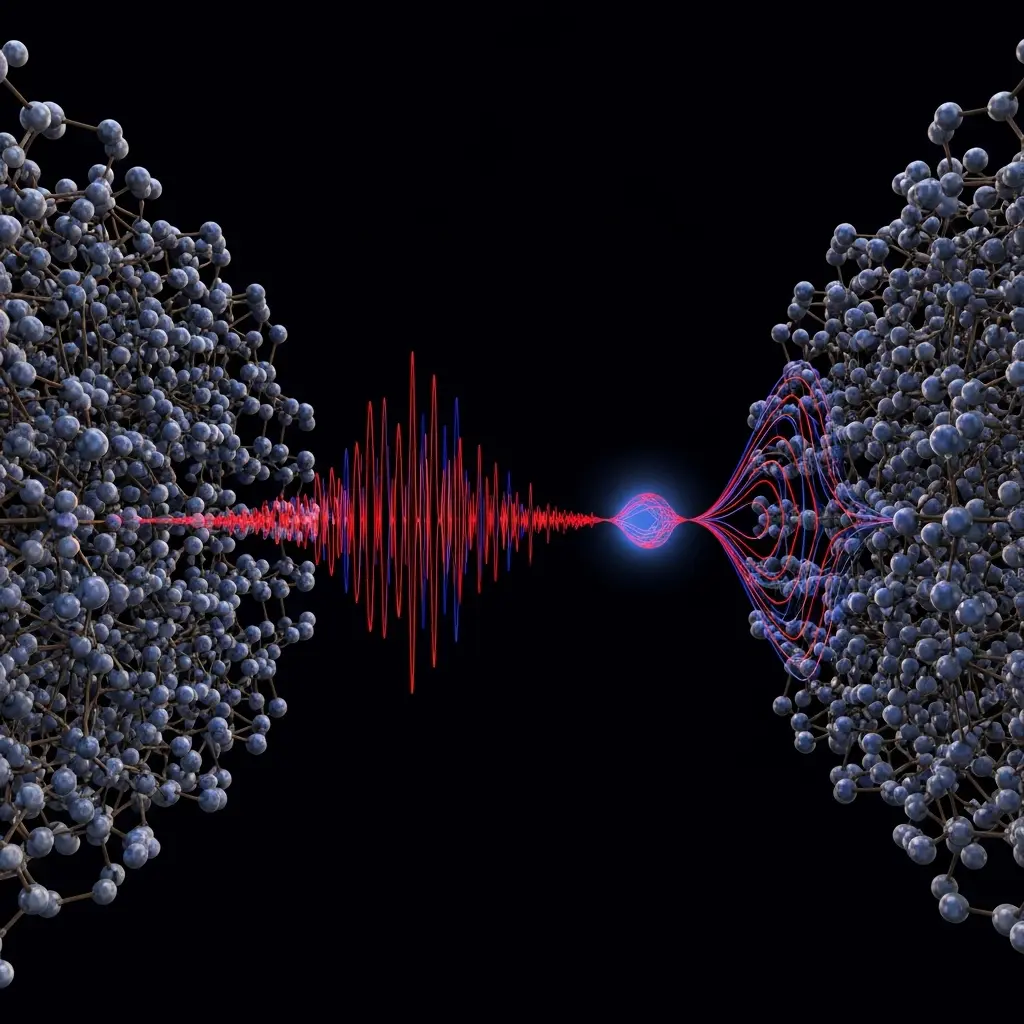
Haldane chains, one-dimensional magnets exhibiting unique disordered ground states, continue to fascinate physicists due to their complex behaviour under external magnetic fields. I. Jakovac, M. S. Grbić, and M. Dupont, alongside colleagues N. Laflorencie, S. Capponi, and Y. Hosokoshi, present a comprehensive investigation into the transition from a Tomonaga-Luttinger liquid to a Bose-Einstein condensate within the organic Haldane chain system 3,5-bis(N-tert-butylaminoxyl)-3′-nitrobiphenyl (BoNO). This research is significant because the BoNO system lacks the intrinsic anisotropies that plague many previously studied materials, allowing for a clearer exploration of the theoretical predictions surrounding field-induced phases. Through a combination of nuclear magnetic resonance and theoretical modelling, the team accurately maps the boundary between these phases and confirms universal scaling behaviour. The findings represent a full experimental validation of decades-old theoretical predictions, solidifying understanding of magnetic behaviour in these intriguing materials.
The research team successfully characterised the Tomonaga-Luttinger liquid (TLL) state and Bose-Einstein condensate (BEC) phases within the organic Haldane chain system 3,5-bis(N-tert-butylaminoxyl)-3′-nitrobiphenyl, or BoNO. This breakthrough was enabled by the unique properties of BoNO, specifically its lack of anisotropy and a moderate strength of intrachain interaction, allowing for comprehensive exploration of the system’s complete phase diagram. The study employed 1H nuclear magnetic resonance, combined with rigorous theoretical analysis, to meticulously map the behaviour of BoNO under varying magnetic fields and temperatures.
Mapping Quantum Phases and Critical Transitions
Experiments revealed the critical field, Bc1, at which the energy gap closes and the system transitions into the gapless TLL regime, and subsequently identified the boundary, Tc(B), defining the onset of the BEC phase. Crucially, the researchers determined a critical exponent of ν ≈ 0.66 at Bc2, and demonstrated universal quasiparticle scaling within the quantum-critical regime, confirming key theoretical predictions. This work represents a significant advancement in understanding quantum magnetism, as previous experimental systems often suffered from limitations such as intrinsic anisotropies or excessively large interaction strengths. The absence of these constraints in BoNO allowed the team to probe the full theoretical diagram, providing unprecedented insight into the behaviour of these complex materials.
The researchers established that the gap magnitude is primarily determined by the dominant intrachain interaction, J1D, and that the BEC phase persists up to a field strength proportional to 4J1D/gμB. The Haldane chain system, a one-dimensional quantum magnet, exhibits a unique ground state characterised by strong fluctuations and a gapped excitation spectrum. Applying a magnetic field fundamentally alters this state, closing the gap at Bc1 and driving the system into a gapless TLL regime, which at lower temperatures transitions into a BEC ground state. This research provides full experimental validation of these predicted field-induced phases, confirming theoretical models developed over twenty years ago.
The ability to precisely control and characterise these transitions in BoNO opens avenues for exploring novel quantum phenomena and potential applications in quantum technologies. The innovative use of BoNO, an organic material with negligible spin-orbit coupling, overcomes longstanding challenges in studying Haldane chains. Unlike previous systems based on transition-metal complexes, BoNO’s properties enable access to the complete B-T phase diagram, facilitating a comprehensive investigation of the TLL and BEC phases. This detailed characterisation, achieved through advanced nuclear magnetic resonance techniques, not only validates existing theoretical frameworks but also establishes a benchmark for future research into low-dimensional quantum magnetism and its potential for technological innovation.
BoNO Haldane Chain Phase Diagram via NMR
Material Properties Governing Quantum Condensation
The research team meticulously investigated the Tomonaga-Luttinger liquid (TLL) and Bose-Einstein condensate (BEC) phases within the organic Haldane chain system, 3,5-bis(N-tert-butylaminoxyl)-3′-nitrobiphenyl (BoNO). This study leveraged the material’s unique properties, specifically the absence of anisotropy and a moderate interaction strength, to comprehensively map the phase diagram. To verify the accuracy of the determined BEC boundary, the team conducted additional NMR measurements down to 1.3 K.
These experiments, combined with theoretical analysis, enabled a refined estimation of the critical field value, Bc1, to be (1.0+0.5 −0.2) Tesla. High-field measurements, extending down to 460 mK, were then used to extrapolate the upper critical field, Bc2, achieving a value of (33.65 ±0.04) Tesla and a critical exponent, ν, of (0.66 ±0.07). This extrapolation employed a standard windowing method alongside Bayesian inference analysis (BIA) to ensure robust parameter estimation. Furthermore, the study pioneered the use of quantum Monte Carlo (QMC) simulations, performed on a spin-1 chain with tetragonally coordinated interactions, to calculate the phase boundary Tc(B) and compare it with experimental results. Detailed analysis of spin dynamics, through measurements of T−11, revealed attractive quasiparticle interactions, consistent with the Haldane system. The team demonstrated universal quasiparticle scaling in the quantum-critical regime, confirming consistency with the three-magnon model and previous observations in related compounds. This comprehensive methodology not only validated theoretical predictions made over two decades ago but also provided a detailed understanding of field-induced phase transitions in Haldane chains.
BoNO Chain Exhibits Universal Quantum Criticality
Comprehensive Validation of Field-Induced Quantum States
Scientists have achieved comprehensive validation of theoretical predictions regarding field-induced phases in a spin-1 Haldane chain, utilising the organic compound 3,5-bis(N-tert-butylaminoxyl)-3’-nitrobiphenyl, or BoNO. The research team meticulously characterised the Tomonaga-Luttinger liquid (TLL) properties and mapped the Bose-Einstein condensate (BEC) boundary within the BoNO system, a material notable for its lack of anisotropy and moderate intrachain coupling. Experiments revealed a critical exponent of approximately 0.66 at a critical field, Bc2, demonstrating universal quasiparticle scaling in the quantum-critical regime. Through 1H nuclear magnetic resonance, combined with detailed theoretical analysis, the study precisely determined the behaviour of the TLL state and the transition to the BEC phase.
Measurements confirm the BEC phase boundary, Tc(B), and establish the associated critical exponent, ν ≈ 0.66, at Bc2, providing quantitative data supporting established theoretical models. The absence of magnetic anisotropy and a moderate value of J1D, the dominant intrachain interaction, enabled exploration of the complete B-T phase diagram, a feat previously unattainable in other experimental systems. The team measured a quasi-linear increase in magnetisation between Bc1, approximately 2 Tesla, and Bc2, reaching 33 Tesla, consistent with the behaviour expected from coupled spin-1 chains. BoNO exhibits an effective moment of 2.7 ±0.1 μB per formula unit, with an intrachain coupling of J1D = 11.1 ±0.2 K and a total three-dimensional coupling of zJ3D approximately 0.6 K.
These precise measurements of material parameters are crucial for understanding the observed quantum phenomena and validating theoretical predictions. This breakthrough delivers full experimental validation of predictions made over two decades ago concerning field-induced phases in Haldane chains. The work demonstrates universal quasiparticle scaling in the quantum-critical regime, solidifying the understanding of low-dimensional quantum magnets and opening avenues for exploring complex quantum phenomena with unprecedented precision. The unique properties of BoNO, particularly its negligible spin-orbit coupling and isotropic g-tensor, position it as a model system for future investigations into quantum magnetism and related fields.
🗞 Magnetic field-induced phases in a model S=1 Haldane chain system
🧠 ArXiv: https://arxiv.org/abs/2601.10489