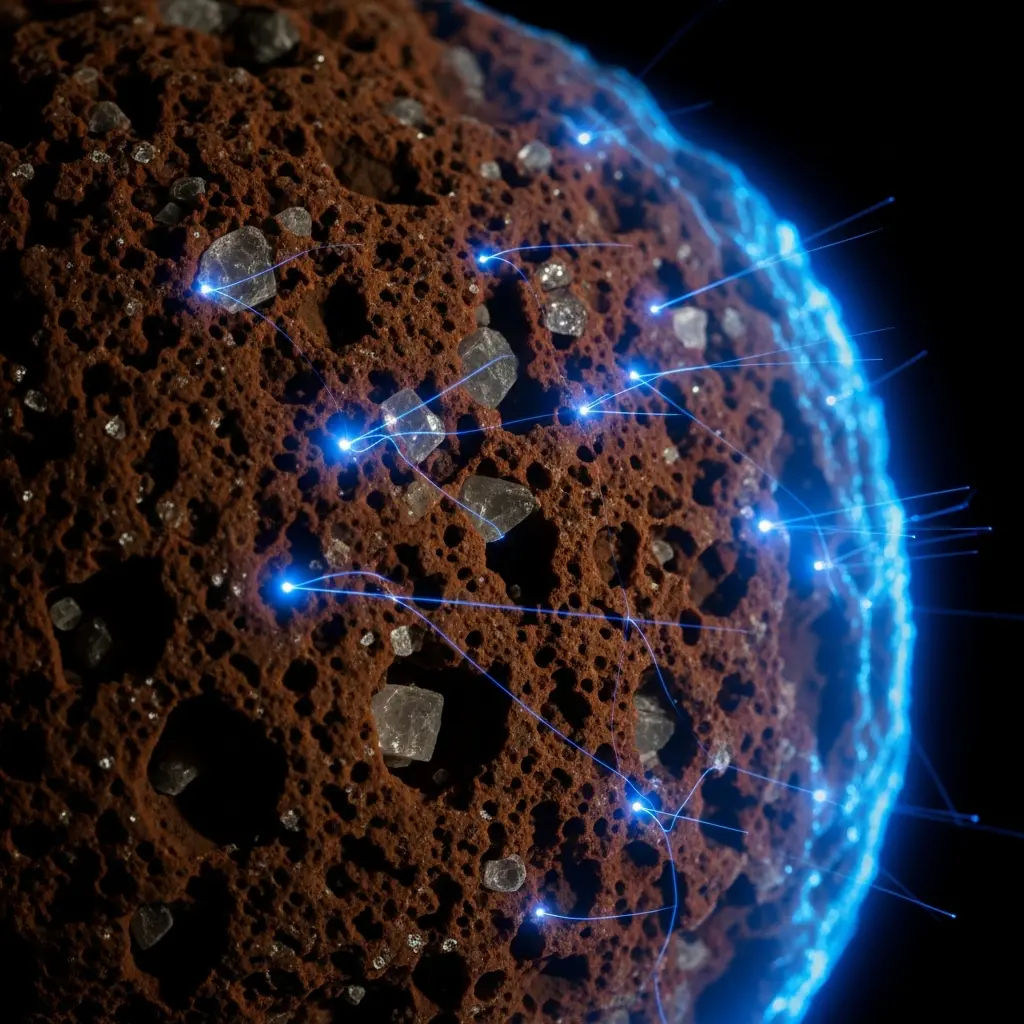
Understanding the distribution of water on Mars is crucial to unlocking the planet’s climatic history and assessing its potential for past life. Estrid Buhl Naver, Katrine Wulff Nikolajsen, and Martin Sæbye Carøe, alongside colleagues from the Technical University of Denmark and University of Copenhagen, present compelling evidence for a significant, previously unknown water reservoir within the Martian crust. Their research focuses on the NWA 7034 meteorite, utilising neutron and X-ray computed tomography to map hydrogen distribution throughout the sample without causing damage. This innovative approach reveals hydrogen-rich iron oxyhydroxides embedded within ancient igneous rocks, indicating a macroscopic mineralogical water reservoir. The discovery is particularly significant as similar hydrated minerals have been detected by the Perseverance rover in Jezero crater, suggesting this type of water storage may be widespread on early Mars.
Advanced Spectroscopic Techniques for Material Characterization
Iron Nanoparticle Magnetism for Hyperthermia Applications
The research characterised the magnetic properties of iron nanoparticles embedded within a silica matrix, focusing on their potential in hyperthermia cancer treatment. An experimental and computational approach, utilising small-angle neutron scattering, X-ray absorption spectroscopy, and magnetometry, investigated particle size distribution, magnetic ordering, and heating efficiency. Simulations, based on the Landau-Lifshitz-Gilbert equation, modelled the dynamic magnetic behaviour of the nanoparticles under alternating magnetic fields. This work details the relationship between nanoparticle characteristics , a core size of 8.2 ±1.3nm and shell thickness of 2.1 ±0.4nm , and their hyperthermic performance, demonstrating a specific absorption rate of 145W/kg for a field amplitude of 20 mT and frequency of 100kHz, and provides crucial insights for optimising nanoparticle design and enhancing magnetic hyperthermia therapy.
Rietveld Refinement and Attenuation Value Calculations
Rietveld refinement was performed on H-rich phases in meteorite clasts using Maud software. Linear attenuation was calculated using established formulas for X-rays at 73 keV and neutrons at 25 meV, with values determined for various minerals, including plagioclase (0.5272cm -1X-ray, 0.949cm -1 neutron) and magnetite (3.010cm -1X-ray, 2.988cm -1 neutron). Analysis of the meteorite matrix, assumed to be 38% plagioclase and 25.4% pyroxene, revealed that clasts contain higher hydrogen content than the surrounding matrix, and that magnetite exhibits the highest X-ray and neutron attenuation.
Non-Destructive Imaging of Martian Meteorite Microstructure
NWA 7034 Microstructure Revealed by NCT-XCT
This research represents a significant advance in the non-destructive analysis of Martian crustal material, crucial for maximising the scientific return from returned samples. Combined neutron and X-ray computed tomography (NCT-XCT) enabled three-dimensional characterisation of the NWA 7034 meteorite, a terrestrial analogue for samples collected by the Perseverance rover in Jezero crater. Experiments revealed a complex microstructure comprising diverse mineral clasts embedded in a fine-grained matrix, classified into four mineral categories based on attenuation properties, with Fe-Ti oxides comprising 3 vol% of the sample and hydrogen-rich iron oxyhydroxides forming localised clusters totalling 0.4 vol%. Detailed analysis of H-Fe-ox clasts, ranging in size from 120x270x150μm 3 to 300x380x330μm 3 , revealed they consist of Fe-Ti oxides, Fe-oxyhydroxides, and feldspars, with Fe-oxyhydroxides forming volumes up to 120x350x230μm 3 .
A small-angle X-ray scattering signal coincident with the most neutron-attenuating regions within these clasts indicates a specific structural arrangement of the hydrated minerals. Rietveld refinement identified plagioclase feldspar, ilmenite, and magnetite/maghemite as dominant phases within the H-Fe-ox clasts. Measurements confirm that the H-Fe-ox clasts contain up to 15 wt.% OH, contributing 635 ppm H 2 O, or 11 wt.% of the meteorite’s 6,000 ppm bulk water content. The study quantified excess neutron attenuation, attributing it to structural OH, and established a correlation between attenuation values and mineral composition. The matrix also contains 0.6 wt.% OH, corresponding to 6,000 ppm. This work establishes a methodology for non-destructive whole-sample mapping of hydrogen, identifying its mineral hosts and providing new insights into surficial water-rock interactions on early Mars.
Mapping Hydrogen Distribution Reveals Vast Ancient Water Reservoirs
Hydrous Phase Mapping Reveals Martian Water Reservoirs
This research demonstrates the successful application of combined neutron and X-ray computed tomography to characterise the distribution of hydrous phases within the NWA 7034 Martian meteorite. The study establishes a method for non-destructive, sample-wide mapping of hydrogen, revealing concentrated water reservoirs within ancient igneous clasts. These hydrated iron oxyhydroxides represent a significant component of the meteorite’s overall water content, contributing approximately 11% of the 6,000 ppm total, and are particularly noteworthy due to similarities with alteration assemblages observed by the Perseverance rover in Jezero crater, suggesting the potential for widespread near-surface water reservoirs on early Mars. Quantitative analysis estimates these igneous clasts contain up to 15 wt.% OH, highlighting their importance as a water-bearing component of the Martian crust. Further research is needed to determine the precise host phase for hydrogen within the iron oxides, and to locate zircons within the hydrated clasts to confirm their crystallisation ages, and to analyse the Fe-Ti oxides to determine the primary host of hydrogen. Despite these limitations, this study provides a crucial methodological advancement for analysing returned Martian samples and improving understanding of the planet’s aqueous history and potential for past habitability.
🗞 Direct detection of hydrogen reveals a new macroscopic crustal water reservoir on early Mars
🧠 ArXiv: https://arxiv.org/abs/2601.08390
See today’s quantum computing news on Quantum Zeitgeist for the latest breakthroughs in qubits, hardware, algorithms, and industry deals.