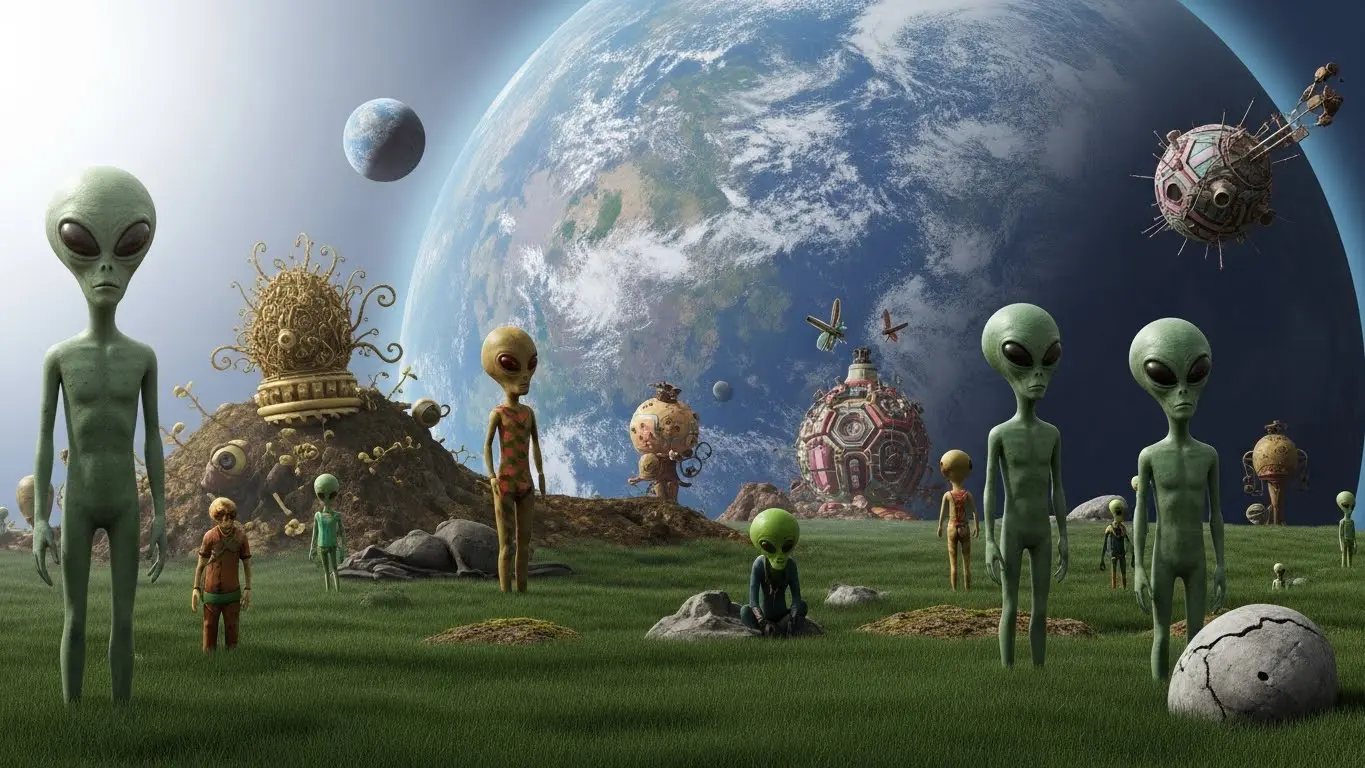
The vastness of the universe is almost incomprehensible. Billions of galaxies, each containing billions of stars, many of which likely harbor planets. Given these staggering numbers, it seems statistically improbable that Earth is the sole cradle of life, let alone intelligent life. This apparent contradiction, the high probability of extraterrestrial civilizations versus the lack of observed evidence, is known as the Fermi Paradox, named after the Italian-American physicist Enrico Fermi, who casually posed the question during a lunchtime conversation in 1950. Fermi, renowned for his work on nuclear reactors and quantum theory, wasn’t necessarily searching for aliens, but his simple query sparked a debate that continues to challenge our understanding of the universe and our place within it. The paradox isn’t about whether life exists elsewhere, but where is everyone?
The Statistical Imperative: Why We Should Expect Company
The foundation of the Fermi Paradox lies in the sheer scale of the cosmos and the principles of probability. Frank Drake, an astronomer at the National Radio Astronomy Observatory, formalized this thinking in 1961 with the Drake Equation. This equation, while not providing a definitive answer, attempts to estimate the number of detectable extraterrestrial civilizations in the Milky Way galaxy. It considers factors like the rate of star formation, the fraction of stars with planets, the number of planets potentially capable of supporting life, and the probability that life will actually arise on those planets. Even using conservative estimates for these variables, the Drake Equation suggests that hundreds, if not thousands, of civilizations should have emerged in our galaxy alone. The universe is approximately 13.8 billion years old, giving ample time for life to evolve and civilizations to develop. Given this timeframe, some of these civilizations should have become technologically advanced enough to be detectable, either through radio signals, megastructures, or interstellar travel.
If the universe is teeming with potential for life, why haven’t we detected any signs of it? One proposed explanation is the “Great Filter.” This concept, popularized by economist Robin Hanson, suggests that there’s a barrier preventing most life from reaching a stage where it becomes observable. This filter could lie in our past, meaning the emergence of life itself, or the evolution of complex multicellular organisms, is far rarer than we assume. Alternatively, the filter could lie in our future, representing a catastrophic event that wipes out most civilizations before they can become interstellar. Possible future filters include self-destruction through war, environmental collapse, or unforeseen technological dangers. The unsettling implication is that if the filter is ahead of us, humanity may be on a collision course with extinction.
The Rare Earth Hypothesis: A Delicate Balance of Conditions
While the Drake Equation emphasizes the abundance of potentially habitable planets, the “Rare Earth Hypothesis, ” championed by geologist Peter Ward and astronomer Donald Brownlee, argues that the conditions necessary for complex life to evolve are exceptionally rare. They posit that Earth’s unique combination of factors, a large moon stabilizing its axial tilt, plate tectonics regulating climate, a Jupiter-like planet shielding it from asteroid impacts, and its position within the galactic habitable zone, are unlikely to be replicated elsewhere. These factors aren’t simply about having liquid water; they’re about maintaining a stable and conducive environment for billions of years, allowing for the slow, incremental process of evolution to unfold. This hypothesis doesn’t necessarily preclude life elsewhere, but suggests that complex, intelligent life may be exceedingly uncommon.
Perhaps extraterrestrial civilizations are aware of our existence, but are deliberately avoiding contact. The “Zoo Hypothesis, ” proposed by astronomer John Ball, suggests that advanced civilizations may be observing Earth as a protected wildlife preserve, allowing us to develop naturally without interference. This is analogous to how humans observe animals in the wild, taking care not to disrupt their behavior. The motivation for such a policy could be ethical, a desire to avoid cultural contamination, or strategic, a reluctance to reveal their presence to a potentially hostile species. While seemingly far-fetched, the Zoo Hypothesis offers a plausible explanation for the lack of detectable signals, assuming the observers are sufficiently advanced and discreet.
The Dark Forest Theory: A Universe of Silent Predators
A more chilling explanation comes from the “Dark Forest Theory, ” articulated by Chinese science fiction author Liu Cixin in his novel The Three-Body Problem. This theory, rooted in game theory, suggests that the universe is a dangerous place where civilizations remain silent out of self-preservation. Any civilization that reveals its existence risks attracting the attention of hostile, more advanced civilizations, who may view it as a threat and destroy it. Therefore, the optimal strategy for survival is to remain hidden, creating a “dark forest” where every civilization is a hunter, and every signal is a potential death sentence. This grim perspective paints a picture of a universe filled with paranoia and distrust, where silence is the ultimate defense.
Our search for extraterrestrial intelligence (SETI) has primarily focused on detecting radio signals, assuming that advanced civilizations would use this technology for communication. However, this assumption may be flawed. Frank Drake, the originator of the Drake Equation, initially focused on radio signals, but later acknowledged the limitations of this approach. Advanced civilizations might use communication methods we haven’t even conceived of, or they might have moved beyond broadcasting signals altogether, opting for more efficient and secure forms of communication. Furthermore, our search has been limited to a relatively small portion of the galaxy, and we may simply not have looked in the right place at the right time. The vastness of space and the limitations of our technology pose significant challenges to the search for extraterrestrial life.
The Technological Singularity: A Potential Evolutionary Bottleneck
Another potential filter, one that may be unique to our era, is the technological singularity. Ray Kurzweil, a futurist at Google, predicts that artificial intelligence will surpass human intelligence in the coming decades, leading to a period of rapid and unpredictable technological change. While this could unlock incredible possibilities, it also poses existential risks. An uncontrolled AI could potentially view humanity as an obstacle, or simply be indifferent to our fate. If the singularity represents a genuine bottleneck for intelligent life, it could explain why we haven’t detected other civilizations, they may have succumbed to the same fate. This hypothesis highlights the potential dangers of unchecked technological advancement.
Beyond Signals: Searching for Technosignatures
Recognizing the limitations of solely searching for radio signals, scientists are increasingly focusing on “technosignatures”, any detectable evidence of advanced technology. This includes searching for Dyson spheres (hypothetical megastructures built around stars to capture their energy), artificial light sources on exoplanets, or unusual atmospheric compositions indicative of industrial activity. Avi Loeb, a Harvard astronomer, has been a vocal advocate for this approach, arguing that we should broaden our search beyond traditional radio SETI. He proposes searching for interstellar objects with artificial propulsion systems, or evidence of alien probes in our solar system. This shift in focus represents a more holistic and open-minded approach to the search for extraterrestrial intelligence.
The Anthropic Principle suggests that our observations of the universe are necessarily biased by the fact that we exist. In other words, we can only observe a universe that allows for our existence. This principle, championed by physicist Brandon Carter, doesn’t necessarily explain the absence of extraterrestrial life, but it does suggest that we may be overestimating the probability of finding it. Perhaps the conditions necessary for life are so rare that we are, by definition, an outlier. This perspective challenges the assumption that the universe should be teeming with life, and suggests that our existence may be a statistical fluke.
The Silence Continues: A Mystery for Future Generations
Despite decades of searching, the Fermi Paradox remains unresolved. The lack of evidence for extraterrestrial life is a profound mystery, forcing us to confront fundamental questions about the universe, life, and our place within it. Whether the answer lies in a Great Filter, a Rare Earth scenario, a deliberate lack of contact, or simply the limitations of our search, the silence continues to echo across the cosmos. The search for extraterrestrial intelligence is not just a scientific endeavor; it’s a philosophical quest that challenges our assumptions and expands our understanding of the universe. The answer, when it finally arrives, will undoubtedly reshape our perception of reality.
See today’s quantum computing news on Quantum Zeitgeist for the latest breakthroughs in qubits, hardware, algorithms, and industry deals.