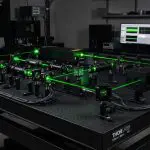
Fermilab and NYU Langone Health won a top-10 spot in the NIH Quantum Computing Challenge with their QuantuMRI project. The team developed a quantum algorithm to simulate human tissue response during MRI scans, aiming for faster, high-resolution estimates of tissue properties. This work advances Quantitative MRI and could lead to more accurate and efficient medical imaging technologies.
Fermilab-NYU QuantuMRI Advances Medical Imaging
The QuantuMRI team is developing a quantum algorithm to improve Quantitative MRI, or qMRI, which measures how magnetic moments in tissues respond to external fields. This advanced imaging technique goes beyond traditional MRI by analyzing relaxation times to reveal subtle changes in tissue composition, potentially detecting conditions earlier and with greater precision. Achieving accurate, high-resolution simulations of these tissue behaviors currently demands substantial computing power. This collaboration aims to utilize quantum computing to accelerate qMRI and obtain fast, reproducible estimates of tissue properties. By combining Fermilab’s quantum system expertise with NYU Langone’s imaging research, the team hopes to advance medical diagnostics and personalized medicine.
Quantum Algorithms Simulate Tissue Response in qMRI
The QuantuMRI team is focused on improving quantitative MRI (qMRI) by simulating tissue response with a novel quantum algorithm. Traditional qMRI measures how magnetic moments within tissues relax, providing insights into composition, but accurately simulating this process demands substantial computing power. This new approach aims to rapidly and accurately estimate multiple tissue properties at high resolution, a critical advancement for detecting subtle changes currently invisible with standard MRI techniques. This work builds on the intrinsic magnetic properties of atoms within tissues and their interaction with external fields, offering deeper diagnostic potential.
By leveraging quantum computing, researchers hope to accelerate qMRI and move towards personalized medicine through more precise and reproducible results. The team is currently in the second phase of the NIH Quantum Computing Challenge, working toward scalable tools to enhance patient care and diagnostics.
SQMS Center Drives Cross-Disciplinary Quantum Research
The Superconducting Quantum Materials and Systems (SQMS) Center fosters collaboration between diverse fields to advance quantum research, exemplified by the partnership between Fermilab and NYU Langone Health. This collaboration, involving over 40 institutions including national labs and academia, combines Fermilab’s experience in complex accelerator construction with NYU Langone’s imaging expertise. Specifically, this synergy is driving innovations in Quantitative MRI (qMRI) through the development of quantum algorithms. NYU Langone joined the SQMS collaboration in 2022 with a focus on new MRI analysis methods, highlighting a commitment to bridging physics, computer science, and medicine.
The SQMS Center leverages its established strengths in superconducting technologies and qubit engineering to build quantum processor platforms. This multidisciplinary approach aims to deliver scalable, high-resolution qMRI tools for improved diagnostics and personalized medicine.
The collaboration between Fermilab and NYU Langone is a perfect example of how quantum computing can be applied to real-world challenges with meaningful impact.
Riccardo Lattanzi




See today’s quantum computing news on Quantum Zeitgeist for the latest breakthroughs in qubits, hardware, algorithms, and industry deals.