
The efficient solution of linear systems is critical for real-time applications in engineering and scientific computing, and this research addresses the challenge of accelerating Cholesky factorization for block tridiagonal matrices. Roland Schwan, Daniel Kuhn, and Colin N. Jones, from the Automatic Control Lab and Risk Analytics and Optimization Chair at EPFL in Switzerland, detail a novel GPU-accelerated framework designed to significantly reduce computational complexity. By employing a multi-stage permutation strategy, the researchers achieve a performance improvement, scaling from traditional sequential methods to a substantially faster solution when utilising parallel processing resources. This implementation, exceeding the speed of existing solvers like QDLDL, BLASFEO, and CUDSS, offers a particularly compelling solution for long-horizon problems and establishes a foundation for advancements in fields such as robotics and autonomous systems. The open-source code, available via GitHub, allows for wider adoption and further development of this promising technique.
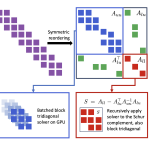
The research team engineered a multi-stage permutation strategy, utilising nested dissection, which reduces computational complexity from O(Nn³) for sequential Cholesky factorization to O(log₂(N)n³) when sufficient parallel processing resources are available, where ‘n’ represents block size and ‘N’ is the number of blocks.
This logarithmic scaling proves particularly beneficial for long-horizon problems demanding substantial computational power. The implementation harnesses the Warp library and CUDA, enabling parallelism at multiple levels within the factorization algorithm. Experiments employed a carefully constructed experimental setup, utilising GPU resources to accelerate the process and measure performance gains.
This approach preserves the numerical stability and robustness of the underlying solver, ensuring broad applicability across diverse optimisation frameworks. Researchers achieved speedups exceeding 100x compared to the sparse solver QDLDL, a significant improvement over existing methods. Further performance gains were demonstrated with speedups of 25x against a highly optimised CPU implementation using BLASFEO and more than 2x compared to the CUDSS library.
The team meticulously optimised the system through fused and blocked kernel implementations, tailored for varying problem sizes and memory constraints. Operation-level parallelism was achieved through CUDA streams and atomic operations, minimising critical path length and maximising throughput. This work pioneers a method that parallelises directly at the linear algebra level, reducing overhead and paving the way for extensions to more complex structures.
Comprehensive numerical experiments, conducted across a range of problem sizes and precisions, validate the practical effectiveness of the framework. The resulting system delivers a foundation for GPU-accelerated optimisation solvers applicable to robotics, autonomous systems, and other fields requiring repeated solutions of structured linear systems, with the implementation freely available as an open-source resource.
GPU Acceleration of Block Tridiagonal Solvers
Scientists have developed a groundbreaking GPU-accelerated framework for solving block tridiagonal linear systems, a common challenge in real-time engineering and scientific computing applications. The research team achieved a significant reduction in computational complexity, scaling from traditional sequential Cholesky factorization to when sufficient parallel resources are available, where ‘n’ represents the block size and ‘N’ is the number of blocks.
This advancement stems from a novel multi-stage permutation strategy based on nested dissection, meticulously designed to unlock the potential of parallel processing. Experiments revealed substantial performance gains with the new framework, exceeding 100x speedups when compared against the sparse solver QDLDL. Further tests demonstrated a 25x improvement over a highly optimized CPU implementation utilizing the BLASFEO library, and a greater than 2x acceleration compared to the CUDSS library developed by NVIDIA.
These measurements confirm the practical effectiveness of the approach across a diverse range of problem sizes and precision levels, highlighting its ability to handle complex calculations efficiently. The logarithmic scaling with horizon length is particularly advantageous for long-horizon problems frequently encountered in real-time control systems. The core of this breakthrough lies in the implementation using the Warp library and CUDA, enabling exploitation of parallelism at multiple levels within the factorization algorithm.
Scientists measured operation-level parallelism through CUDA streams and atomic operations, which demonstrably reduced the critical path length of the calculations. Furthermore, the team employed fused and blocked kernel implementations, carefully optimized to accommodate varying problem sizes and memory constraints. Data shows that these optimizations contribute significantly to the overall speed and efficiency of the framework. Comprehensive numerical experiments consistently demonstrate speedups ranging from 100x to 500x compared to QDLDL, and 25x to 40x compared to BLASFEO.
These results were obtained through rigorous testing across various problem sizes and precision settings, validating the robustness and scalability of the developed framework. The work delivers a foundation for GPU-accelerated optimization solvers applicable to robotics, autonomous systems, and other fields reliant on the repeated solution of structured linear systems, offering a powerful tool for advancing these technologies. The implementation is freely available as an open-source project, facilitating further research and development within the scientific community.
GPU Acceleration of Tridiagonal System Solves
This research details a new GPU-accelerated framework designed to efficiently solve block tridiagonal linear systems, a common requirement in many engineering and scientific applications. The authors demonstrate a reduction in computational complexity from O(Nn³) to O(log₂(N)n³) through a novel multi-stage permutation strategy inspired by nested dissection, when sufficient parallel processing resources are available.
This improvement is achieved by exploiting parallelism at multiple levels within the Cholesky factorization algorithm, implemented using the Warp library and CUDA. Comprehensive testing on NVIDIA GPUs reveals substantial performance gains; the framework surpasses existing methods like QDLDL by over 100x, BLASFEO by 25x, and even CUDSS by a factor of two. This advantage arises from the algorithm’s capacity to effectively utilise the dense block structure inherent in these matrices, a feature not fully exploited by general-purpose sparse solvers.
The logarithmic scaling with horizon length is particularly beneficial for real-time applications demanding solutions to long-horizon problems, offering a foundation for optimisation solvers in fields like robotics and autonomous systems. The authors acknowledge that their performance comparisons exclude the time taken for symbolic analysis, which is significantly slower than the factorization itself but can be performed offline given the known matrix structure. Furthermore, they suggest future research could focus on kernel fusion, extending the framework to handle block banded matrices with larger bandwidths, and exploring mixed-precision strategies to further optimise performance.
These developments promise to enhance the framework’s applicability and efficiency in increasingly complex computational scenarios. The efficient solution of linear systems is critical for real-time applications in engineering and scientific computing, and this research addresses the challenge of accelerating Cholesky factorization for block tridiagonal matrices. By employing a multi-stage permutation strategy, the researchers achieve a performance improvement, scaling from traditional sequential methods to a substantially faster solution when utilising parallel processing resources. Given the availability of parallel resources, the research focused on developing an algorithm where performance scales with the block size, n, and the number of blocks, N.
👉 More information
🗞 GPU-Accelerated Cholesky Factorization of Block Tridiagonal Matrices
🧠 ArXiv: https://arxiv.org/abs/2601.03754



See today’s quantum computing news on Quantum Zeitgeist for the latest breakthroughs in qubits, hardware, algorithms, and industry deals.