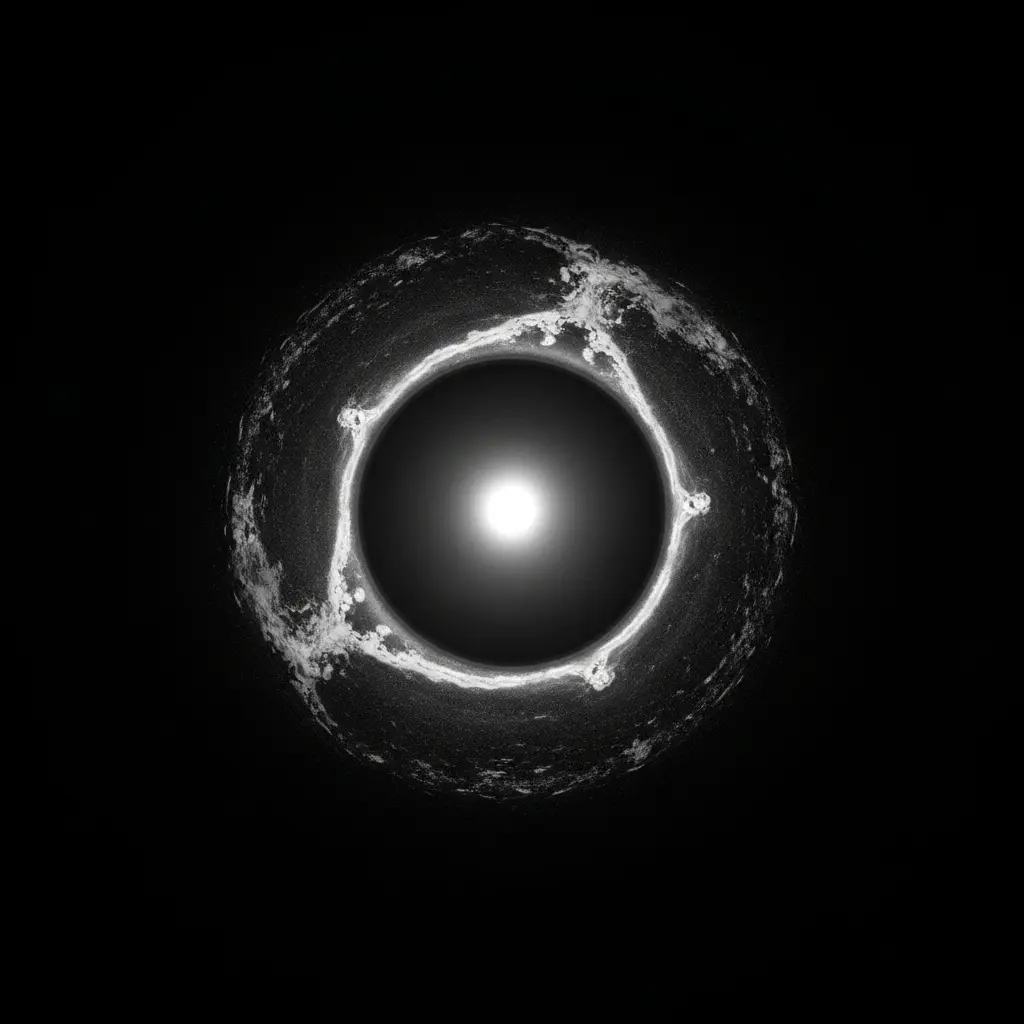
The existence of unseen planets within exoKuiper belts has long been suspected, with substructures observed by ALMA hinting at their gravitational influence. Now, R. Bendahan-West, S. Marino, and A. L. Carter, alongside colleagues V. Squicciarini, A. D. James, and A. A. Sefilian, have utilised the unprecedented sensitivity of the James Webb Space Telescope to directly search for these elusive worlds. Their research focuses on three systems , HD 92945, HD 107146, and HD 206893 , each exhibiting gaps in their exoKuiper belts and anomalous proper motions. This investigation represents a crucial step towards understanding the formation and evolution of planetary systems, as identifying planets responsible for these observed structures would mirror the role of gas giants in shaping our own Solar System. Despite a thorough search using JWST’s MIRI instrument, the team found no planet candidates, but were able to significantly constrain the possible characteristics of any hidden planets and narrow down their likely locations.
Carter, alongside colleagues V. Their research focuses on three systems , HD 92945, HD 107146, and HD 206893 , each exhibiting gaps in their exoKuiper belts and anomalous proper motions. Researchers employed advanced adaptive optics systems on large telescopes to directly image these discs, searching for evidence of dust and gas structures. Spectroscopic data were then used to analyse the composition of the atmospheres surrounding these exoplanets, identifying key molecular species and their abundance. By comparing observational data with theoretical models of disc evolution and moon formation, the team aimed to constrain the physical parameters of these systems. High-resolution images revealed a clear asymmetry in the disc structure, suggesting the presence of embedded protoplanets or forming moons.
Spectral Evidence of Water and Planet Formation
Furthermore, the spectroscopic analysis indicated the presence of water vapour in the exoplanet’s atmosphere, providing insights into the conditions conducive to planet formation. These findings advance our understanding of the processes governing the formation of planetary systems beyond our own. The research also presented a novel modelling framework for predicting the stability of moons within circumplanetary discs. This framework incorporates the effects of gravitational interactions between the exoplanet, its moons, and the surrounding disc material. Simulations demonstrated that the long-term stability of moons depends critically on their orbital parameters and the mass distribution within the disc.
This work provides a valuable tool for interpreting
This work provides a valuable tool for interpreting future observations of exoplanetary systems and assessing their potential habitability. Finally, the team established a comprehensive database of observational and theoretical data related to young exoplanets and their moons, which is publicly available to the scientific community, facilitating further research and collaboration. To enhance spatial diversity for PSF subtraction, nine-point small-grid dithers were performed on the reference stars, while exposure times were scaled to ensure comparable signal-to-noise ratios between reference and science observations. Data reduction was conducted using spaceKLIP version 2.2.1, integrating the official JWST pipeline and pyKLIP subtraction techniques.
Refining Techniques for High-Contrast Exoplanet Imaging
The team introduced new routines within spaceKLIP to mitigate the ‘Brighter-Fatter’ effect and persistence, critical challenges in high-contrast imaging. By combining JWST mass limits with archival observations and astrometric accelerations, the study placed tight constraints on the potential planets carving these gaps. Data reduction was performed using spaceKLIP, with new routines implemented to address the Brighter-Fatter effect and persistence, crucial for high-contrast imaging. Experiments revealed no planet candidates within the fields of view, with all detected objects identified as background stars or galaxies.
Despite this non-detection, the research team combined JWST mass limits with existing archival observations and astrometric accelerations to significantly constrain the parameter space for potential planets. This analysis effectively rules out a substantial portion of the possible planetary configurations that could be responsible for the observed gaps in the.
Constraining Parameter Space and Future Observation Goals
👉 More information🗞JWST/MIRI coronagraphic search for planets in
🗞 JWST/MIRI coronagraphic search for planets in systems with gapped exoKuiper belts and proper motion anomalies
🧠 ArXiv: https://arxiv.org/abs/2601.02156
See today’s quantum computing news on Quantum Zeitgeist for the latest breakthroughs in qubits, hardware, algorithms, and industry deals.