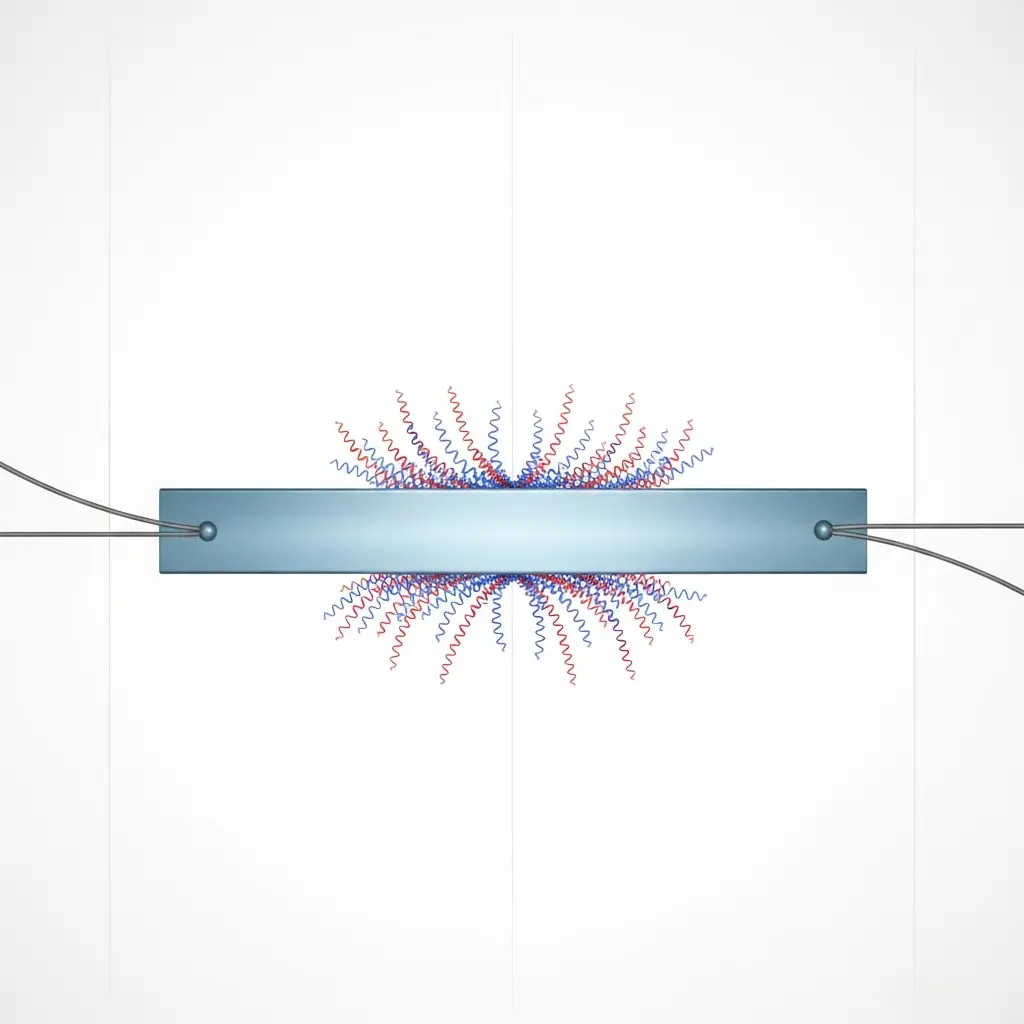
The interplay between strong electron correlations and topological band structures is currently a major focus in materials science, particularly within the rapidly developing field of moiré materials. Boran Zhou and Ya-Hui Zhang, both from Johns Hopkins University, alongside their colleagues, have now predicted the existence of a novel state of matter , the symmetric topological Mott insulator , which challenges conventional understandings of these correlated systems. Their research demonstrates that these materials, exhibiting a quantized charge or spin Hall response, emerge through a fascinating mechanism involving exciton pairing and a transition from Bose-Einstein condensation to Bardeen-Cooper-Schrieffer behaviour. This work not only expands the landscape of topological quantum matter but also identifies a related Mott semimetal phase and proposes potential realisation in AA-stacked MoTe /WSe heterostructures, potentially paving the way for new electronic devices.
The study centres on half-filling of each flavour per unit cell, exploring the conditions under which these states emerge. Initially, the researchers established this phase within a bilayer Haldane-Hubbard model, employing localized orbitals on the A sublattice and a dispersive band on the B sublattice. Manipulation of the sublattice potential induced a Bose-Einstein condensation (BEC) to Bardeen-Cooper-Schrieffer (BCS) transition of the associated p −ip exciton pairing, resulting in the realisation of a topological Mott insulator characterised by a Chern number, C = 1, per flavour.
Moiré Bilayers and Exciton Bose-Einstein Condensation
The study investigates symmetric topological Mott insulators (STMIs) within moiré materials, moving beyond conventional Hartree-Fock descriptions of ground states at integer fillings. Researchers began with a bilayer Haldane-Hubbard model, employing localized orbitals on one sublattice and dispersive bands on the other, to establish the existence of STMIs exhibiting a quantized charge or spin Hall response at half-filling. This approach involved tuning the sublattice potential to induce a transition from a trivial Mott insulator, driving a Bose-Einstein condensation to Bardeen-Cooper-Schrieffer pairing of excitons, ultimately realizing the topological Mott insulating phase. To generalize this construction, the team developed a single-layer spinful model, revealing that the resulting STMI hosts charge edge modes alongside bulk local moments.
Crucially, the research identified a Mott semimetal at the critical point separating the STMI from the trivial Mott insulator, demonstrating a single Dirac cone per flavor. Experiments employed an effective Hamiltonian incorporating a Zeeman field to capture ferromagnetic ordering below a critical temperature, Tc, approximately equal to |Jeff|. This Zeeman field term enabled the splitting of the critical point for the topological transition between the two spin sectors, resulting in a ferromagnetic Chern insulator with a Chern number of 1 in the intermediate regime. The study notes a spin Chern number of 2, consistent with a quantum spin Hall effect. Scientists further proposed that AA-stacked MoTe2/WSe2 could exhibit a ferromagnetic Chern insulator as a low-temperature phase originating from the symmetric Mott semimetal.
Symmetric Topological Mott Insulators in Bilayers Demonstrated
Scientists have demonstrated the existence of symmetric topological Mott insulators (STMIs) within bilayer Haldane-Hubbard models, challenging conventional understandings of ground states in moiré materials. The research establishes these STMIs through meticulous tuning of a sublattice potential, inducing a Bose-Einstein condensation to Bardeen-Cooper-Schrieffer transition of exciton pairing, ultimately realizing a topological Mott insulator. Experiments revealed a quantized charge or spin Hall response within these STMIs, a key indicator of their unique topological properties and potential for novel electronic behaviour.
The team constructed an explicit STMI phase on a honeycomb lattice, utilizing a flat band on the A sublattice and a dispersive band on the B sublattice. This construction relies on inter-sublattice p-ip exciton pairing as the underlying mechanism driving the transition from a trivial Mott insulator to the STMI phase. Measurements confirm that this quantum phase transition is marked by the emergence of a Mott semimetal, characterized by a single Dirac cone per flavor, echoing similar physics observed at charge neutrality in twisted bilayer graphene. This Mott semimetal serves as a critical point between the STMI and the trivial Mott insulator, offering a pathway for controlled manipulation of electronic states. Further work generalized this construction to a single-layer spinful model, where the resulting STMI hosts charge edge modes coexisting with bulk local moments. Data shows that at integer filling, the conventional heavy fermion paradigm is inapplicable, with topological exciton pairing providing the correct physical picture for these mixed-valence Mott states.
Symmetric Mott Insulator and Dirac Semimetal Transition
This work details the discovery of a symmetric topological Mott insulator (STMI) occurring at half-filling within a topological band structure. Unlike conventional topological insulators described by single-particle frameworks, these newly identified states exhibit quantized anomalous or spin Hall effects and necessitate a description beyond a simple Slater determinant. The researchers demonstrated the existence of this STMI phase through a model incorporating a flat band on one sublattice and a dispersive band on another, revealing that inter-sublattice exciton pairing is the underlying mechanism driving the transition from a trivial Mott insulator.
The emergence of a Mott semimetal, characterised by a single Dirac cone per flavor, marks the quantum phase transition between the trivial and topological Mott insulating phases. This finding connects to similar physics observed in charge neutrality in twisted bilayer graphene. The authors suggest relevance to moiré materials, including twisted bilayer graphene and WSe2, where the coexistence of localized and dispersive bands is prominent. Importantly, the analysis indicates that the conventional heavy fermion picture does not apply in these systems, with topological exciton pairing offering a more accurate description of the observed mixed-valence Mott states. The authors acknowledge that their theory is specifically developed for AA-stacked bilayer materials, differing from existing theories for AB-stacked configurations. They propose that further investigation into the trivial to STMI transition and the symmetric Mott semimetal at higher temperatures would be valuable, and that future research could explore the potential for a ferromagnetic Chern insulator to emerge as a low-temperature phase from the identified Mott semimetal.
👉 More information
🗞 Symmetric topological Mott insulator and Mott semimetal
🧠 ArXiv: https://arxiv.org/abs/2601.02485