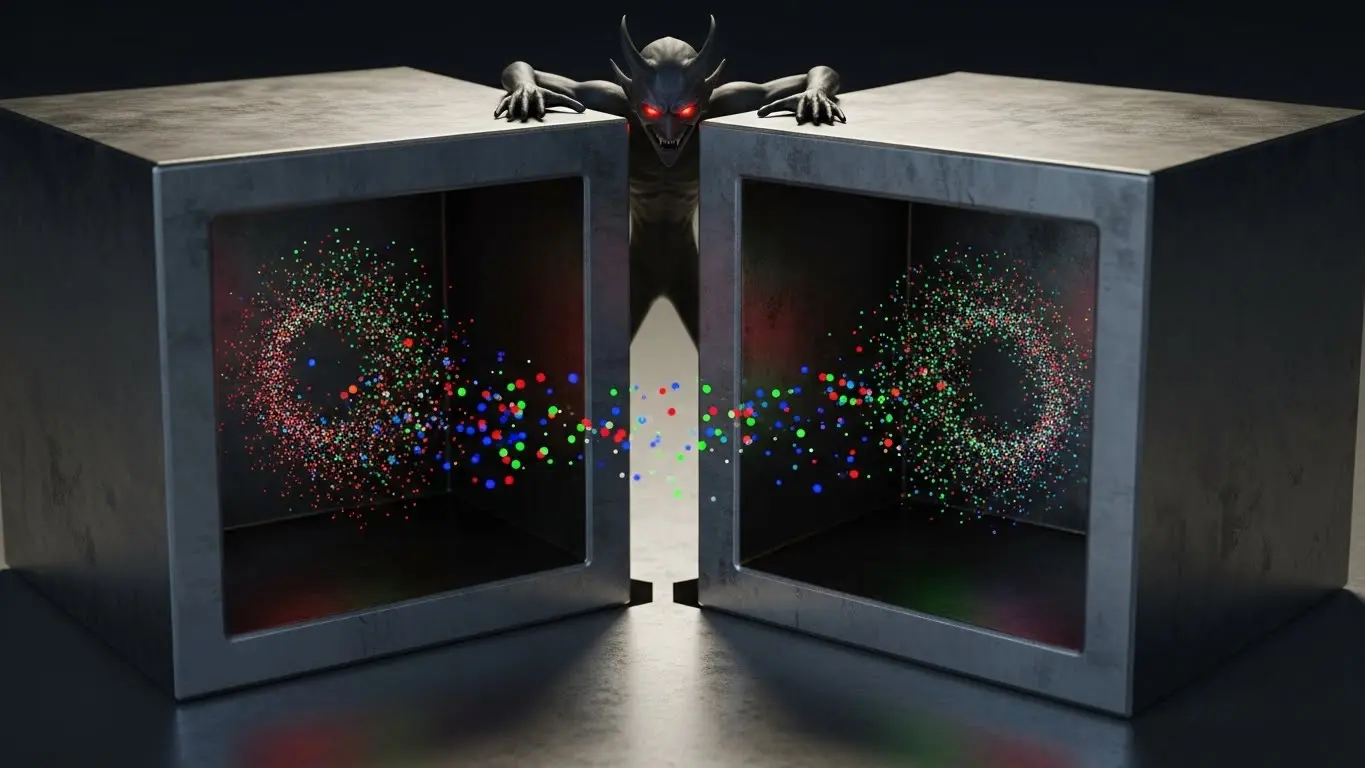
For over a century and a half, a thought experiment known as Maxwell’s Demon haunted the halls of theoretical physics. Proposed by James Clerk Maxwell in 1867, the demon imagined a tiny, intelligent being capable of violating the second law of thermodynamics, the law stating that entropy, or disorder, in a closed system always increases. Maxwell posited this demon could sort molecules, separating hot and cold without expending energy, seemingly creating order from chaos. This, if true, would unravel the very foundations of our understanding of heat, energy, and the arrow of time.
The paradox remained a persistent challenge, a nagging question about the limits of physical law, until the work of Rolf Landauer, a physicist at IBM Research, in the early 1960s offered a resolution. Landauer didn’t banish the demon with a wave of equations, but rather exposed its hidden energetic cost, revealing that even information processing has a fundamental thermodynamic price.
From Victorian Parlors to the Quantum Realm
James Clerk Maxwell, renowned for his equations of electromagnetism, initially conceived of his demon as a playful thought experiment. He wasn’t suggesting a literal, microscopic being, but rather a way to probe the statistical nature of the second law. The second law isn’t absolute; it’s a statement about probabilities. While it’s overwhelmingly likely that entropy increases in a system, there’s a tiny chance it could decrease spontaneously. Maxwell’s demon, by cleverly exploiting this statistical fluctuation, appeared to circumvent the law. The demon would observe molecules approaching a barrier, opening a gate for faster (hotter) molecules to pass to one side and slower (colder) molecules to the other. This would create a temperature difference without any external work, seemingly violating the second law. The problem captivated physicists like Lord Kelvin, who attempted to explain the demon’s failure by invoking the energy cost of observation. However, these early attempts proved insufficient, leaving the paradox unresolved.
Landauer’s Principle: The Price of Forgetting
The breakthrough came with Rolf Landauer’s work at IBM in 1961. Landauer, a pioneer in the field of information theory and its connection to physics, proposed that erasing information, resetting a bit from 1 to 0, for example, is not a cost-free process. He demonstrated that erasing one bit of information requires a minimum energy dissipation of kT\\ln(2) joules, where k is Boltzmann’s constant and T is the absolute temperature. This energy must be released as heat into the environment, increasing entropy and upholding the second law. This became known as Landauer’s Principle. Crucially, this principle applies to any physical realization of information, whether it’s stored in a computer memory, a biological system, or, indeed, the “memory” of Maxwell’s demon.
The Demon’s Hidden Accounting
Landauer’s principle directly addresses the paradox of Maxwell’s demon. The demon, to perform its sorting task, must store information about the velocity of each molecule. It needs to “remember” which molecules are hot and which are cold. But storing information requires physical space and energy. More importantly, to continue sorting, the demon must erase its memory after each molecule is processed, making room for new information. This erasure, according to Landauer’s principle, is where the energy cost arises. The demon isn’t violating the second law; it’s simply paying for the information processing required to appear to do so. As John Wheeler, the Princeton physicist who coined the term ‘black hole’, later articulated, “it from bit”, information is fundamental, and manipulating it has physical consequences.
Beyond the Demon: Information as a Physical Entity
Landauer’s work wasn’t just about resolving a paradox; it fundamentally shifted our understanding of information. Before Landauer, information was often viewed as an abstract concept, separate from the physical world. Landauer demonstrated that information is inextricably linked to physics, a physical entity with measurable energy and entropy. This realization has profound implications for fields ranging from computer science to biology. The minimum energy required to erase a bit of information sets a fundamental limit on the efficiency of computation. It suggests that there’s a physical cost to intelligence itself, a thermodynamic constraint on thought.
The Limits of Computation and the Rise of Reversible Computing
The implications of Landauer’s principle extend to the design of computers. Traditional computers dissipate significant energy as heat during computation, largely due to the irreversible erasure of information. Each logic gate operation and each bit flip generate entropy. This is why computers get hot. However, Landauer’s work inspired the field of reversible computing, which aims to design computers that perform computations without erasing information. In a reversible computation, every operation can be perfectly reversed, meaning no information is lost. While building a fully reversible computer is a significant engineering challenge, it offers the potential for dramatically reducing energy consumption and overcoming the theoretical limits imposed by Landauer’s principle. Charles Bennett, a researcher at IBM alongside Landauer, demonstrated that a logical operation could be performed without increasing entropy if it was reversible.
The Connection to Statistical Mechanics and Entropy Production
Landauer’s principle isn’t an isolated result; it’s deeply connected to the broader framework of statistical mechanics. Statistical mechanics provides a microscopic explanation of macroscopic phenomena like temperature and entropy. Entropy, in this context, is a measure of the number of possible microscopic states that correspond to a given macroscopic state. Erasing information reduces the number of possible states, effectively decreasing entropy. However, this decrease in entropy must be compensated for by an increase in entropy elsewhere in the system, ensuring the second law remains intact. The heat dissipated during information erasure is a manifestation of this entropy increase, a way of “paying the price” for reducing uncertainty. As David Deutsch, the Oxford physicist who pioneered quantum computing theory, has argued, information is physical, and its manipulation is fundamentally tied to entropy production.
The Demon’s Legacy: From Paradox to Practicality
The story of Maxwell’s demon and Landauer’s resolution is a testament to the power of theoretical physics. What began as a seemingly abstract thought experiment led to a profound understanding of the relationship between information, energy, and entropy. Landauer’s principle isn’t just a theoretical curiosity; it has practical implications for the design of energy-efficient computers and the development of new technologies. It also forces us to reconsider our fundamental assumptions about the nature of information and its role in the universe. The demon, once a symbol of potential thermodynamic violation, now serves as a reminder that even the most subtle forms of information processing have a physical cost.
Beyond Classical Limits: Quantum Information and Landauer’s Bound
While Landauer’s principle holds true for classical information, the realm of quantum information introduces new complexities. Quantum bits, or qubits, can exist in a superposition of states, allowing them to store more information than classical bits. However, measuring a qubit collapses its superposition, effectively erasing information. Researchers are exploring ways to manipulate quantum information reversibly, potentially circumventing Landauer’s bound in certain scenarios. This research is still in its early stages, but it suggests that the relationship between information and energy may be even more nuanced in the quantum world. As Leonard Susskind, a Stanford physicist and pioneer of string theory, has pointed out, the holographic principle, the idea that all information about a volume of space can be encoded on its boundary, further blurs the lines between information and physical reality.
The Future of Information and Thermodynamics
The legacy of Maxwell’s demon and Landauer’s principle continues to shape our understanding of the universe. As we push the boundaries of computation and information processing, the thermodynamic limits imposed by Landauer’s principle will become increasingly important. The quest for energy-efficient computing, the development of new materials for information storage, and the exploration of quantum information technologies all rely on a deep understanding of the fundamental connection between information and energy. The demon, finally exorcised, has left behind a powerful lesson: in a universe governed by the laws of thermodynamics, even the act of forgetting has a price.




See today’s quantum computing news on Quantum Zeitgeist for the latest breakthroughs in qubits, hardware, algorithms, and industry deals.