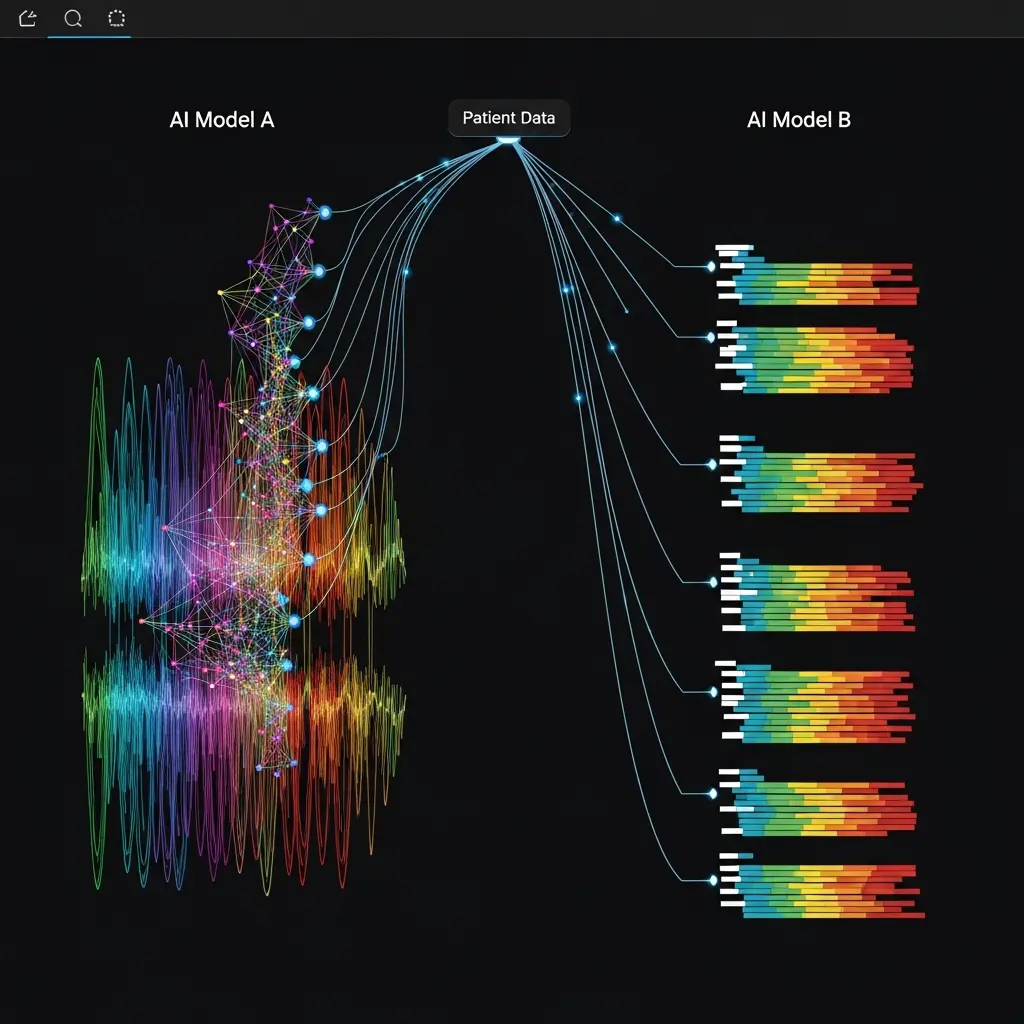
The increasing application of machine vision to interpret physiological signals, such as electrocardiograms, often demands vast amounts of training data and provides little understanding of why a model reaches a particular conclusion. Alaa Alahmadi from Newcastle University and Mohamed Hasan from the University of Leeds, along with their colleagues, now demonstrate a significant step towards addressing these limitations, revealing how incorporating principles of human visual perception can dramatically improve both the accuracy and interpretability of deep learning models. Their research focuses on the challenging case of long QT syndrome, a condition where identifying subtle heart rhythm abnormalities is crucial, yet complicated by limited available data. By visually encoding key clinical features into the data, the team achieves impressive results, enabling models to learn effectively from just a few examples and, crucially, to highlight the same meaningful patterns in ECGs that clinicians rely on, paving the way for more reliable and trustworthy medical artificial intelligence.
Current deep learning approaches for analysing complex physiological data, such as electrocardiograms (CG), often demand extensive training datasets and offer limited understanding of the factors driving their predictions. This restricted data efficiency and interpretability hinders their dependable clinical application and compatibility with human reasoning processes. This research demonstrates that a perception-informed pseudo-colouring technique, previously validated in enhancing human interpretation of ECGs, can simultaneously improve explainability and few-shot learning capabilities within deep neural networks analysing complex physiological data. The study concentrates on drug-induced long QT syndrome (LQTS) as a particularly challenging clinical example, characterised by heterogeneous and complex physiology.
Perception-Informed Deep Learning Improves LQTS Diagnosis
Scientists have achieved a significant breakthrough in medical machine intelligence by demonstrating that incorporating human perceptual principles into deep learning models dramatically improves both accuracy and interpretability when analysing complex physiological data. The research focuses on diagnosing drug-induced long QT syndrome (LQTS), a condition characterised by variable heart rates and a scarcity of positive cases indicating life-threatening arrhythmias. This challenging scenario served as a stringent test of model performance under conditions of extreme data limitation., The team developed a perception-informed pseudo-colouring technique, building on prior work showing its effectiveness in enhancing human ECG interpretation, and integrated it into deep neural networks. Experiments revealed that encoding clinically relevant temporal features, specifically QT-interval duration, into structured colour representations enables models to discriminate and interpret features from as few as one or five training examples.
Using prototypical networks and a ResNet-18 architecture, the researchers evaluated models on ECG images derived from both single cardiac cycles and full 10-second rhythms. Results demonstrate that the pseudo-colouring technique guides the model’s attention towards clinically meaningful ECG features, effectively suppressing irrelevant signal components., Measurements confirm that the model achieved high performance even with limited data, mirroring the perceptual averaging process humans employ when assessing heartbeats. Specifically, the study utilized a 2-way 5-shot approach for few-shot learning and a 2-way 1-shot approach for one-shot learning, successfully classifying ECGs as either ‘at risk of Torsades de Pointes’ or ‘no TdP risk’. The dataset comprised 5050 ECG recordings, with 180 positive cases indicating high arrhythmia risk and 4870 negative cases, presenting a significant data imbalance. The team processed ECG signals into four image representations, single heartbeat with and without pseudo-colouring, and 10-second heart rhythms with and without pseudo-colouring, to comprehensively assess performance., The breakthrough delivers a pathway towards more explainable and data-efficient machine intelligence for complex physiological signals, offering a promising approach to bridge the gap between human reasoning and artificial intelligence in medical diagnostics. Tests prove that this method enhances model robustness and generalisation capabilities, even when presented with minimal training data, and explainability analyses confirm the model prioritises clinically relevant features.
🗞 Human-like visual computing advances explainability and few-shot learning in deep neural networks for complex physiological data
🧠 ArXiv: https://arxiv.org/abs/2512.22349




See today’s quantum computing news on Quantum Zeitgeist for the latest breakthroughs in qubits, hardware, algorithms, and industry deals.