

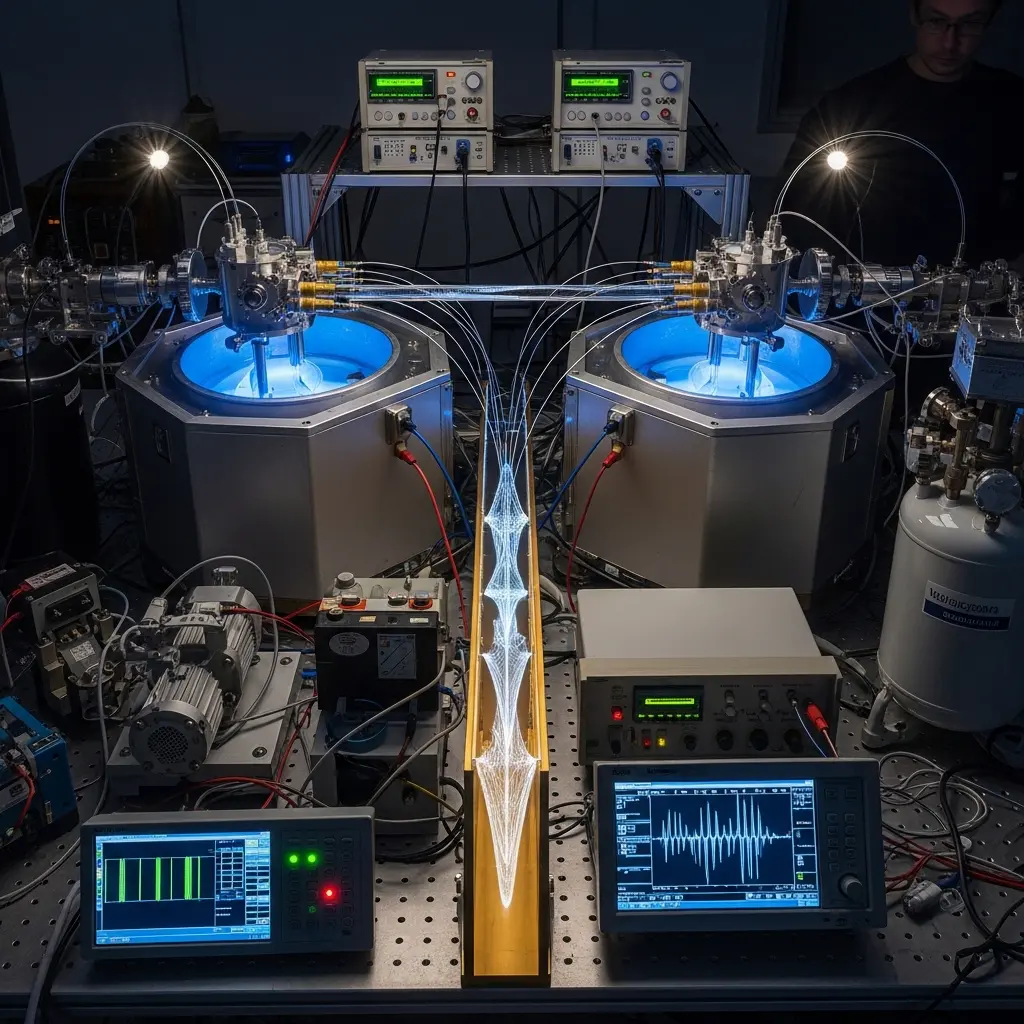
Quantum teleportation, a process that transfers quantum states between locations, promises revolutionary advances in secure communication and distributed computing, and a team led by W. K. Yam, M. Renger, and S. Gandorfer, alongside colleagues at various institutions, now demonstrates a pathway towards its practical implementation. This research focuses on teleportation using microwave signals, a technology crucial for connecting superconducting circuits and potentially enabling short-range wireless communication. The scientists investigate how imperfections in the classical communication needed for teleportation, such as signal loss and noise, impact the accuracy of the process, and importantly, they reveal that these issues can be overcome with careful signal amplification. Furthermore, the team establishes new limits for successful teleportation when using limited resources, and demonstrates resilience against attempts to intercept the communication, paving the way for robust and secure quantum networks.
Change of information represents a fundamental aspect of quantum mechanics. The quantum teleportation protocol allows for a deterministic and secure transfer of unknown quantum states by utilising pre-shared quantum entanglement and classical feedforward communication. Quantum teleportation in the microwave regime provides an important tool for high-fidelity remote quantum operations, enabling distributed quantum computing with superconducting circuits and potentially facilitating short-range, open-air microwave quantum communication. This work considers practical application scenarios for the microwave analogue of the quantum teleportation protocol, based on continuous-variable states, and focuses on the effect of feedforward communication on the teleportation process, investigating its impact on fidelity and performance under realistic conditions.
Microwave Photons Demonstrate Quantum Teleportation Protocol
This research details experimental quantum teleportation using microwave photons, a fundamental protocol in quantum information science. Unlike qubits, which are discrete 0 or 1, this approach uses continuous variables, employing properties like the amplitude and phase of electromagnetic fields. Microwaves are well-suited for superconducting circuits, the building blocks of many quantum computing platforms, and serve as the information carrier in this experiment. Entanglement, a crucial quantum phenomenon linking particles even when separated, is the resource enabling teleportation. The team employed squeezed states, special states of light where the uncertainty in one property is reduced, to improve measurement sensitivity.
Feedforward, a technique for correcting errors, enhances the fidelity of the teleported state, and the protocol’s security against eavesdropping was also investigated. The researchers generated entangled microwave photons using a parametric amplifier, prepared an unknown quantum state on one photon, and performed a Bell state measurement, a challenging joint measurement projecting photons into entangled states. The result of this measurement was sent via a classical channel to the receiver, who then applied corrections to reconstruct the original state. Results demonstrate successful teleportation of microwave quantum states with high fidelity, even when using finite-energy codebooks, a practical consideration for limited resources. The team also analyzed the security of the protocol against eavesdropping attacks, determining the secure fidelity, and compared their results to other quantum teleportation experiments, highlighting the advantages of their continuous-variable approach. This work contributes to the development of practical quantum communication networks and demonstrates the potential of using microwave photons for quantum information processing relevant to superconducting quantum computing.
Continuous Variable Teleportation Corrects Communication Imperfections
Scientists have achieved advancements in quantum teleportation, demonstrating robust and secure communication using microwave networks. The work focuses on continuous-variable quantum teleportation, transferring unknown quantum states between locations using pre-shared entanglement and classical communication. Experiments reveal that imperfections in classical feedforward communication, such as losses and noise, can be fully corrected by optimizing the feedforward gain, maintaining high-fidelity transfer of quantum information. The team investigated teleportation using finite-size codebooks, deriving modified no-cloning thresholds crucial for establishing unconditionally secure communication.
Measurements confirm these thresholds differ significantly from conventional values when subjected to public channel attacks, highlighting the importance of considering realistic security threats. The research utilizes coherent states as input signals and employs a two-mode squeezed vacuum state as the entanglement resource, a configuration well-suited for microwave applications. The method involves Alice performing a Bell-type measurement on the input state combined with her share of the entangled resource, and Bob applying a local unitary operation based on the classical feedforward signal, reconstructing the original input state. Scientists generated coherent signals using commercial microwave sources and produced squeezed states with superconducting Josephson parametric amplifiers, demonstrating a practical implementation pathway. This breakthrough delivers a pathway towards distributed computing with superconducting circuits and potentially enables short-range, open-air microwave communication, advancing quantum communication protocols.
Microwave Teleportation Corrects Channel Imperfections
This research advances quantum communication by demonstrating analog continuous-variable quantum teleportation in the microwave regime, even with realistic channel imperfections. Scientists successfully show that quantum teleportation can overcome losses and noise in the classical feedforward channel, a critical step towards practical applications. The team theoretically analyzed how imperfections in the feedforward process affect the fidelity of teleported coherent states and demonstrated that these imperfections can be fully corrected with appropriate gain adjustments. The investigation extends to finite-size codebooks, more practical for experimental implementation, and establishes modified no-cloning thresholds relevant to these configurations.
Researchers also examined security against eavesdropping on the public communication channel, revealing that secure fidelity thresholds can differ significantly from traditional no-cloning values. While fidelity is ultimately limited by losses in the entanglement distribution channel, results indicate that high-fidelity teleportation, exceeding the classical threshold, is achievable with current microwave technology at liquid helium temperatures, even with substantial feedforward losses. This work contributes to the development of microwave quantum networks, offering a pathway for secure and robust quantum communication between superconducting quantum computing nodes and potentially enabling short-range communication at room temperature.
🗞 Practical quantum teleportation with finite-energy codebooks
🧠 ArXiv: https://arxiv.org/abs/2512.23388


See today’s quantum computing news on Quantum Zeitgeist for the latest breakthroughs in qubits, hardware, algorithms, and industry deals.



