

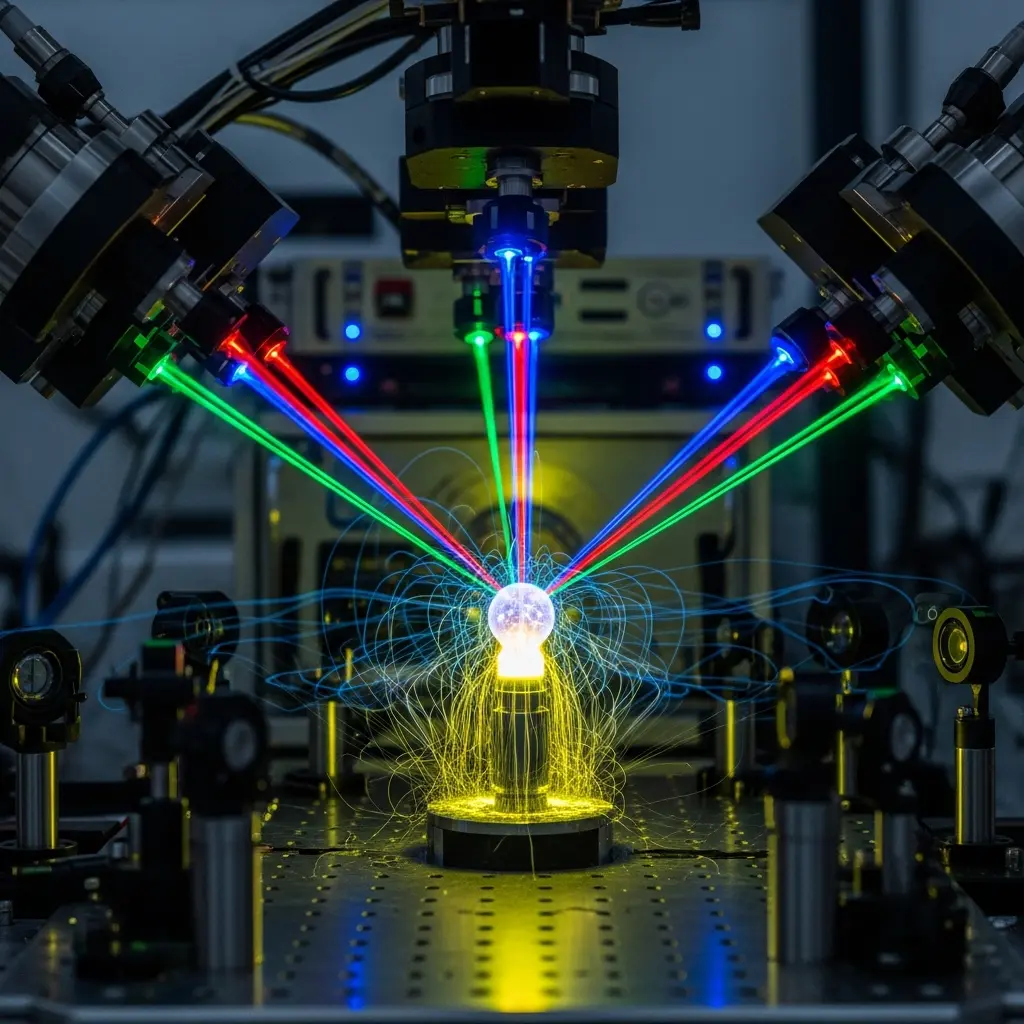
The quest for practical quantum technologies relies on developing sources of light with uniquely quantum properties, yet existing methods struggle to deliver both control and brightness. Ivan Gonoskov, Christian Hünecke, and Stefanie Gräfe, from the Institute of Physical Chemistry at Friedrich Schiller University Jena, and the Fraunhofer Institute for Applied Optics and Precision Engineering, address this challenge by establishing a theoretical framework that explains how intensely driven quantum systems generate nonclassical light. Their work bridges the gap between strong-field physics, which produces bright and tunable radiation, and quantum optics, revealing the fundamental origins of quantum effects within this process. The team demonstrates that quantum correlations and squeezing emerge naturally from the interaction between light and matter, paving the way for designing bright, high-photon-number quantum states at specific frequencies and offering a pathway towards compact, versatile quantum light sources for applications ranging from secure communication to advanced sensing.
Strong Laser Fields and Nonclassical Radiation
Current platforms for generating nonclassical light, essential for emerging quantum technologies, often lack tunability and produce low numbers of photons. Researchers are investigating whether strong-field physics, which creates bright, tunable coherent radiation through high-order harmonic generation (HHG), can overcome these limitations. This work demonstrates that HHG, under specific conditions, can exhibit nonclassical features like photon antibunching and squeezing, hallmarks of quantum light. The approach involves a theoretical investigation of electron behaviour in strong laser fields and a detailed analysis of the resulting harmonic radiation.
The team employs a theoretical framework to accurately describe the interaction between the laser and the quantum system, accounting for many-body effects and the coherent evolution of quantum states. This allows prediction of the statistical properties of the generated photons, including their correlation functions and higher-order moments. Calculations demonstrate that HHG from a driven quantum well can generate photon pairs with strong quantum correlations, exhibiting significant photon antibunching at specific harmonic orders. The degree of squeezing depends on laser intensity and quantum well parameters, and can be enhanced by tailoring the laser pulse shape and system properties, paving the way for bright, tunable, nonclassical light sources.
Quantum Dynamics of High Harmonic Generation
Despite recent experimental observations of entanglement, squeezing, and quantum-state modification in high harmonic generation, a comprehensive theoretical framework to explain and control these effects has been lacking. Researchers address this gap by investigating the quantum dynamics of light interacting with a responding medium using a non-perturbative approach. This methodology involves solving the time-dependent Schrödinger equation for a model system, a one-dimensional semiconductor quantum well subjected to a strong laser field. The quantum well potential incorporates parabolic confinement and electron-hole interaction via a Coulomb term.
Experiments involve generating high harmonics using a titanium-sapphire laser system with a central wavelength of 800nm, a 25fs pulse duration, and a 1kHz repetition rate. The laser beam is focused onto a zinc selenide crystal, and the resulting harmonic signal is analysed using a flat-field grating spectrometer and a CCD camera. Polarization-resolved measurements and coincidence measurements characterise the correlations between the driving and generated fields, providing insights into the quantum nature of the process.
Many-Body Pulse Generation of Non-Classical Light
Scientists are investigating the generation of non-classical states of light using a system of many quantum emitters driven by a strong laser pulse. The core challenge lies in understanding how the nonlinear response of these emitters to the laser field leads to these non-classical effects, specifically through high-order harmonic generation. Researchers use simplified one-dimensional models of quantum emitters, including atoms, molecules, and semiconductors, interacting with a strong, short-pulse laser. The team solves the time-dependent Schrödinger equation to determine how electrons in the emitters respond to the laser field, calculating the collective dipole moment from all emitters. A mathematical approach involving transformations and a nonlocal operator is used to solve for the evolution of the light-state wavefunction, revealing that the nonlinear dependence of the dipole moment on the light’s momentum is crucial for generating non-classical light. By controlling the dipole moment through laser parameters and emitter properties, they can generate squeezed states and other non-classical states, with the number of emitters enhancing these effects.
Quantum Light Generation via Harmonic Interaction
This research presents a new theoretical framework for understanding the generation of nonclassical light through high-order harmonic generation. Scientists developed a mathematically rigorous approach that explains how quantum characteristics, such as squeezing and negativity in the Wigner function, emerge naturally from the interaction between intense light and matter. The method successfully simplifies the complex interplay between electrons and light, revealing the conditions that amplify nonclassical features. The team demonstrated the potential for designing bright, tunable quantum states of light at ultraviolet frequencies, suggesting a pathway towards compact sources for quantum technologies. Calculations indicate that systems with a large number of emitters can exhibit noticeable nonclassicality, and that starting with nonclassical input light further enhances these effects. While the current model includes simplifications, the authors plan to incorporate Coulomb interactions between emitters to refine the theory, ultimately advancing strong-field quantum optics and its applications in sensing, communication, and quantum information processing.
🗞 Emergence of nonclassical radiation in strongly laser-driven quantum systems
🧠 ArXiv: https://arxiv.org/abs/2512.23156




See today’s quantum computing news on Quantum Zeitgeist for the latest breakthroughs in qubits, hardware, algorithms, and industry deals.



