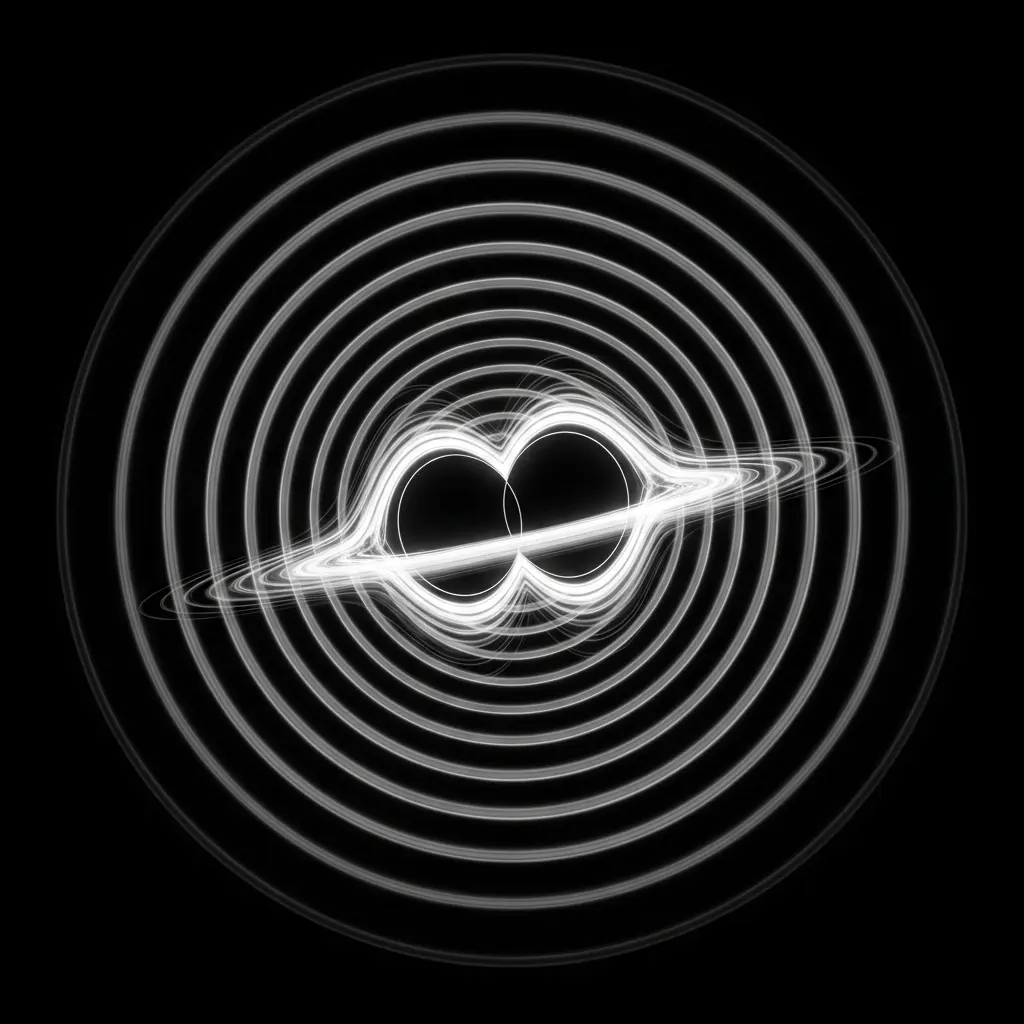
The recent detection of gravitational waves from black hole mergers continues to reveal surprising details about the origins of these cosmic events, and two signals, GW241011 and GW241110, present particularly intriguing puzzles. Guo-Peng Li and Xi-Long Fan, from Wuhan University, along with their colleagues, investigate whether these signals originate from hierarchical mergers, a process where black holes themselves form from the collision of earlier black holes. These events exhibit unusual characteristics, including significantly different black hole masses and misaligned spins, which are difficult to explain by standard models of black hole formation from collapsing stars. By employing a novel method to measure the efficiency of entropy transfer during mergers, the team demonstrates that GW241011 aligns with expectations for a hierarchical merger within a dense star cluster, while the origin of GW241110 remains less certain due to inherent uncertainties in the data.
Scientists are investigating whether these signals originate from hierarchical mergers, a process where black holes form from the collision of earlier black holes.
The team developed a novel method, the merger entropy index, to measure the efficiency of entropy transfer during black hole collisions, allowing comparison between observed events and theoretical models. Results demonstrate that GW241011 strongly aligns with a hierarchical merger origin, suggesting it formed from black holes resulting from previous mergers, while the origin of GW241110 remains less certain due to inherent uncertainties in the data.
Analysis of GW241011 reveals characteristics consistent with a hierarchical merger, achieving high likelihood scores and favorable statistical tests when compared to models of hierarchical mergers. In contrast, GW241110 presents a more complex picture, with statistical analyses offering differing perspectives, highlighting the impact of data uncertainties and the nuances of analytical approaches.
Compact Binary Mergers and Populations
Research focuses on understanding the population characteristics of merging compact binaries, their masses, spins, formation channels, and evolution, with a specific interest in mergers occurring in hierarchical scenarios, such as black holes merging within dense star clusters. This work utilizes Python-based software packages for scientific computing, data analysis, and visualization, including NumPy, SciPy, Matplotlib, IPython, and Seaborn, alongside specialized cluster Monte Carlo codes for modeling dense star clusters.
Hierarchical Mergers Explain Gravitational Wave Sources
Scientists have achieved a significant breakthrough in understanding the origins of gravitational wave events, specifically GW241011 and GW241110, which challenge traditional formation theories for binary black hole mergers. The team employed the merger entropy index to determine whether these events originated from first-generation mergers or hierarchical mergers, where black holes themselves are the result of previous mergers.
The analysis demonstrates that GW241011 strongly aligns with a hierarchical merger origin, suggesting it formed from black holes that themselves resulted from previous mergers. Evidence also supports a hierarchical origin for GW241110, although the interpretation remains somewhat uncertain due to limitations in the signal quality of this event.
The consistent results obtained using different population models strengthen the reliability of these conclusions and provide a robust foundation for future investigations, potentially revealing more detailed insights into the prevalence of hierarchical mergers and the formation history of binary black hole systems.
👉 More information
🗞 GW241011 and GW241110: Hints of Hierarchical Mergers from the Merger Entropy Index
🧠 ArXiv: https://arxiv.org/abs/2512.20965


See today’s quantum computing news on Quantum Zeitgeist for the latest breakthroughs in qubits, hardware, algorithms, and industry deals.