The digital world we inhabit is built upon the bit – a fundamental unit of information representing a 0 or a 1. This binary foundation has driven decades of technological advancement, but its limitations are becoming increasingly apparent as we strive to solve increasingly complex problems. The pursuit of computational power beyond the capabilities of classical computers has led to the exploration of quantum computing, a paradigm shift leveraging the principles of quantum mechanics. At the heart of this revolution lies the qubit, a quantum bit that transcends the limitations of its classical counterpart. However, the journey to realizing practical quantum computers is not merely an engineering challenge; it is a continuation of a century-long intellectual quest, rooted in the foundational debates that shaped our understanding of the universe. This quest began with a series of conferences, most notably the Solvay Conferences, where the brightest minds in physics grappled with the implications of the emerging quantum theory, unknowingly laying the groundwork for the qubit and the future of computation.
The Solvay Conferences, held in Brussels beginning in 1911, brought together pioneers like Marie Curie, Albert Einstein, Max Planck, and Niels Bohr to discuss the perplexing questions arising from the new physics. These weren’t simply technical discussions; they were philosophical debates about the nature of reality itself. The very concepts that would later underpin the qubit – superposition and entanglement – were hotly contested during these meetings. The implications of a reality governed by probability, rather than deterministic laws, were profound, and the debates shaped the development of quantum mechanics. It is within this historical context, a legacy of intellectual curiosity and rigorous debate, that the development of the qubit and the field of quantum computing must be understood. The qubit isn’t just a technological innovation; it’s the culmination of a century of theoretical exploration, born from the very questions debated at those pivotal Solvay Conferences.
The Fundamental Principles Behind Quantum Information
The classical bit, the cornerstone of modern computing, can exist in one of two definite states: 0 or 1. The qubit, however, leverages the principles of quantum mechanics to exist in a superposition of both states simultaneously. This means a qubit isn’t simply either 0 or 1, but rather a probabilistic combination of both, described by a complex-valued amplitude for each state. This superposition is not merely a mathematical abstraction; it’s a fundamental property of quantum systems, allowing qubits to explore a vastly larger computational space than classical bits. The state of a qubit is represented by a vector in a two-dimensional complex Hilbert space, allowing for a continuous range of possible states between 0 and 1. This ability to exist in multiple states simultaneously is what gives quantum computers their potential for exponential speedups over classical computers for certain types of problems.
Beyond superposition, another crucial quantum phenomenon enabling quantum computation is entanglement. Entanglement occurs when two or more qubits become correlated in such a way that their fates are intertwined, regardless of the distance separating them. Measuring the state of one entangled qubit instantaneously determines the state of the others, a phenomenon Einstein famously termed “spooky action at a distance.” This correlation isn’t a result of any physical signal traveling between the qubits; it’s a fundamental property of the quantum state itself. Entanglement allows for the creation of complex quantum states and enables powerful quantum algorithms that would be impossible to implement on classical computers. The combination of superposition and entanglement provides the foundation for quantum information processing, allowing qubits to perform computations in ways that are fundamentally different from classical bits.
How Quantum Coherence Enables Computation
While superposition and entanglement are essential for quantum computation, maintaining these fragile quantum states is a significant challenge. Quantum coherence, the ability of a qubit to maintain its superposition, is easily disrupted by interactions with the environment. Any external disturbance, such as heat, electromagnetic radiation, or even stray particles, can cause the qubit to “decohere,” collapsing its superposition into a definite state of 0 or 1. This decoherence is the primary obstacle to building practical quantum computers, as it introduces errors into the computation. The time it takes for a qubit to decohere is known as the coherence time, and it is a critical parameter in determining the feasibility of quantum computation.
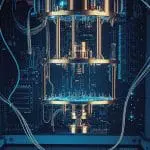
To combat decoherence, researchers employ various techniques to isolate qubits from the environment. These include cooling qubits to extremely low temperatures, shielding them from electromagnetic radiation, and using error correction codes to detect and correct errors caused by decoherence. Superconducting qubits, for example, are typically cooled to temperatures near absolute zero to minimize thermal noise. Trapped ion qubits are isolated in vacuum chambers and shielded from external disturbances. Despite these efforts, maintaining coherence for long enough to perform complex computations remains a significant challenge. The development of more robust qubits and more effective error correction codes is crucial for realizing the full potential of quantum computing.
Why Qubit Fidelity Matters for Performance
The fidelity of a qubit refers to the accuracy with which it can perform quantum operations. A high-fidelity qubit is one that can reliably maintain its superposition and entanglement, and accurately execute quantum gates. Quantum gates are the fundamental building blocks of quantum algorithms, analogous to logic gates in classical computers. The accuracy of these gates directly impacts the overall accuracy of the quantum computation. Even small errors in the execution of quantum gates can accumulate over time, leading to significant errors in the final result.
Improving qubit fidelity requires precise control over the qubit’s physical properties and minimizing sources of noise and error. This involves optimizing the qubit’s design, improving the control electronics, and developing more robust quantum gates. Researchers are exploring various qubit technologies, each with its own strengths and weaknesses in terms of fidelity, coherence time, and scalability. Superconducting qubits, for example, offer relatively high fidelity and scalability, but are susceptible to noise and decoherence. Trapped ion qubits offer high fidelity and long coherence times, but are more difficult to scale. The choice of qubit technology depends on the specific application and the trade-offs between these different parameters.
Current Performance Benchmarks and Metrics
Evaluating the performance of quantum computers requires a set of standardized benchmarks and metrics. One commonly used metric is the number of qubits, but this is not a complete measure of performance. A quantum computer with more qubits is not necessarily more powerful than one with fewer qubits. The quality of the qubits, as measured by their fidelity and coherence time, is equally important. Another important metric is the quantum volume, which takes into account both the number of qubits and their connectivity. Quantum volume measures the size of the largest quantum circuit that can be reliably executed on a given quantum computer.
Researchers are also developing more sophisticated benchmarks that are tailored to specific applications. These benchmarks aim to assess the performance of quantum computers on problems that are relevant to real-world applications, such as drug discovery, materials science, and financial modeling. The development of standardized benchmarks and metrics is crucial for comparing the performance of different quantum computers and tracking progress in the field. It also helps to identify areas where further research and development are needed.
Key Industry Players and Commercial Leaders
The field of quantum computing is rapidly evolving, with a growing number of companies and research institutions investing in the technology. Leading companies in the field include IBM, Google, Microsoft, Rigetti Computing, IonQ, and PsiQuantum. IBM has been a pioneer in the development of superconducting qubits and has made its quantum computers available to researchers and developers through the cloud. Google has also made significant progress in superconducting qubits and has demonstrated quantum supremacy, the ability to perform a computation that is impossible for classical computers. Microsoft is pursuing a different approach, focusing on topological qubits, which are theoretically more robust to noise and decoherence. Rigetti Computing and IonQ are also developing superconducting and trapped ion qubits, respectively. PsiQuantum is pursuing a photonic approach to quantum computing, using photons as qubits.
In addition to these companies, a number of research institutions are also playing a key role in the development of quantum computing. These include universities such as MIT, Harvard, Caltech, and Stanford, as well as national laboratories such as Sandia National Laboratories and Oak Ridge National Laboratory. The collaboration between industry and academia is crucial for accelerating the development of quantum computing and bringing the technology to market.
Practical Applications in Drug Discovery
Quantum computing has the potential to revolutionize drug discovery by enabling the simulation of molecular interactions with unprecedented accuracy. Traditional drug discovery methods rely heavily on trial and error, which is time-consuming and expensive. Quantum computers can simulate the behavior of molecules at the quantum level, allowing researchers to predict the efficacy and safety of potential drug candidates before they are synthesized and tested in the lab. This can significantly reduce the time and cost of drug discovery and lead to the development of more effective and targeted therapies.
Quantum algorithms such as the variational quantum eigensolver (VQE) and the quantum approximate optimization algorithm (QAOA) are being used to simulate molecular energies and predict molecular properties. These algorithms can be implemented on near-term quantum computers, even those with a limited number of qubits. Quantum machine learning algorithms are also being used to analyze large datasets of molecular data and identify potential drug candidates.
Practical Applications in Materials Science
Quantum computing can also accelerate the discovery of new materials with desired properties. Materials science relies heavily on understanding the behavior of electrons in materials, which is governed by the laws of quantum mechanics. Quantum computers can simulate the electronic structure of materials with greater accuracy than classical computers, allowing researchers to predict their properties, such as conductivity, strength, and magnetism.
Quantum algorithms such as the density functional theory (DFT) and the quantum Monte Carlo method are being used to simulate the electronic structure of materials. These algorithms can be implemented on near-term quantum computers, even those with a limited number of qubits. Quantum machine learning algorithms are also being used to analyze large datasets of materials data and identify promising new materials.
The Path Forward: Near-Term Developments
The field of quantum computing is still in its early stages of development, but significant progress is being made. Near-term quantum computers, with a limited number of qubits, are already being used to explore a variety of applications. These computers are not yet powerful enough to solve complex problems that are beyond the reach of classical computers, but they are providing valuable insights into the potential of quantum computing.
One of the key challenges facing the field is improving the fidelity and coherence time of qubits. Researchers are exploring various qubit technologies and developing new techniques to mitigate noise and decoherence. Another challenge is developing quantum algorithms that are tailored to specific applications. Researchers are also working on developing quantum error correction codes that can protect quantum computations from errors.
The Future of Quantum-Enhanced Simulation
Looking ahead, the future of quantum computing lies in the development of fault-tolerant quantum computers, which can perform complex computations without being affected by errors. These computers will require a large number of qubits and sophisticated error correction codes. The development of fault-tolerant quantum computers is a long-term goal, but it is essential for realizing the full potential of quantum computing. Once fault-tolerant quantum computers become available, they will revolutionize a wide range of fields, including drug discovery, materials science, financial modeling, and artificial intelligence. The legacy of the Solvay Conferences, a commitment to rigorous inquiry and a willingness to challenge conventional wisdom, will continue to guide the development of quantum computing and shape the future of computation.