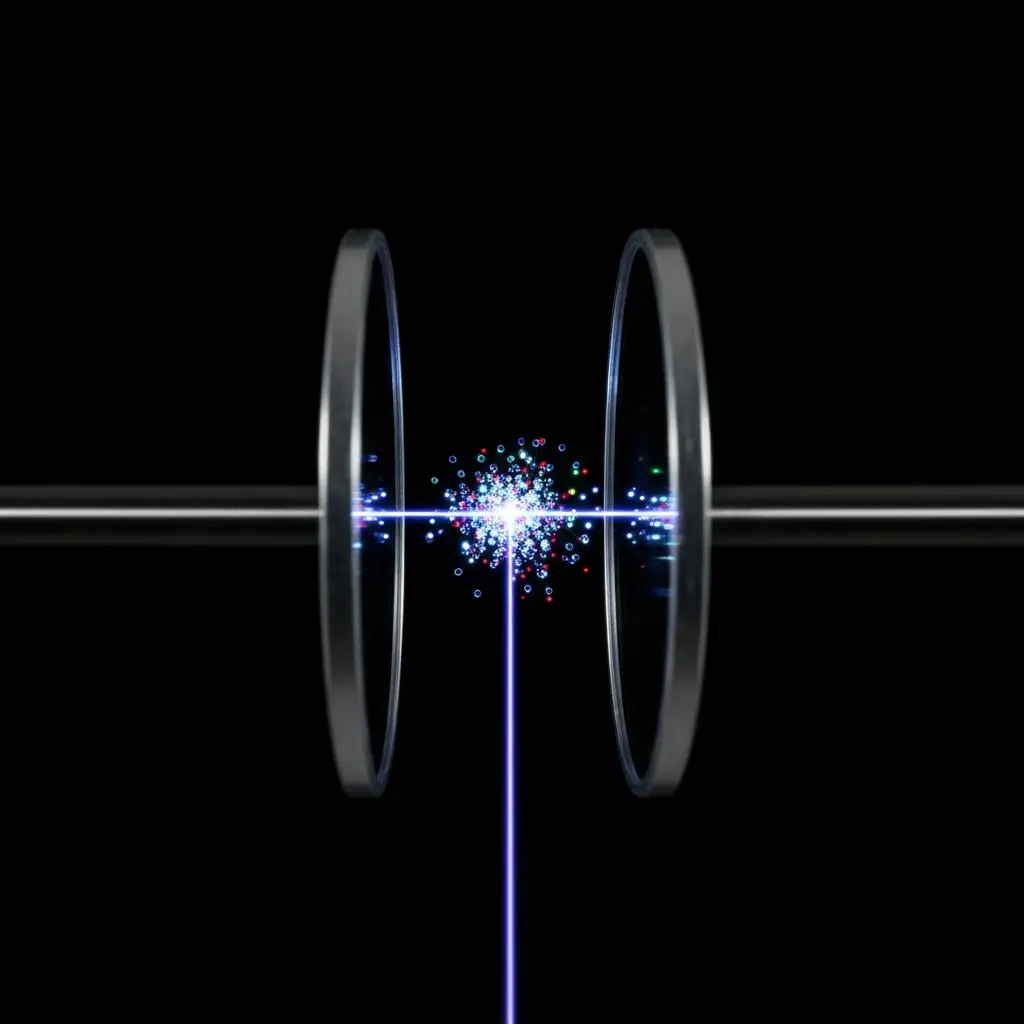
The pursuit of macroscopic quantum states and the understanding of quantum phase transitions represent fundamental challenges in modern physics, and recent work by Ni Liu, Xinyu Jia from South University, and J. -Q. Liang from South University addresses these challenges through a detailed investigation of three-level atoms within an optical cavity. This research resolves a long-standing ambiguity in how to describe the interaction between light and matter, demonstrating a unified approach that encompasses both conventional and alternative descriptions of this interaction. The team’s analysis reveals how the system undergoes an abrupt shift in its properties, transitioning from a normal state to a superradiant state, and importantly, highlights the crucial role of initial conditions in experimentally verifying these different theoretical descriptions. Furthermore, the study extends these findings to scenarios where energy is not conserved, revealing how this affects the stability of the superradiant state and ultimately limits the types of quantum states that can exist.
Scientists address a long-standing ambiguity concerning gauge choice, specifically the Coulomb and dipole gauges, by implementing a time-dependent gauge transformation directly on the Schrödinger equation. This innovative approach yields a unified gauge, encompassing both A · p and d · E interactions, demonstrably equivalent to the minimum coupling principle while reducing to the Coulomb and dipole gauges as special cases. The study meticulously analyzes the quantum phase transition using the spin-coherent-state variational method, allowing for a detailed comparison of results obtained under the Coulomb, dipole, and newly developed unified gauges.,.
Unified Gauge Resolves Superradiant Phase Transition Ambiguity
Researchers investigated the quantum phase transition from a normal phase to a superradiant phase in three-level atoms interacting within a single-mode optical cavity, exploring both Hermitian and non-Hermitian systems. The research resolves a long-standing ambiguity concerning the choice of gauge, specifically the Coulomb and dipole gauges, by introducing a time-dependent gauge transformation applied to the Schrödinger equation. This transformation yields a unified gauge encompassing both the A · p and d · E interactions, demonstrating its equivalence to the minimum coupling principle, with the Coulomb and dipole interactions representing special cases. Remarkably, the team found that all three interactions produce identical results under resonant conditions, while significant differences emerge with red and blue detunings.
The quantum phase transition was analyzed using a spin-coherent-state variational method, revealing abrupt changes in the energy spectrum, average photon number, and atomic population at the critical interaction constant. Crucially, experiments demonstrate a sensitive dependence on the initial optical phase, providing a valuable method for experimentally validating the three gauges. Investigations into non-Hermitian atom-field interactions revealed the emergence of an exceptional point beyond which the semiclassical energy function becomes complex; however, the energy spectrum of the variational ground state remains real in the absence of this point. The superradiant state proves unstable due to photon-number loss induced by the non-Hermitian interaction, resulting in the exclusive existence of the normal phase within the non-Hermitian Dicke Model Hamiltonian.,.
Unified Gauge Resolves Light-Matter Interaction Ambiguity
This research clarifies the long-standing ambiguity in describing the interaction between light and matter, specifically for three-level atoms within an optical cavity. Scientists have established a unified gauge that demonstrates equivalence to the minimum coupling principle, encompassing both Coulomb and dipole interactions as special cases. Through the application of a spin coherent-state variational method, the team analyzed the quantum phase transition from a normal state to a superradiant state, revealing how this transition depends critically on the initial phase of the optical field. Notably, the investigation demonstrates that while the semiclassical energy function can become complex under certain conditions, the variational ground state energy remains real, preventing the emergence of a superradiant state in the non-Hermitian Dicke model Hamiltonian. The results indicate that photon number loss induced by non-Hermitian interactions destabilizes the superradiant state, thus suppressing the quantum phase transition. This work provides a refined understanding of light-matter interactions and establishes a foundation for further investigations into quantum phenomena within optical cavities.
👉 More information
🗞 Macroscopic quantum states, quantum phase transition for three-level atoms in an optical cavity — Gauge principle and non-Hermitian Hamiltonian
🧠 ArXiv: https://arxiv.org/abs/2512.20321




See today’s quantum computing news on Quantum Zeitgeist for the latest breakthroughs in qubits, hardware, algorithms, and industry deals.