

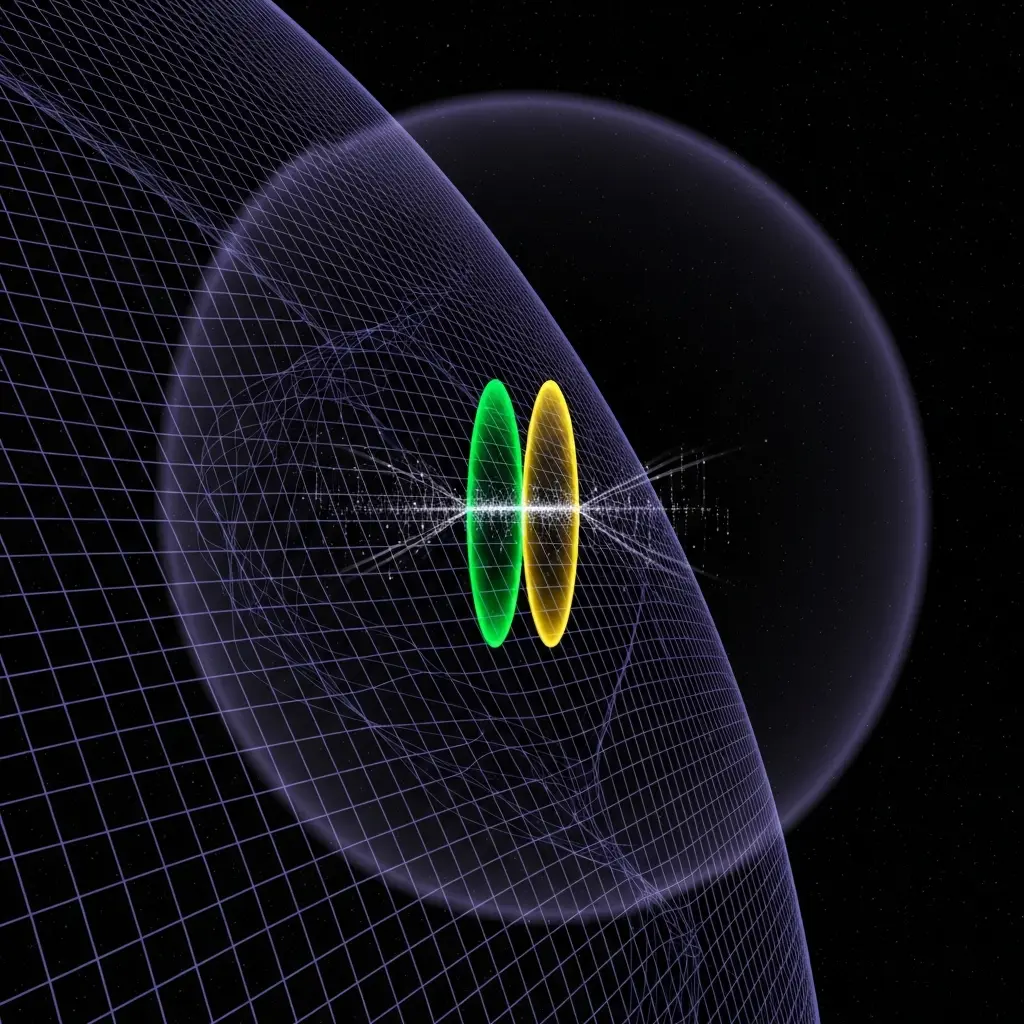
The very fabric of spacetime, as described by Einstein’s theory of gravity, exhibits quantum properties that remain largely unexplored, but recent research illuminates a pathway towards generating squeezed states within the gravitational field itself. Arunima Das, Maulik Parikh, and Frank Wilczek, all from Arizona State University, alongside Raphaela Wutte from Arizona State University and the University of Southampton, demonstrate a general framework for creating these squeezed states through time-dependent interactions. This work reveals that both evolving spacetime geometries and changing distributions of matter naturally produce squeezing, a quantum phenomenon where uncertainty in one property is reduced at the expense of another. Generating and controlling squeezed states of gravity represents a significant step towards probing the quantum nature of spacetime and could have profound implications for our understanding of the universe at its most fundamental level.
Quantum Gravitational Waves and Detectability
Recent research explores the quantum nature of gravitational waves, moving beyond their classical description as ripples in spacetime. Scientists are investigating whether gravitational waves exhibit quantum properties like squeezing and entanglement, which could reveal fundamental insights into quantum gravity. They explored methods to determine the squeezing parameter, a measure of quantum uncertainty reduction, and leveraged mathematical techniques, including the su(1,1) algebra, to simplify calculations and connect them to physical parameters. Extending these techniques to scalar field theory, the team demonstrated how time-dependent potentials influence quantum field squeezing, paving the way for further investigations into quantum gravity.,.
Squeezed Gravitational Fields from Time-Dependent Couplings
A new framework demonstrates that squeezed states of the gravitational field naturally arise from the quantum vacuum due to time-dependent couplings inherent in dynamic spacetimes and matter distributions. Scientists found that both evolving spacetime geometries and changing distributions of matter contribute to this phenomenon, revealing a broad range of physical scenarios where squeezing occurs. Detailed analysis reveals that time-dependent prefactors in the quadratic perturbations are essential for generating these squeezed states.,.
Gravitational Squeezing From Dynamic Spacetimes
Scientists have developed a comprehensive framework for generating squeezed states of the gravitational field within a linearized theory of gravity. Their work demonstrates that squeezed states naturally arise from the quantum vacuum due to time-dependent couplings, and that the magnitude of squeezing exhibits linear growth under specific resonance conditions. Detailed calculations reveal that the squeezing parameters depend on the polarization of gravitational waves and their angular relationships, offering new insights into the interplay between gravity and quantum mechanics. Generating and controlling these squeezed states represents a significant step towards probing the quantum nature of spacetime and could have profound implications for our understanding of the universe.
👉 More information
🗞 Squeezed States in Gravity
🧠 ArXiv: https://arxiv.org/abs/2512.20601



See today’s quantum computing news on Quantum Zeitgeist for the latest breakthroughs in qubits, hardware, algorithms, and industry deals.



